A landlord policy covers a great deal. The gaps are where investors get hurt, and they are predictable enough to list.
Ranked by how often they actually cost money in this state.
The Ten
1. Flood. Excluded from standard landlord policies. Requires a separate policy. Relevant across the coastal plain, along every river, and in places the maps did not anticipate, which western North Carolina learned in 2024.
2. Water backup through drains and sewers. Excluded from most forms and available by endorsement for very little. One of the most common losses in older and multifamily property.
3. Windstorm and hail in coastal territories. Frequently excluded from the dwelling policy in beach areas and written separately, with a percentage named storm deductible. That deductible is a real number and most owners have never calculated it.
4. Wear and tear, deterioration, and maintenance. Not a gap so much as the boundary of insurance. A roof at the end of its life is a capital expense.
5. Vacancy past the stated period. Coverage restricts or suspends once a property is vacant beyond a stated period, commonly 30 to 60 days. Between tenants and during a rehab is exactly when that bites.
6. Ordinance and law. The extra cost of rebuilding to current code after a covered loss. On older housing stock this is a large number and it is available by endorsement.
7. A tenant’s belongings. Not your coverage and not a gap you should close. That is renters insurance, which you can require.
8. Earthquake. Excluded, and available separately. Lower priority here than in the West and not zero.
9. Short-term rental use. A standard landlord policy frequently does not contemplate nightly rental, which makes undisclosed platform use a coverage problem rather than a gap.
10. Mold, in most forms, with limited exceptions, and it follows a water loss more often than anything else.
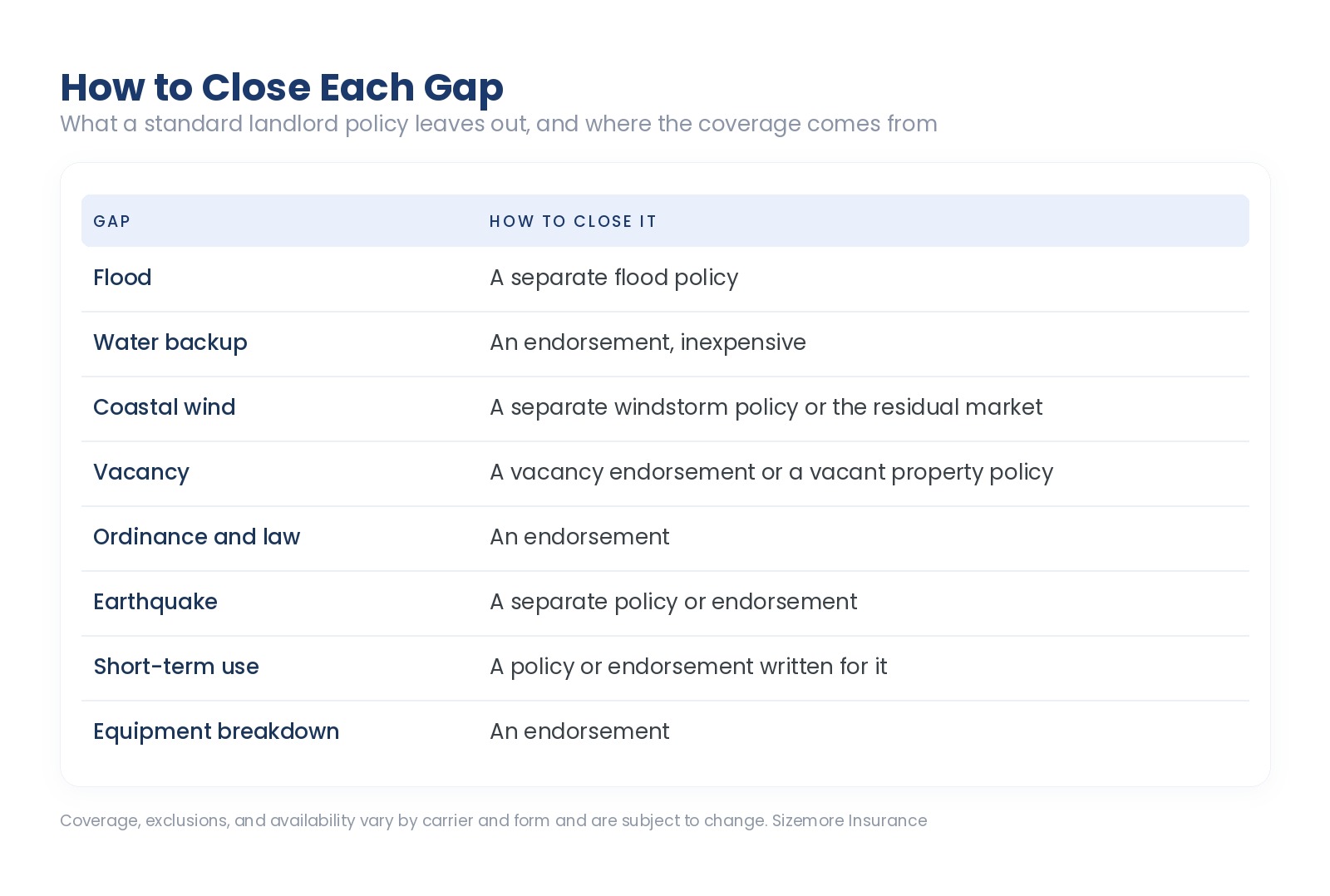
The takeaway: water backup and ordinance and law are the two cheapest fixes on this list and the two most commonly missing on a Carolina rental.
Coverage, exclusions, and availability vary by carrier and form and are subject to change.
The Three Worth Doing Today
Water backup. Generally costs little, covers a common loss, and takes one phone call.
Ordinance and law, if the property predates current code, which in much of the Piedmont and older coastal stock it does.
A flood quote, regardless of your zone. Outside a high-risk zone it typically costs less, and the maps are not a guarantee.
Where This Gets Complicated
Vacancy is the one investors underestimate. A property empty between tenants for two months can cross the threshold, and the exposure is not theoretical during a turnover with work being done.
Renovation is a different policy, because a landlord policy is written for an occupied rental. Builders risk and vacant coverage handle a rehab.
A percentage wind deductible grows as construction costs rise, and nobody notifies you.
Mold follows water, which makes the water backup endorsement worth more than it looks.
A tenant’s business in the unit raises exposures a landlord policy did not contemplate.
Pets, pools, and trampolines are liability questions rather than property ones, and some are eligibility questions.
Older systems are insurability rather than coverage. Knob and tube, fuse panels, and polybutylene narrow the market, and fixing them widens it.
Common Questions
Does landlord insurance cover flood?
No. Standard landlord policies exclude it and it requires a separate policy.
Is water backup included?
Generally not. It is an inexpensive endorsement and it covers a common loss.
What about wind on the coast?
Frequently excluded from the dwelling policy in coastal territories and written separately.
What happens if the property sits empty?
Coverage restricts or suspends past a stated vacancy period, commonly 30 to 60 days.
Does it cover my tenant’s belongings?
No, and it should not. That is renters insurance.
Can I rent short-term on a standard landlord policy?
Frequently not. Undisclosed platform use is a coverage problem.
The Bottom Line
- Add water backup, because it is inexpensive and the loss is common.
- Add ordinance and law on older construction.
- Get a flood quote whatever your zone says.
- Calculate your coastal wind deductible in dollars if the property is near the water.
- Tell us before a vacancy or a rehab, because both fall outside a standard landlord policy.
- Require renters insurance rather than trying to cover the tenant’s property.
Sizemore Insurance is an independent insurance company founded in North Carolina in 1977, writing in both North Carolina and South Carolina. Send us a declarations page and we will tell you which of these ten are open on your property. Insurance made just for you.
Coverage, exclusions, endorsement availability, and requirements vary by carrier and form and are subject to change. Nothing here is a coverage determination. Review your own policy or talk to your advisor.