Reviewed for insurance accuracy by Brad Sizemore, Owner and CEO, NPN 6595451 · November 13, 2026
View reviewer profilePeople in this state associate wildfire with the West, and North Carolina has a fall fire season that produces real events. The Party Rock fire near Lake Lure in 2016 burned for weeks and forced evacuations. The mountains have the terrain, the fuel, and the drought cycles for it.
What has changed recently is not the hazard. It is that carriers now measure it. Wildfire risk scoring at the individual address level is part of how western North Carolina homes get underwritten, and homeowners are seeing the results at renewal without knowing what produced them.
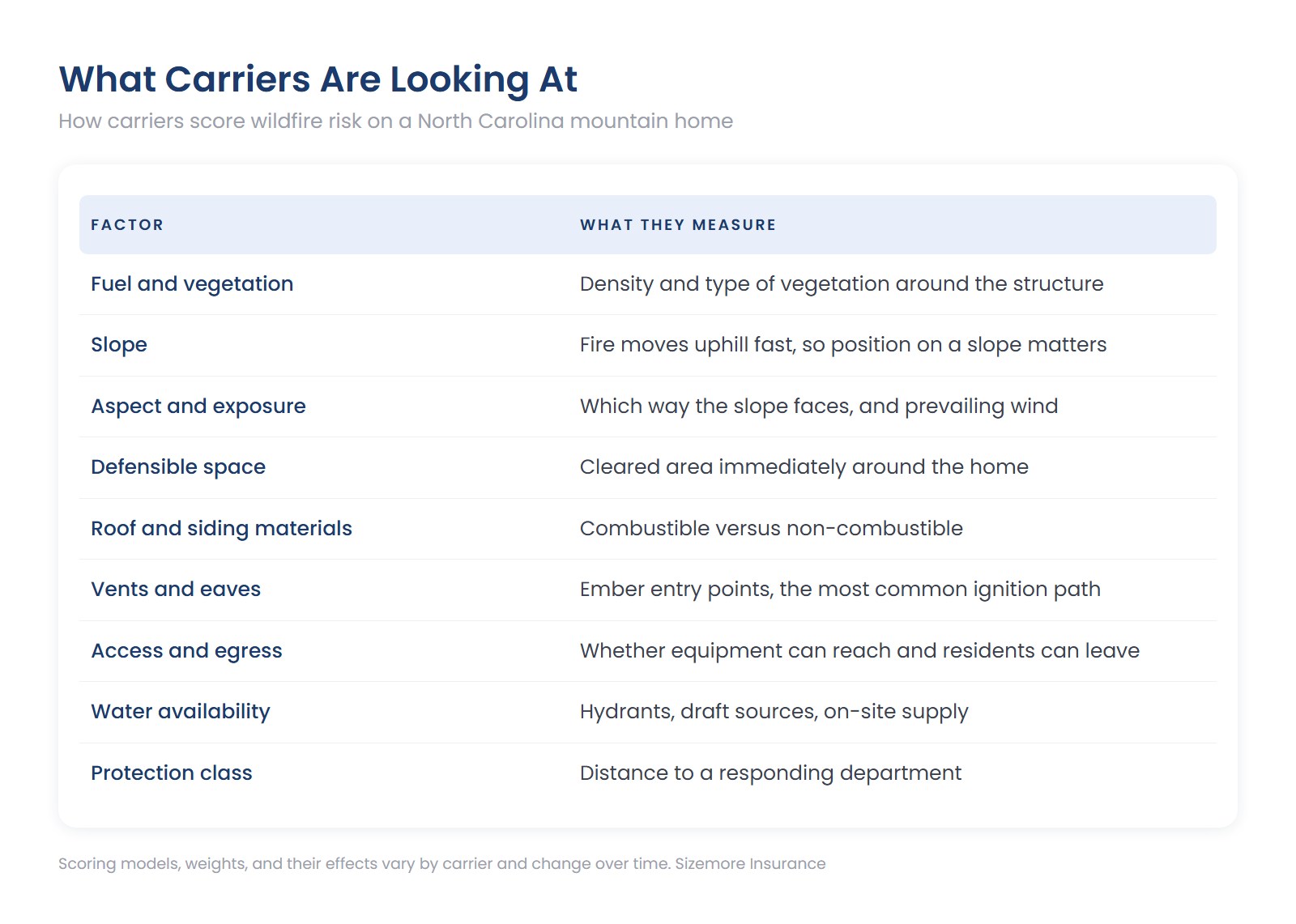
The takeaway: embers, not flame fronts, ignite most homes, which means vents, gutters, decks, and the first five feet around the house matter more than the tree line. That is also the part an owner most controls.
Scoring models, weights, and their effects vary by carrier and change over time.
The first five feet. Non-combustible material immediately around the foundation. No mulch against the siding, no firewood stacked on the deck, no shrubs under windows. This is the highest-value zone and the cheapest to address.
Ember-resistant vents. Fine mesh or listed vents on attic and crawlspace openings. Embers entering a vent is the most common way a house ignites at a distance.
Clean gutters and roof valleys. Accumulated leaf litter is an ember catcher.
Deck treatment. Enclosing the underside, clearing what is stored beneath, and non-combustible surfacing.
Defensible space out to thirty feet and beyond. Thinning, limbing up, and removing ladder fuels that carry fire from ground to canopy.
Roof material. A class A roof assembly is meaningfully better in this exposure.
Firewise participation. The Firewise USA program recognizes communities that organize around mitigation. Some carriers recognize participation, and it is worth documenting regardless.
It happens in this region now and it is not the end of the conversation.
Ask for the reason in writing. Wildfire scoring is model-driven and models sometimes reflect stale imagery or the wrong parcel.
Document mitigation with photographs and dates. Cleared defensible space, ember-resistant vents, a new roof, and a thinning project all matter and only if the underwriter can see them.
Ask for a reinspection. Where mitigation has been completed since the last assessment, some carriers will reconsider.
Market to carriers with different appetite. Wildfire appetite varies substantially, and a decline from one is not a decline from all.
Surplus lines is a legitimate step, and the FAIR Plan exists as a backstop for property that cannot obtain standard coverage.
Never let coverage lapse while you work through it.
Wildfire and protection class compound. A remote house in heavy fuel faces both, and they are separate assessments that stack.
Mitigation on your lot has limits if the neighborhood has not done it. This is why the community programs matter and why a subdivision-level effort is worth more than any single owner’s work.
Scoring can lag reality in both directions. Post-fire imagery and vegetation change take time to appear in models.
A recent burn nearby is not automatically bad. Burned fuel is consumed fuel, and how a model treats it varies.
Ordinance or law matters here too. Rebuilding after a fire in a jurisdiction with updated wildland urban interface requirements can cost more than the original construction.
Extended replacement cost matters after any regional event, wildfire included, because local construction costs spike when many homes need rebuilding at once.
Is wildfire a real risk in North Carolina?
Yes, particularly in the mountains during fall fire season and in drought years.
Does homeowners insurance cover wildfire?
Fire is a covered peril on a standard policy, including wildfire. The issue is eligibility and pricing, not whether the peril is covered.
Why did my carrier bring up wildfire this year when they never had before?
Address-level wildfire scoring became part of standard underwriting relatively recently. The hazard did not change as fast as the measurement did.
What is the single most effective thing I can do?
Clear and harden the first five feet around the house, and screen the vents.
Does Firewise participation help?
Some carriers recognize it. It is worth documenting either way, and community-level mitigation matters more than individual effort alone.
What if nobody will write my house?
Surplus lines, and the FAIR Plan as a backstop. It is placeable, and mitigation plus documentation is what moves it back toward the standard market.
Sizemore Insurance is an independent insurance company founded in North Carolina in 1977. Send us photographs of the property and we will tell you how it is likely scoring and what mitigation would change it. Insurance made just for you.
Sources: North Carolina Department of Insurance, homeowners underwriting and surplus lines (ncdoi.gov); North Carolina Insurance Underwriting Association, the NC FAIR Plan (ncjua-nciua.org).
Scoring models, underwriting criteria, credits, and availability vary by carrier and change. Review your own policy or talk to your advisor.
Coverage details: North Carolina Home Insurance