Most people think renters insurance covers their stuff.
It does, and that is not the biggest reason to have it.
Your belongings. Furniture, clothes, electronics, kitchen things, and everything else you own. Covered against fire, theft, vandalism, certain water damage, and other causes listed in your policy. This is what people buy it for.
Your liability. If someone is injured in your place, or if you accidentally damage someone else’s property, this is what responds. It also pays to defend you. This is the part that matters most and the part many renters never think about.
Somewhere to live. If a covered loss makes your place unlivable, additional living expense pays for a hotel or a temporary rental, plus the extra costs of living somewhere else. After a fire, this is the coverage that keeps you off a friend’s couch.
Medical payments to others. A small amount that covers a guest’s minor injury without anyone arguing about fault. It resolves small things before they become claims.
Your belongings are replaceable and you probably know roughly what they are worth.
Liability is the part that reaches beyond what you own.
A grease fire in your kitchen spreads. The building is damaged and the landlord’s insurance company comes looking for whoever caused it. That is you, and the number is not furniture-sized.
Your dog bites someone.
A guest falls on your steps and is seriously hurt.
Your bathtub overflows and damages the apartment below.
In each of those, someone else’s loss becomes your responsibility. Liability coverage pays it and defends you, and it is why a renters policy is worth having even if you own almost nothing.
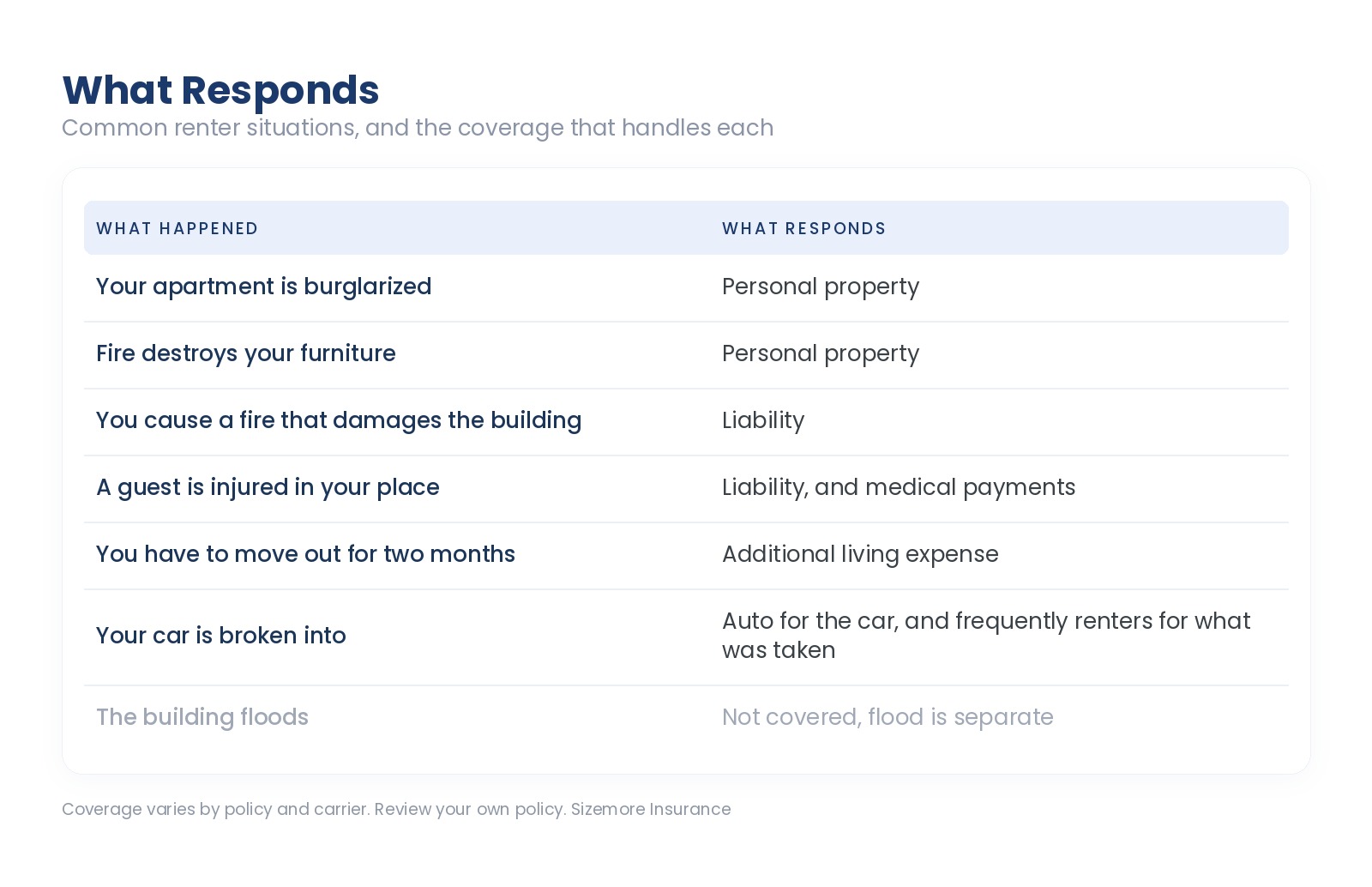
The takeaway: personal property is why people buy it and liability is why they should.
Coverage varies by policy and carrier. Review your own policy.
The building. That is your landlord’s.
Flood. Excluded from standard renters policies. Separate contents flood coverage exists and it has its own article.
Your car, which is your auto policy. Things stolen from your car are frequently covered by your renters policy, and the car itself is not.
Earthquake, generally, without a separate endorsement.
Your roommate’s belongings, unless they are on your policy.
Wear and tear, pests, or maintenance issues.
Business property beyond a small limit, which matters if you work from home.
Your landlord’s policy does not cover you. It covers the building. This is one of the most common misunderstandings in renting and it has its own article.
Sublimits apply to certain categories. Jewelry, cash, electronics, and firearms frequently have their own lower limits inside the policy. An engagement ring is the classic example.
Property away from home is generally covered, though some policies limit the amount, including for things in a storage unit or at a second residence.
Roommates are separate. One policy generally does not cover everyone.
What does renters insurance cover?
Your belongings, your liability, additional living expense, and a small amount of medical payments for guests.
Does my landlord’s insurance cover my stuff?
No. It covers the building.
What is the most important part?
Liability, because it reaches beyond what you own.
Does it cover my car?
No, that is auto. Things stolen from inside the car frequently are covered here.
Does it cover flood?
No. Flood coverage for renters is separate.
Does it cover my roommate?
Generally not unless they are named on the policy.
Sizemore Insurance is an independent insurance company founded in North Carolina in 1977, writing in both North Carolina and South Carolina. Tell us where you live and roughly what you own and we will tell you what it costs. Insurance made just for you.
Coverage, limits, and exclusions vary by carrier and policy and are subject to change. Nothing here is a coverage determination. Review your own policy or talk to your advisor.