

On the road, every driver around you is legally required to carry liability coverage. Some do not, and the requirement exists.
On the water there is generally no such requirement in either Carolina. The boat that runs into you may be carrying nothing at all, and there is no state mechanism behind it.
That single difference is why this coverage deserves more attention on a boat policy than it gets.
Uninsured boater coverage pays for your injuries and your passengers' injuries when the at-fault operator has no insurance, or cannot be identified after leaving the scene.
Underinsured boater coverage, where offered, pays when the at-fault operator has coverage but not enough.
Both pay you rather than someone else, which is why they get overlooked. They do not feel like an obligation, so people leave them off or at a minimum.
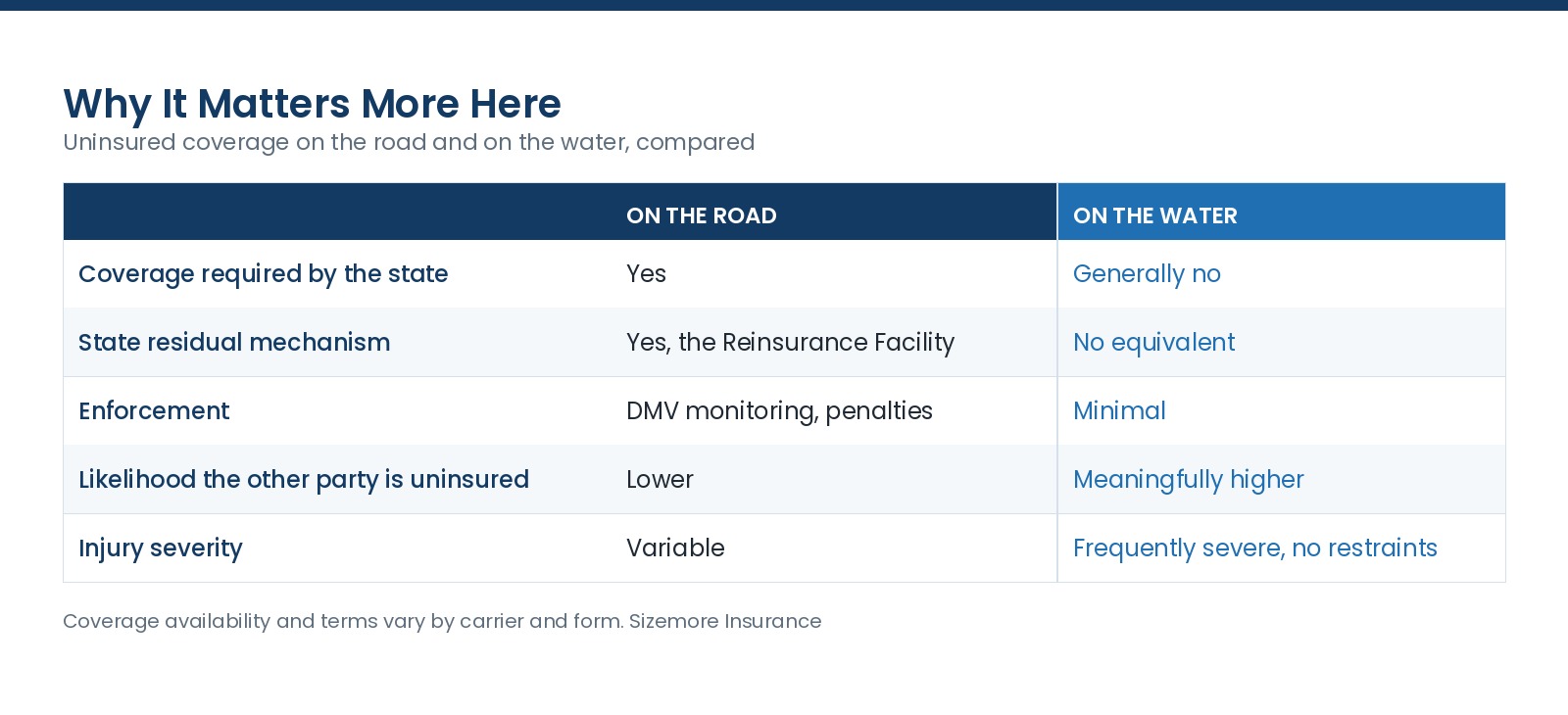
The takeaway: there is no system making sure the other operator carries anything, and the injuries on the water tend to be serious.
Coverage availability and terms vary by carrier and form. Review your own policy.
Boating incidents involving an operator who leaves are more common than people expect, and identification is harder than on the road.
There are no license plates in the ordinary sense, no traffic cameras, and frequently no fixed reference points. A registration number on a hull is smaller and harder to read at distance than a plate.
Which means the practical advice is the same as on the road and matters more.
Contributory negligence applies. If you contributed to the incident, your recovery against the other operator can fail entirely, and that is one more reason your own coverage matters.
Medical payments coverage pays regardless of fault and it is generally inexpensive. On a boat policy it works alongside uninsured boater coverage rather than instead of it.
Property damage to your vessel is generally handled by your hull coverage rather than by uninsured boater coverage, subject to your deductible.
Passengers are covered too, which matters because they are usually people you know and a claim against you is otherwise the alternative.
Limits should match your liability limits where the carrier permits it.
Availability varies. Not every carrier offers underinsured boater coverage as a distinct coverage. Ask what is available.
Is boat insurance required in North Carolina or South Carolina?
Neither state generally requires it. Lenders and marinas frequently do.
What does uninsured boater coverage do?
Pays for your injuries and your passengers' injuries when the at-fault operator has no insurance or cannot be identified.
Is it expensive?
It is typically one of the less expensive coverages on a boat policy relative to what it does.
Does it cover damage to my boat?
Generally that is hull coverage, subject to your deductible.
What if the other boat leaves?
Report immediately to law enforcement, document everything, and get witnesses. Reporting requirements typically attach.
What limit should I carry?
Matching your liability limit where the carrier permits it.
We have been an independent insurance company in North Carolina since 1977. Send us your declarations page and we will tell you whether this is on it and what raising it costs. Insurance made just for you.
Coverage, availability, limits, and reporting requirements vary by carrier, form, and jurisdiction. Nothing here is legal advice. Review your own policy or talk to your advisor.