

Every couple of years there is a headline about a large requested rate increase in North Carolina, and every couple of years the number that actually takes effect is a fraction of it.
Owners read the headline and brace for the request. Understanding the difference between what gets filed and what gets approved makes the whole system legible, and it tells you when the next one can happen.
North Carolina is unusual. The North Carolina Rate Bureau files rates on behalf of the insurance companies collectively rather than each carrier filing individually. The Insurance Commissioner reviews the filing and can approve it, reject it, or negotiate a settlement.
That structure produces the pattern: a large filed request, a rejection, a period of dispute, and a settlement well below the request.
Most states do not work this way, which is why national commentary about rate increases frequently does not describe what happens here.
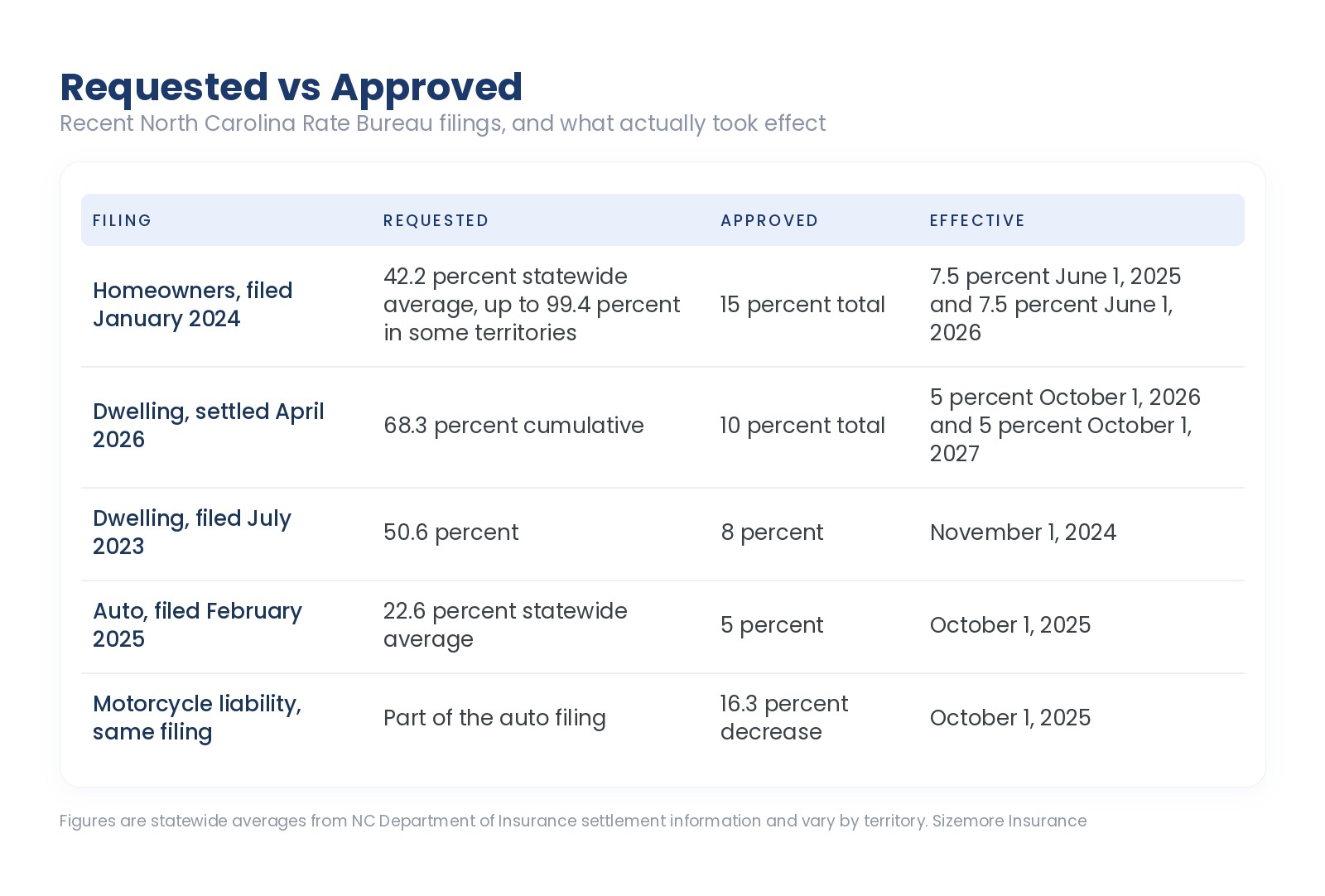
The takeaway: in every one of these increase requests, the approved figure came in far below the request. The Department of Insurance estimated the homeowners settlement saved roughly $777 million against the request and the dwelling settlement roughly $268 million.
Rate figures reflect Department of Insurance settlement information and are subject to change.
Homeowners base rates. The settlement bars insurers from requesting another base rate increase before June 2027.
Dwelling rates. The second step takes effect October 1, 2027, and the settlement covers that period.
Auto. The Rate Bureau is required to file auto rates every year by February 1, so auto is never locked for long. Check the current filing before each October renewal.
That matters practically. It means homeowners base rates are stable for the next renewal cycles, and an increase you see on a homeowners policy in that window is more likely coming from your dwelling limit rising with construction costs, or from changes specific to your policy, than from a base rate change.
That is a genuinely different situation and it changes what you should do about a higher renewal.
The April 2026 dwelling settlement built mitigation credits for fortified homes and roofs into the dwelling rate structure in many eastern North Carolina territories.
That prices construction quality directly on rental and second-home policies rather than treating it as an underwriting preference. For an owner planning a roof replacement, it changes the return calculation on doing it to enhanced standards.
A statewide average is not your number. Coastal territories and inland territories moved differently in every one of these proceedings. Your increase can be well above or below the headline.
Dwelling policies are not homeowners policies. Dwelling covers non-owner-occupied residential property, meaning rentals and second homes. If you own both, you are subject to both schedules on different dates.
Base rate stability is not premium stability. Your limit rises with construction cost inflation each year, which raises the premium even with no rate change. Compare this year’s limit to last year’s before assuming a rate increase.
Reinsurance costs sit underneath all of it, and they are global rather than set here.
Surplus lines is not covered by these settlements, so a property placed with a non-admitted carrier does not follow this schedule.
The residual markets have their own rate mechanisms.
Was the 42 percent homeowners increase approved?
No. It settled at 15 percent total, split across June 2025 and June 2026.
Can rates go up again soon?
The homeowners settlement bars another base rate request before June 2027.
Why did my premium rise if base rates are locked?
Frequently because your dwelling limit rose with construction cost inflation. Compare this year’s limit to last year’s.
Does this apply to my rental property?
Rentals fall under the dwelling filing, which is on a different schedule with steps in October 2026 and October 2027.
Do these settlements cover surplus lines?
No. A property placed with a non-admitted carrier is outside this structure.
What did the dwelling settlement change besides rates?
It built mitigation credits for fortified homes and roofs into many eastern North Carolina territories.
Sizemore Insurance is an independent insurance company that has been placing coverage in North Carolina since 1977. Send us this year’s and last year’s declarations pages and we will show you how much of your change was rate and how much was limit. Insurance made just for you.
Rate figures reflect North Carolina Department of Insurance settlement information and are subject to change. Review your own policy or talk to your advisor.