

Every carrier that quotes you pulls a document describing your driving history, and it decides a large share of what you pay.
Many drivers have never seen it. Some have something on it that does not belong, and errors do not correct themselves.
Convictions, with the offense, the date, and the disposition. This is where a speeding conviction, a reckless driving conviction, or a DWI appears.
Prayer for Judgment dispositions, which show as a distinct outcome rather than as an ordinary conviction.
License status and class, including any suspension or revocation history.
License issue date, which matters because years of licensed experience is a rating factor. For drivers first licensed on or after July 1, 2025, the inexperienced operator surcharge period runs up to eight years rather than three.
Accidents, in some records, though at-fault determinations frequently come from insurance industry claim databases rather than from the driving record itself.
Carriers also pull a separate claims history report showing losses reported under any policy, which is a different document from the motor vehicle report and worth knowing exists.
You can request your driving record from the North Carolina Division of Motor Vehicles. Certified and uncertified versions exist and both show the history.
Your advisor can also pull the record a carrier would rate from and walk it with you. That is usually faster and it comes with an explanation, which the DMV version does not.
Either way, look at it before you shop, not after a quote comes back higher than you expected.
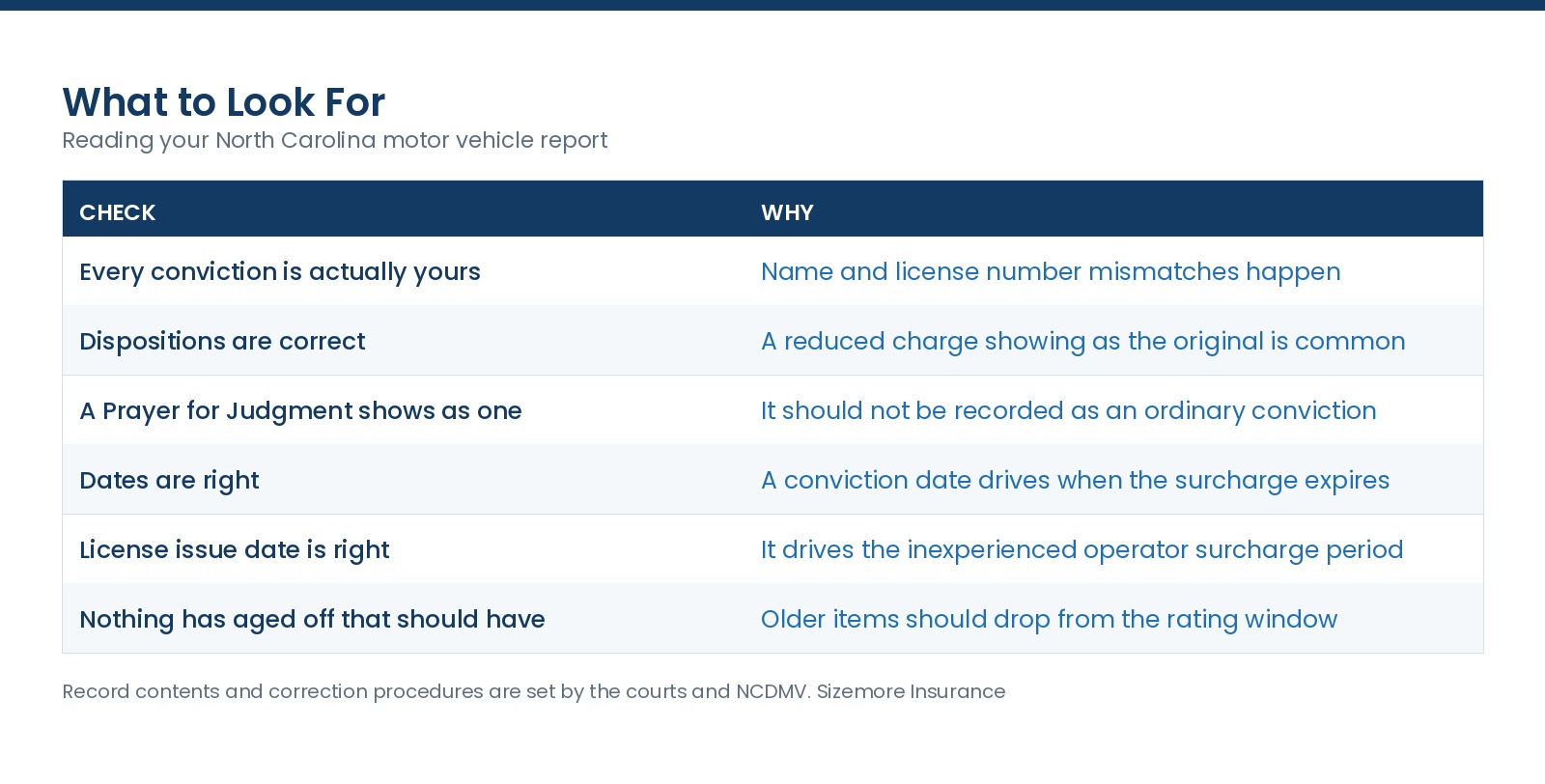
The takeaway: the two errors that cost the most are a wrong disposition and a wrong date. One creates a surcharge that should not exist, and the other extends one that should have ended.
Start with the source. A driving record reflects what the courts reported. If a disposition is wrong, the correction generally runs through the court and then to DMV rather than through your insurance company.
Get documentation. The judgment, the disposition sheet, or the court record showing what actually happened.
Send it to us as well. Even while a correction is pending, we can present the documentation to a carrier and frequently get the rating corrected in the meantime.
Do not wait for a renewal. A surcharge based on an error costs money every month it stands.
Two databases, two purposes. The motor vehicle report shows driving history. A separate claims history report shows losses. A comprehensive claim that produced no points still appears on the second one, which is why frequency can matter even without a surcharge.
Out-of-state convictions report back. A ticket in another state generally makes its way onto your record here.
Household members matter. Carriers rate the household, and a driver with a poor record living at your address affects your policy whether or not they drive your car.
A record can look clean and still be expensive. Years of licensed experience, continuous coverage history, and territory all affect rating independent of violations.
Records are pulled at every renewal, not just at new business. A conviction from eight months ago can surface at your next renewal rather than immediately.
Certified copies matter for court and DMV purposes. For insurance, an uncertified copy is generally sufficient to identify a problem.
How do I get my driving record in North Carolina?
Request it from the Division of Motor Vehicles, or ask your advisor to pull the version carriers rate from and walk it with you.
How far back does it go?
Different versions cover different periods. For insurance rating, what matters is the applicable experience period, generally three years and five for serious convictions occurring on or after July 1, 2025.
Something on mine is wrong. Who fixes it?
Corrections generally run through the court that entered the disposition and then to DMV. Send us the documentation and we can work on the rating in the meantime.
Does a Prayer for Judgment show up?
Yes, as its own disposition rather than as an ordinary conviction.
Do accidents appear on it?
Sometimes. At-fault determinations frequently come from a separate claims history database.
Should I check it before shopping?
Yes. It is the document your quotes are built from.
Sizemore Insurance is an independent insurance company that has been placing coverage in North Carolina since 1977. We will pull your record, read it with you, and tell you what each item is costing and when it comes off. Insurance made just for you.
Record contents, availability, and correction procedures are set by the courts and the Division of Motor Vehicles and are subject to change. Rating practices vary by carrier. Review your own record and policy with your advisor.