This comes up in almost every renters conversation I have, and it is worth being direct about.
Your landlord has insurance. It does not cover you.
The building. Walls, roof, systems, and structure.
Their liability as the property owner, for things like a broken stair rail they were responsible for maintaining.
Their lost rent, if they carry that coverage, when the building is damaged and you cannot live there.
That is the core of it. Their policy exists to protect their asset and their income.
Your belongings. Not your furniture, not your clothes, not your laptop.
Your liability. If you cause a loss, their insurance company may come after you rather than protect you.
Your housing if the place burns and you have nowhere to go. Their loss of rents replaces their income, not your housing.
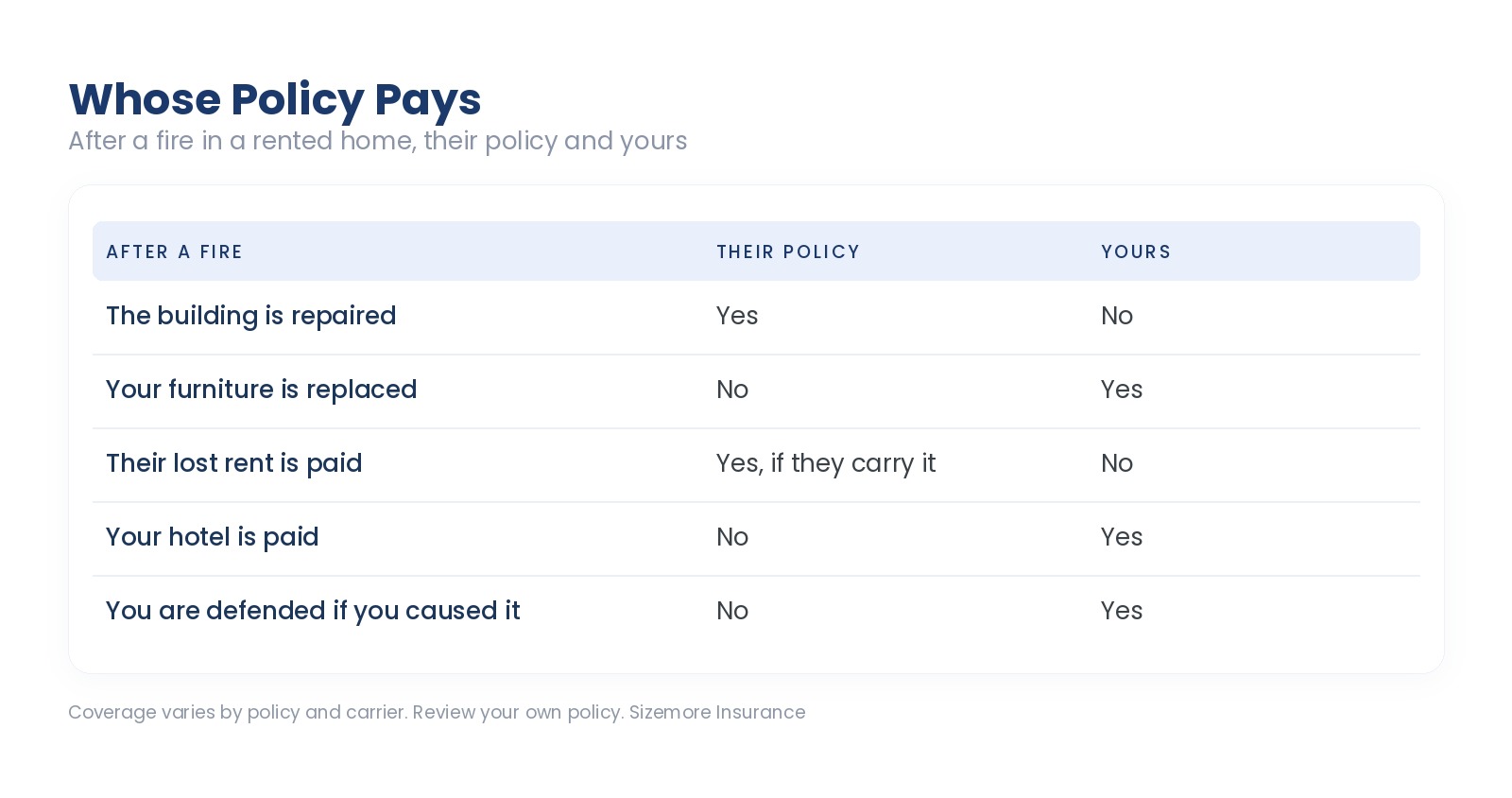
The takeaway: their policy handles their loss and yours handles yours, and if you caused the loss their insurer can pursue you.
Coverage varies by policy and carrier. Review your own policy.
If you cause the damage, your landlord’s insurance company can generally come after you for it.
That is called subrogation and it is common. Their insurer pays to repair the building, then pursues whoever was responsible for the loss.
A candle left burning. A grease fire. An overflowing tub. A space heater.
The building repair is not a furniture-sized number. Without liability coverage, that pursuit is aimed at you personally, and there is nothing standing between you and it.
With a renters policy, your liability coverage responds and defends you. That single scenario is why the coverage is worth having even if your belongings are secondhand.
Many do, and now you know why. It is not paperwork.
It gives your mistakes somewhere to go other than a claim against you personally and a dispute with them.
It means you have housing if the building is damaged, which makes a hard situation less hard for both of you.
It reduces claims on their policy, which affects their premium.
If your lease requires it, they are generally asking for proof of a policy at a stated liability limit, and frequently to be notified if it lapses. Both are easy and that has its own article.
Does my landlord’s insurance cover my belongings?
No. It covers the building and their interests.
If the building burns, will they pay for my hotel?
No. Their loss of rents replaces their income. Your additional living expense pays your housing.
Can their insurance company come after me?
If you caused the loss, generally yes. That is subrogation and it is common.
What protects me from that?
The liability coverage in a renters policy, which pays and defends.
Why does my landlord require renters insurance?
So your mistakes have a source of payment other than you personally, and so you have housing after a loss.
What do they need from me?
Usually proof of coverage at a stated liability limit, and frequently to be notified if it lapses.
Sizemore Insurance is an independent insurance company founded in North Carolina in 1977, writing in both North Carolina and South Carolina. Send us your lease requirement and we will set the policy up to satisfy it. Insurance made just for you.
Coverage, limits, and provisions vary by carrier, policy, and lease and are subject to change. Nothing here is legal advice or a coverage determination. Review your own lease and policy or talk to your advisor.