If this is your first place, here is the short version.
Personal property coverage sized to what you actually own. Walk each room and add it up, because you own more than you think.
Replacement cost, not actual cash value. Small difference in price and a large difference in a claim.
A liability limit above the base, because it is one of the least expensive parts of the policy and the part that reaches furthest.
Additional living expense, which is generally included and worth knowing the limit on.
Scheduling for a ring, a laptop you need for work, or a bike that cost real money.
Bundled with your auto if you have a car, because the discount on the auto side frequently offsets much of the renters premium.
That is the whole setup. It takes one conversation.
Setting the property limit too low. The base amount on a cheap policy is frequently well below what a full apartment costs to replace. Clothes alone surprise people.
Buying the minimum policy at lease signing. There is frequently a link in the lease packet, it is fast, and it frequently produces the cheapest policy that satisfies the requirement and not much else. Compare before you click.
The common question, and the answer is usually two policies rather than one.
A renters policy generally covers the named insured and relatives living with them. An unrelated roommate is neither.
Some carriers will add a roommate as an additional insured, and many will not. It varies and it is not the default.
Even where it is allowed, it creates problems:
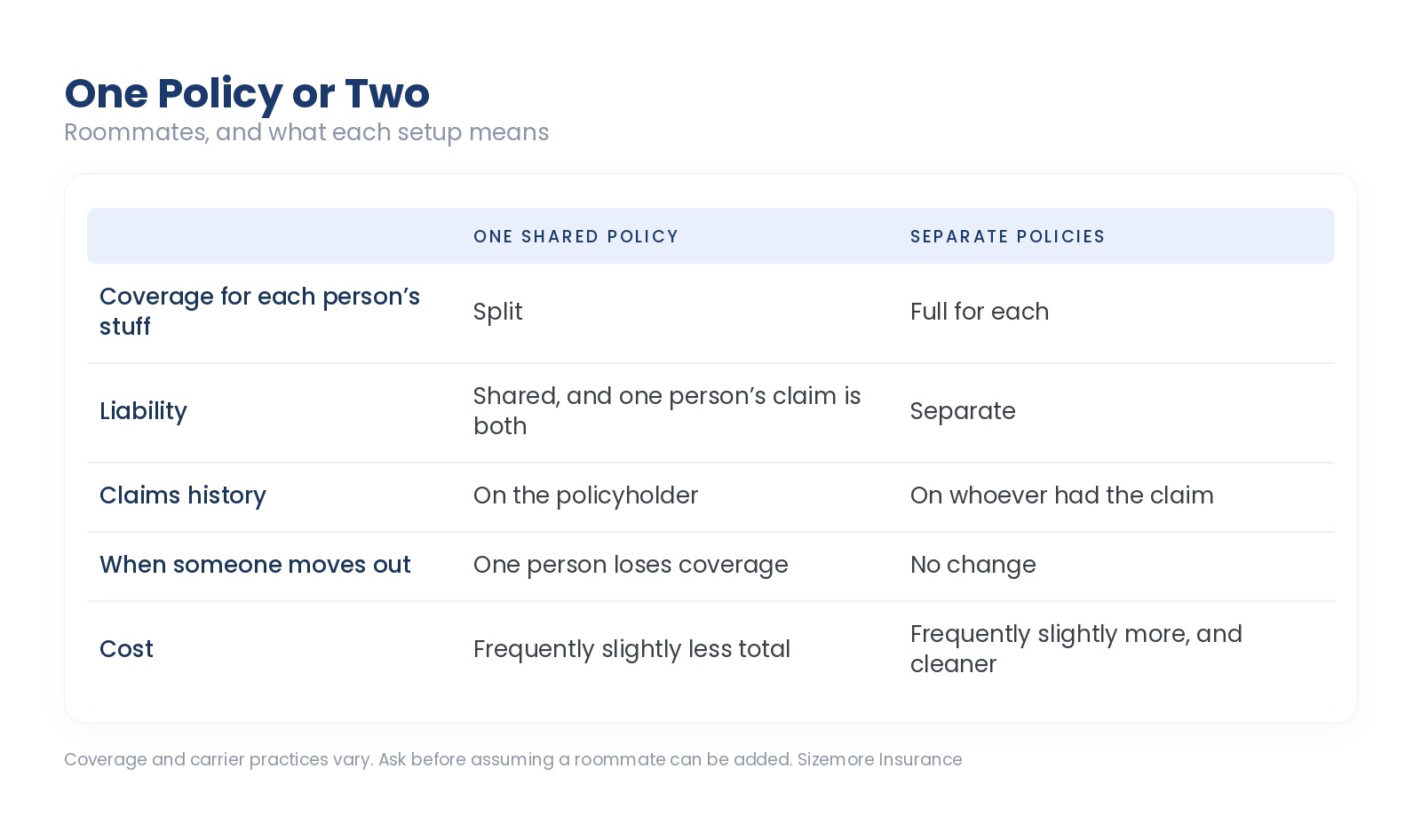
The takeaway: separate policies frequently cost a little more and avoid every one of those problems, which is why we recommend them.
Coverage and carrier practices vary. Ask before assuming a roommate can be added.
Married or domestic partners are a different question than roommates and are frequently on one policy.
A roommate’s guest injuring someone raises whose liability responds.
A roommate causing damage to the building is their liability, and if they have no policy the landlord’s insurer may pursue whoever they can identify.
Subletting raises its own questions and it may violate your lease.
Your landlord’s requirement may specify that each tenant on the lease carries coverage. Read it.
Moving mid-lease means updating the address, which is a two-minute call people forget.
Do roommates need separate renters policies?
Generally yes. A policy typically covers the named insured and relatives, not unrelated roommates.
Can I add my roommate to my policy?
Some carriers allow it and many do not, and even where allowed it creates shared limits and shared claims history.
How much coverage do I need for a first apartment?
Add up what you own room by room. It is frequently more than you would guess.
Should I buy the policy in my lease packet?
Compare first. Those are frequently minimum policies that satisfy the requirement and little else.
Do I need it if I have almost nothing?
Yes, for the liability. That is the reason regardless of what you own.
What if my roommate moves out?
Nothing changes if you each have your own policy. That is one of the reasons to.
Sizemore Insurance is an independent insurance company founded in North Carolina in 1977, writing in both North Carolina and South Carolina. Tell us where you are moving and whether you have a car, and we will set it up in one call. Insurance made just for you.
What to get, what it costs, and why one policy across three roommates is usually the wrong answer.