

This is a coverage owners are frequently missing and least likely to have thought about.
If your vessel sinks in a slip, grounds on a shoal, or ends up somewhere it should not be, removing it is frequently a legal obligation. Not a choice, and not something you can walk away from by declaring the boat a loss.
And the cost of removal has nothing to do with what the boat was worth.
Raising a sunken vessel involves divers, lift bags or a crane, a barge, and environmental containment. Those costs are driven by depth, location, access, and conditions, not by the hull's market value.
A modest boat that sinks in a difficult spot can cost more to remove than it was worth. A larger vessel in an accessible marina can cost less than you would expect. The two numbers are simply not connected.
Which means a total loss settlement does not solve the problem. The insurer pays what the boat was worth and the removal obligation is still yours.
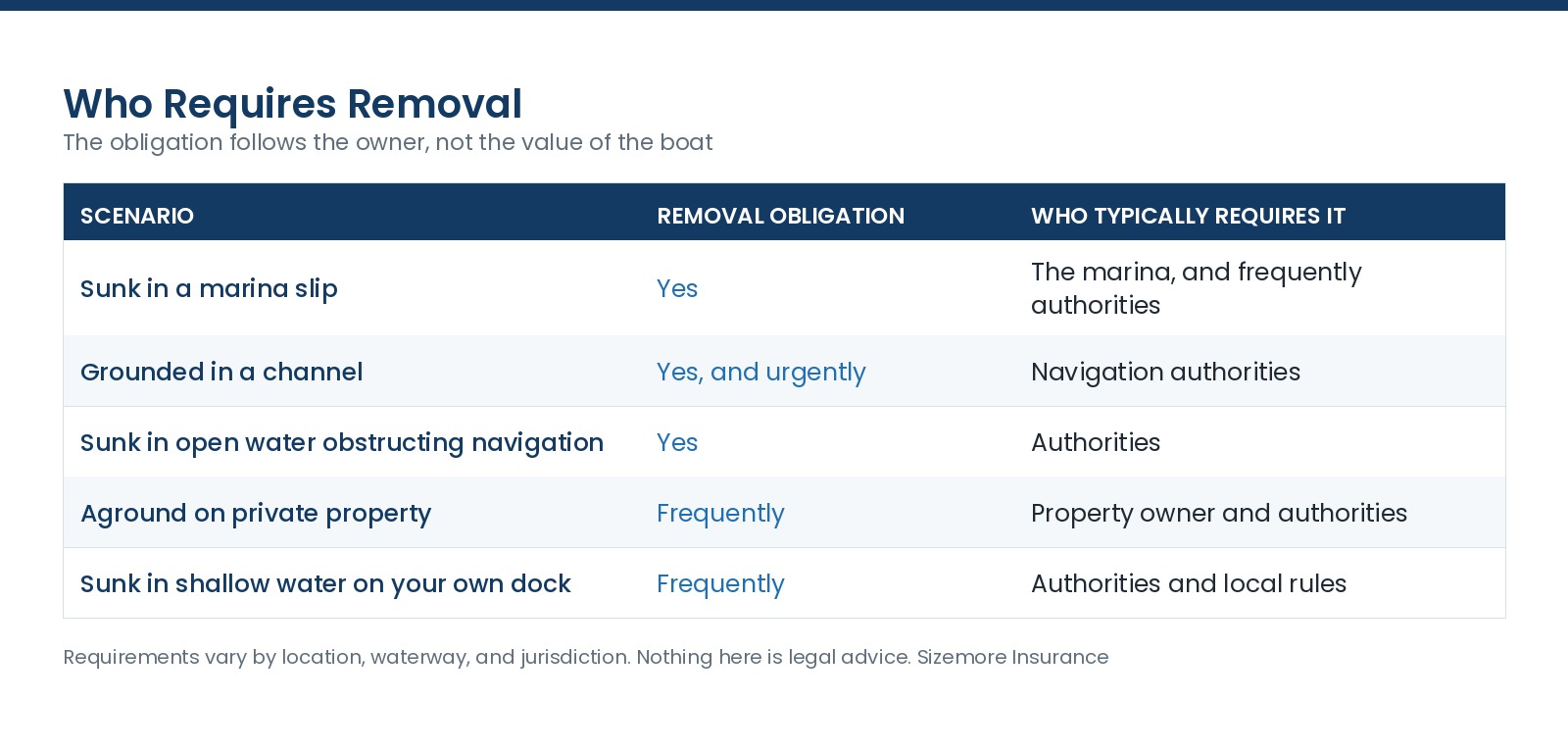
The takeaway: somebody will require the vessel to be removed, and the bill comes to the owner.
Requirements vary by location, waterway, and jurisdiction. Nothing here is legal advice.
Some policies include it with a limit tied to the hull value, which can be inadequate for the reasons above.
Some policies offer a separate limit, which is better, because it is not constrained by what the boat was worth.
Some policies do not include it at all, which is the situation to find and fix.
Ask three questions: is it on the policy, what is the limit, and is that limit separate from or tied to the hull value.
This distinction matters and it is one people get wrong.
Towing is moving a disabled vessel that is not in danger to a facility. Routine and inexpensive.
Salvage is recovering a vessel in peril, meaning aground, sinking, or in imminent danger. Under maritime practice, a salvor can claim compensation based on the value of the property saved, which can be a substantial percentage of the vessel's value rather than an hourly rate.
Wreck removal is removing a vessel that is already lost, as an obligation rather than a rescue.
Three different things, three different cost structures, and a policy may treat each separately. Confirm all three.
Storm losses are where this happens most. Sinking at the dock during a hurricane is a common scenario, and it produces a hull claim, a salvage question, and a removal obligation at once.
Marinas have their own requirements, and many contracts obligate the owner to remove a sunken vessel promptly and hold the marina harmless. Read the slip agreement.
Fuel and oil come with it. A sunken vessel releases fuel, which brings pollution liability into the same event. That is a separate coverage and it is covered separately in this section.
Abandoning the vessel is not an exit. Ownership and the obligation generally follow you.
A total loss settlement does not include removal unless the policy provides for it separately.
Time pressure is real. Authorities and marinas impose deadlines, and delay increases both cost and exposure.
Is wreck removal covered by my boat policy?
Not always. Check for it specifically, along with the limit and whether it is separate from the hull value.
Am I required to remove a sunken boat?
Frequently yes, depending on location and jurisdiction, and marina contracts commonly require it as well.
Does the total loss payment cover removal?
Generally not. It pays what the boat was worth, which is a different number.
What is the difference between salvage and wreck removal?
Salvage is recovering a vessel in peril and can carry a claim based on the value saved. Wreck removal is removing a vessel already lost.
Can I just abandon it?
Generally not. Ownership and the obligation follow you.
How much coverage should I carry?
Enough to reflect removal cost rather than hull value, and a separate limit is better than one tied to the hull.
We have been an independent insurance company in North Carolina since 1977 and we have worked storm seasons on this coast. Send us your declarations page and we will tell you whether this is on it. Insurance made just for you.
Coverage, limits, and legal removal obligations vary by carrier, form, location, and jurisdiction. Nothing here is legal advice. Review your own policy or talk to your advisor.