

One of the most expensive misunderstandings in boating is the difference between a tow and a salvage.
They can start the same way, with a call for help and a boat coming out to you. They end very differently, and the difference is decided by your situation at the moment help arrives.
Towing is assistance to a vessel that is disabled but not in danger. Engine will not start, out of fuel, dead battery. The vessel is safe and it needs to get somewhere. Charged by time and distance, and generally modest.
Salvage is assistance to a vessel in peril. Aground, taking on water, drifting toward a hazard, on fire, or otherwise in danger. Under longstanding maritime practice, a salvor who saves property in peril can claim compensation based on the value of what was saved rather than on time spent.
That claim can be a substantial percentage of the value of the vessel. A boat pulled off a shoal in twenty minutes can produce a bill that is not remotely related to twenty minutes of work.
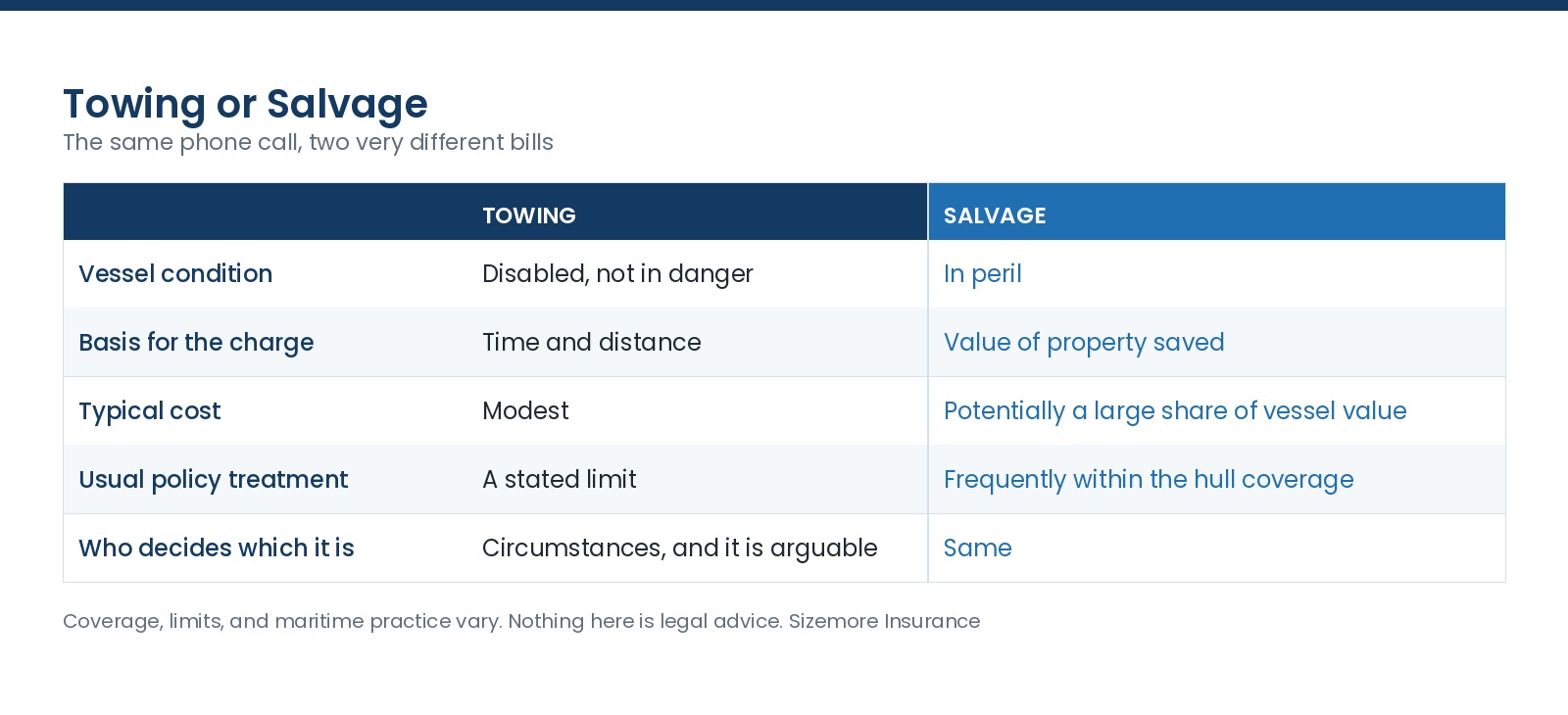
The takeaway: the same phone call can produce two very different bills depending on whether the boat was in danger.
Coverage, limits, and maritime practice vary. Nothing here is legal advice.
Towing and on-water assistance is frequently a stated limit on a boat policy, covering a tow to the nearest facility, jump starts, fuel delivery, and soft ungroundings. Limits vary and they can be modest.
Commercial towing memberships exist separately and provide broader on-water towing benefits. Many owners carry both, and it is worth comparing rather than duplicating.
Salvage is generally addressed within the hull coverage rather than under the towing limit, and how a policy treats a salvage claim is worth asking about specifically.
Wreck removal is a third thing, covered separately in this section.
Soft grounding versus hard grounding is where the argument lives. A boat gently aground on a sandbar in calm water on a rising tide is arguably not in peril. The same boat on a falling tide with a sea running is a different situation.
Weather changes the classification. A situation that is a tow at noon can be a salvage by three.
Towing limits are frequently low relative to a long tow. Offshore or from a remote inlet, distance matters.
Membership programs and policy coverage overlap, and understanding which responds first avoids paying twice.
Fuel delivery and jump starts are the ordinary uses and they are what makes the coverage worth having on a routine basis.
Trailer breakdowns are a road question, and roadside coverage on the auto policy handles those.
What is the difference between towing and salvage?
Towing assists a disabled vessel not in danger and is charged by time and distance. Salvage assists a vessel in peril and can be charged based on the value saved.
Does my boat policy cover towing?
Frequently at a stated limit. Check the amount, because a long tow can exceed it.
Does it cover salvage?
Salvage is generally addressed within the hull coverage. Ask how your policy treats it.
Should I get a towing membership?
Many owners carry one alongside their policy. Compare the benefits rather than duplicating.
What should I ask before accepting help?
Whether they are treating it as a tow or a salvage, and what it will cost and on what basis.
What if I am aground?
That is where the distinction gets argued. Ask before a line goes on the boat, and take the help if you are genuinely in danger.
We have been an independent insurance company in North Carolina since 1977. Send us your declarations page and we will tell you what your towing limit is and how salvage is handled. Insurance made just for you.
Coverage, limits, and maritime salvage practice vary by carrier, form, and circumstances. Nothing here is legal advice. Review your own policy or talk to your advisor.