

Every year in late August I have the same two conversations with boat owners.
The first is somebody discovering that their storm deductible is a percentage rather than a flat number. The second is somebody discovering that their policy required a haul-out plan they never wrote.
Both are avoidable in May and neither is fixable once a storm has a name.
On a coastal boat policy, the deductible for damage from a named storm is frequently a percentage of the insured value rather than a flat dollar amount, exactly like the one on a coastal home.
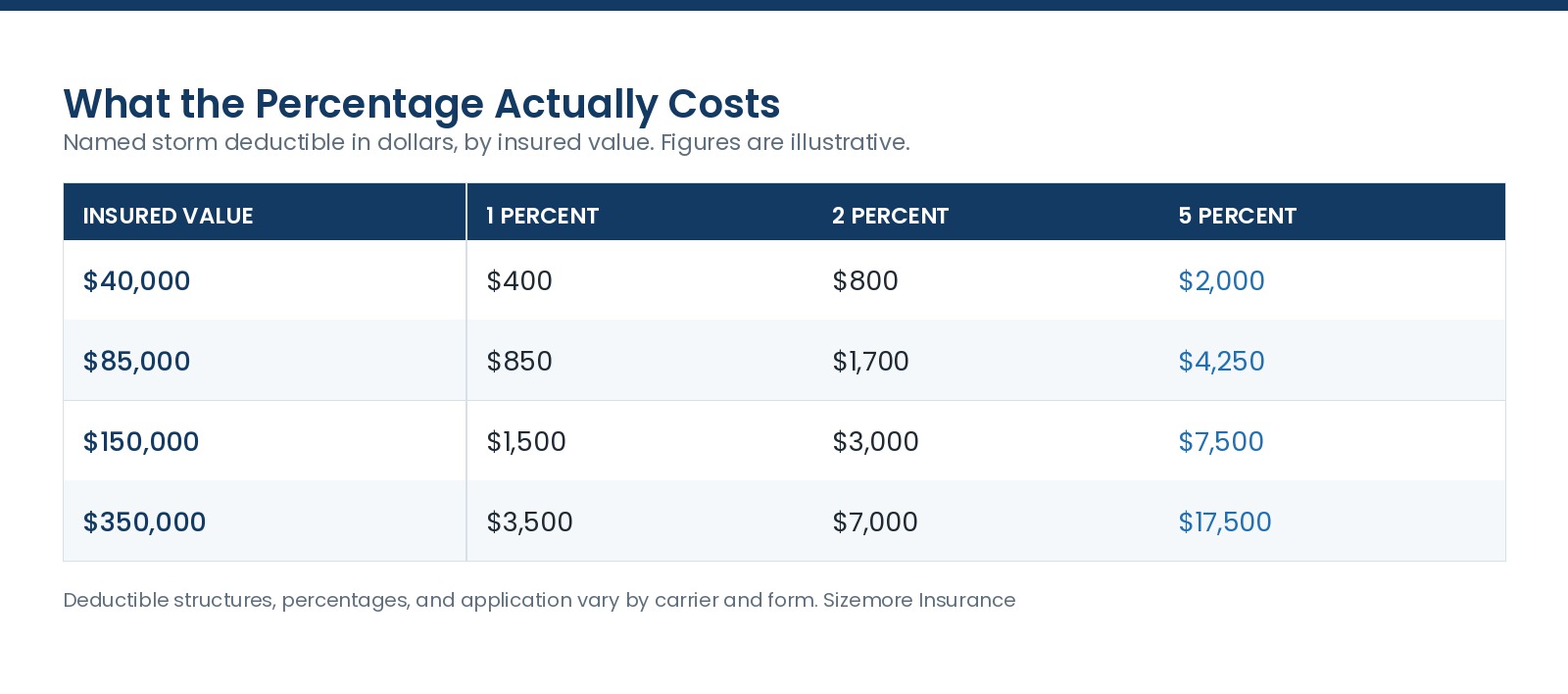
The takeaway: calculate yours in dollars and keep that reserve available before the season. It applies per named storm, so an active year can mean it twice.
Deductible structures, percentages, and application vary by carrier and form. Figures are illustrative.
Your policy may also carry a separate everyday deductible that is a flat amount. Two deductibles on one policy, applying to different events.
Some carriers require a written hurricane plan as a condition of coverage on a coastal vessel. Others offer a credit for having one. Both are worth knowing about before you need it.
A plan generally answers four questions.
Where does the boat go. A specific facility, a specific hurricane hole, a trailer and a storage location, or a marina with a written storm policy.
Who moves it. You, a captain, a marina service, or a hauler, with contact information and an alternate.
When. A defined trigger, frequently tied to a watch or warning being issued for the area, rather than a judgment call in the moment.
How it gets secured. Doubled lines, chafe gear, canvas removed, electronics removed, batteries charged, and drain plugs handled.
Write it down. Some carriers want a copy, and the discipline of writing it forces the decisions you do not want to be making when the marina is already full.
Marina slips fill up. Haulers book solid. The window between a storm becoming a threat and a storm arriving is short, and everyone on that coast is calling the same yards at the same time.
An owner with a standing arrangement and a phone number gets the boat out. An owner deciding in the moment frequently does not.
That is a practical argument rather than an insurance one, and it is the real reason to have the plan.
Coverage may be restricted once a storm is named. Carriers commonly stop binding new coverage and stop increasing limits once a storm is in a defined area. Whatever you have when it is named is what you have.
A haul-out costs money and some policies contribute. Some forms include a storm mitigation or haul-out expense allowance, reimbursing part of what you spend to protect the boat. Ask, because owners frequently pay for a haul-out without knowing they could claim part of it.
Leaving it in the slip may violate a policy condition where a plan is required. That turns a covered loss into a disputed one.
Sinking at the dock is a common outcome, and raising and cleaning a sunken boat is a wreck removal and salvage question as much as a hull one.
Trailer boats are easier and still need a plan. Where the trailer goes, and whether that location floods, is the whole question.
Photograph the boat before the season and again when it is secured. It establishes condition and it establishes that you did what the plan said.
Check your marina's storm policy. Some require you to remove the vessel, some prohibit staying aboard, and some have their own timeline.
What is a named storm deductible on a boat policy?
A deductible, frequently a percentage of insured value, applying when damage comes from a named storm.
How do I calculate mine?
Multiply the percentage by your insured value. Do it now and write the number down.
Does my policy require a hurricane plan?
Some do. Check the conditions, because leaving the boat in the slip where a plan is required can be a problem.
Will my policy help pay for a haul-out?
Some forms include a storm mitigation allowance. Ask, because owners frequently pay out of pocket without checking.
Can I add coverage when a storm is coming?
Generally not. Carriers restrict binding once a storm is in a defined area.
What if my boat sinks at the dock?
That involves hull coverage, salvage, and wreck removal. Confirm all three are on your policy.
We have been an independent insurance company in North Carolina since 1977 and we have worked a lot of storms on this coast. Call us in the spring and we will run this with you while it still does some good. Insurance made just for you.
Deductible structures, policy conditions, binding restrictions, and allowances vary by carrier and form. Figures are illustrative. Review your own policy or talk to your advisor.