

Owners buy boat insurance thinking about the boat. The boat is the bounded exposure. It is worth what it is worth and nothing more can happen to it.
Liability is the unbounded one, and on the water the environment makes it worse: no lanes, no brakes, people swimming, alcohol frequently present, and passengers with no restraints or crash protection.
Bodily injury to people you injure, including passengers on your own boat.
Property damage to other vessels, docks, marina property, and structures.
Legal defense, generally in addition to the limit on most forms.
Water sports liability, where covered, for people you are towing. Confirm this specifically if you pull skiers or tubes.
Wake damage, which is a real claim and one owners never anticipate.
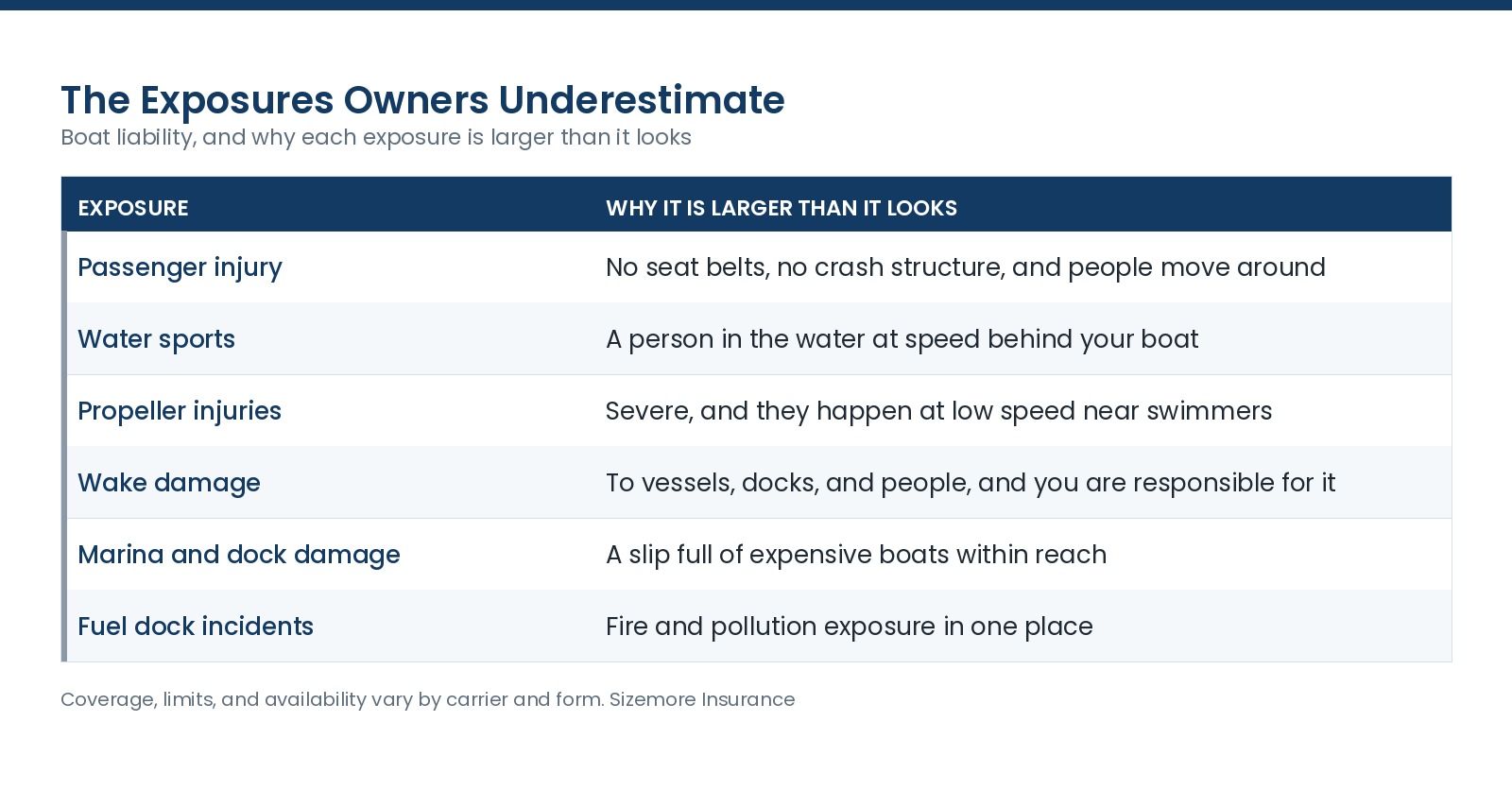
The takeaway: your passengers are your largest liability exposure, and they are usually people you know.
Coverage, limits, and availability vary by carrier and form. Review your own policy.
Minimum limits on a boat policy are not adequate for the exposure. A serious injury claim passes them quickly, and above the limit the claim reaches your assets.
Start at $300,000 to $500,000 on a modest boat with limited passenger capacity.
$500,000 or more on anything carrying multiple passengers, pulling skiers, or running in crowded water.
Add a personal umbrella above it, and confirm the watercraft is scheduled on it and that the underlying limit requirement is met. That last step gets missed constantly.
Add medical payments, which pays for injuries regardless of fault and resolves small incidents before they become claims against you. On a boat full of friends and family, that matters more than the dollar amount suggests.
Contributory negligence applies on the water as it does on the road.
If an injured party contributed to what happened, that can be a complete defense rather than a percentage reduction. That works in your favor when you are the one being claimed against.
It also means the facts decide cases, and on a boat the facts are frequently contested. What was the wake, who was where, was anyone drinking, was a proper lookout kept. Documentation and witness names matter.
It cuts the other way too. If you are injured by another operator and you contributed at all, your recovery from them may fail. That is an argument for your own uninsured boater coverage and medical payments, which is covered separately.
Alcohol is a factor in many boating incidents, and operating impaired raises both a legal problem and a potential coverage one.
Permissive use extends to people you let operate the boat, using your limits. Be deliberate about who runs it.
Operator age and education requirements exist. North Carolina applies a boating safety education requirement based on date of birth for operating vessels above a horsepower threshold. Confirm current requirements with the Wildlife Resources Commission.
Chartering or carrying passengers for hire is a commercial use and it is outside a personal policy.
An umbrella excludes business use, so it does not backstop that.
Rented or borrowed boats may or may not be covered by your policy. Ask before you rent one on vacation.
How much boat liability should I carry?
At least $300,000 on a modest boat and $500,000 or more on anything carrying passengers or pulling skiers, with an umbrella above it.
Are my passengers covered?
Injuries to passengers are generally within your liability coverage, and medical payments pays regardless of fault.
Is water skiing covered?
Frequently, and confirm it specifically. Not every form treats towed sports the same way.
Am I responsible for my wake?
Generally yes, and it is a real claim.
Does my umbrella cover boating?
Only if the watercraft is scheduled on it and the underlying limit requirement is satisfied.
What if I let a friend drive?
Generally covered as permissive use, using your limits. Be deliberate about it.
We have been an independent insurance company in North Carolina since 1977. Tell us what you run and who is usually aboard and we will size the liability to the exposure. Insurance made just for you.
Coverage, limits, and availability vary by carrier and form. Operating and education requirements are set by state agencies. Nothing here is legal advice. Review your own policy or talk to your advisor.