

This is the part of a flood policy that surprises people most, and it surprises them at the worst possible time.
Coverage for areas below grade under the federal program is limited to a defined list of essential building elements. Almost everything that makes a basement a living space, and almost everything you keep down there, is outside it.
The federal program treats an area as a basement when any floor is below ground level on all sides. That includes a finished basement, a walkout on a slope where the floor is still below grade on all sides, and the enclosed area beneath an elevated coastal home.
The last one catches coastal owners constantly. The ground level under a house on pilings is treated the same way a basement is.
Generally limited to essential building elements and certain equipment:
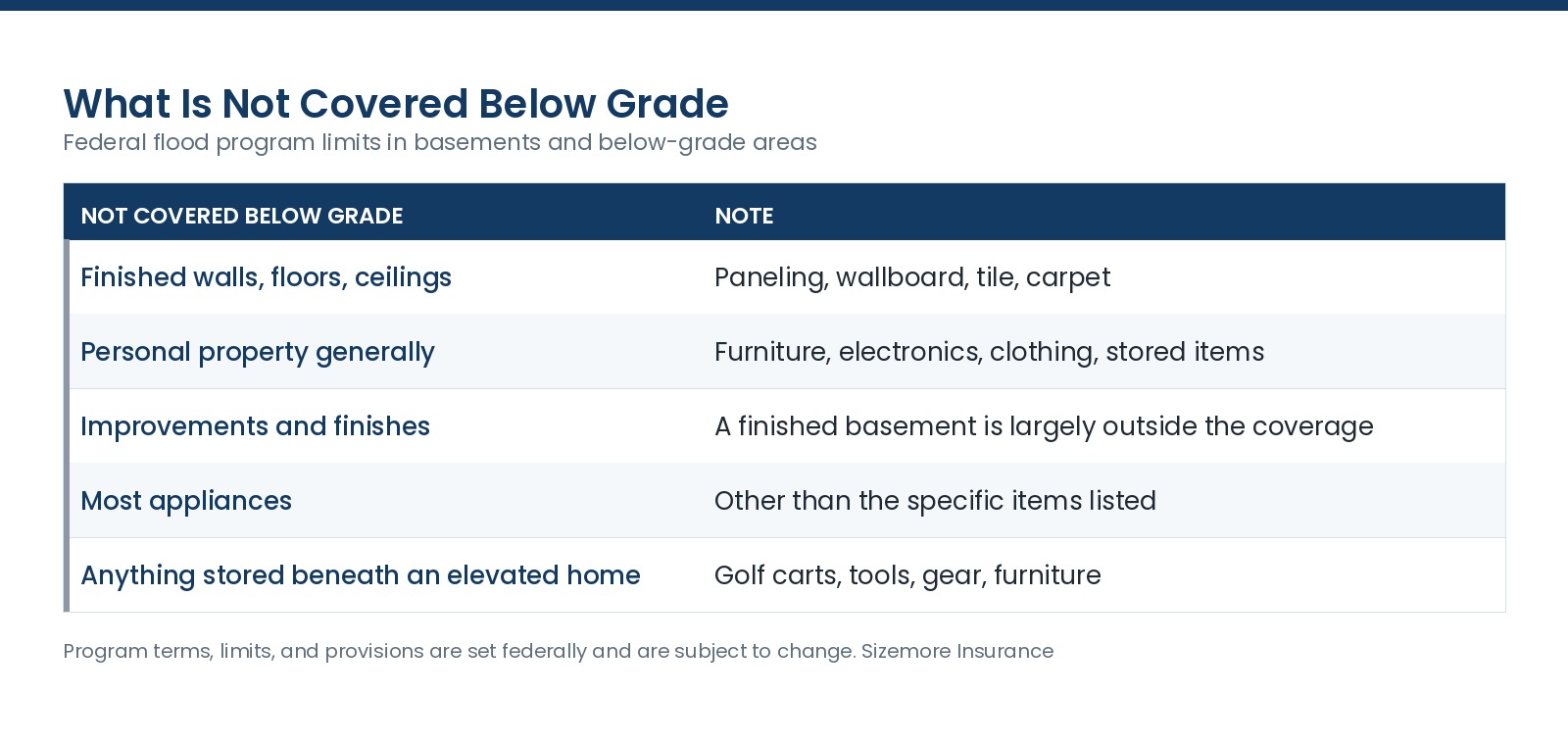
The takeaway: the program covers the building elements that make the structure function and very little of what makes a basement usable or what you keep there.
Program terms and provisions are set federally and are subject to change. Confirm current details.
Do not store anything you care about below grade. That is the whole lesson, and it applies to a finished basement in the Piedmont and to the space under a beach house equally.
A finished basement is largely an uninsured improvement against flood. If you are finishing one in an area with any flood exposure, know that going in.
Move what you can up. The furnace and water heater are covered where they are, and elevating them prevents the loss entirely and helps the rating.
Private flood may treat below-grade areas differently. Some policies are broader here, which is a specific reason to compare markets if you have a finished basement.
Under an elevated coastal home, the enclosure is generally limited to parking, access, and storage anyway, and finishing it can create a permit violation on top of a coverage gap.
A walkout basement can still be a basement under the definition if the floor is below grade on all sides. The way it looks is not the test.
A crawlspace is treated differently than a basement and the analysis is its own question. Ask.
Water backup is not flood. A sewer or drain backing up into a basement is a homeowners endorsement question rather than a flood one, and both can happen in the same event.
Sump pump failure is also not flood in most cases, and it is covered by the water backup endorsement.
Elevating utilities helps twice, through loss prevention and through flood rating.
A finished basement raises the property's replacement cost without adding much flood-covered value, which is worth understanding when setting limits.
Is my finished basement covered by flood insurance?
Largely not under the federal program. Essential building elements receive some coverage and finishes and personal property generally do not.
What about the furnace and water heater?
Those are among the covered items.
Is anything I store down there covered?
Very little. A clothes washer, dryer, and food freezer are among the few contents items reached.
Does this apply under an elevated beach house?
Yes. The enclosed area below the flood elevation is treated similarly.
Is a walkout basement still a basement?
If the floor is below ground level on all sides, generally yes.
Does private flood cover more?
Sometimes. It is a specific reason to compare markets if you have a finished basement.
We have been an independent insurance company in North Carolina since 1977. Tell us what is below grade and we will tell you what your policy would actually pay for. Insurance made just for you.
Program terms, definitions, and provisions are set federally and by private carriers and are subject to change. Review your own policy or talk to your advisor.