An owner acquires a two-story commercial building two blocks from the water and is pleased with the property quote. It came in well below what a neighboring owner described paying.
The policy excludes windstorm and hail.
Nothing was misrepresented. The exclusion is on the form, in the standard place, and the premium reflects it accurately. But on that coast, wind is the peril that actually arrives, and the building is uncovered against the loss it is most likely to have.
On a coastal commercial building, the first question is not what the policy costs. It is whether wind is in it.
Why Wind Gets Separated
Standard carriers price risk they can spread across a large, geographically diverse book. Hurricane wind does not spread. It concentrates on one coastline on one day and damages thousands of structures simultaneously.
In territories where that exposure concentrates, many carriers write the commercial property policy and exclude windstorm and hail. Wind is then written separately, frequently through one of the state’s residual market mechanisms.
North Carolina operates two, and they are routinely confused.
The North Carolina Insurance Underwriting Association, known as the Beach Plan, provides coverage in the beach and coastal areas where the standard market is thinnest. This is the wind market for barrier islands and the immediate coast.
The North Carolina Joint Underwriting Association, known as the FAIR Plan, provides coverage elsewhere in the state for property that cannot obtain coverage in the standard market for other reasons.
Both exist because the legislature decided property owners should have somewhere to go. Neither is intended to be a first choice.
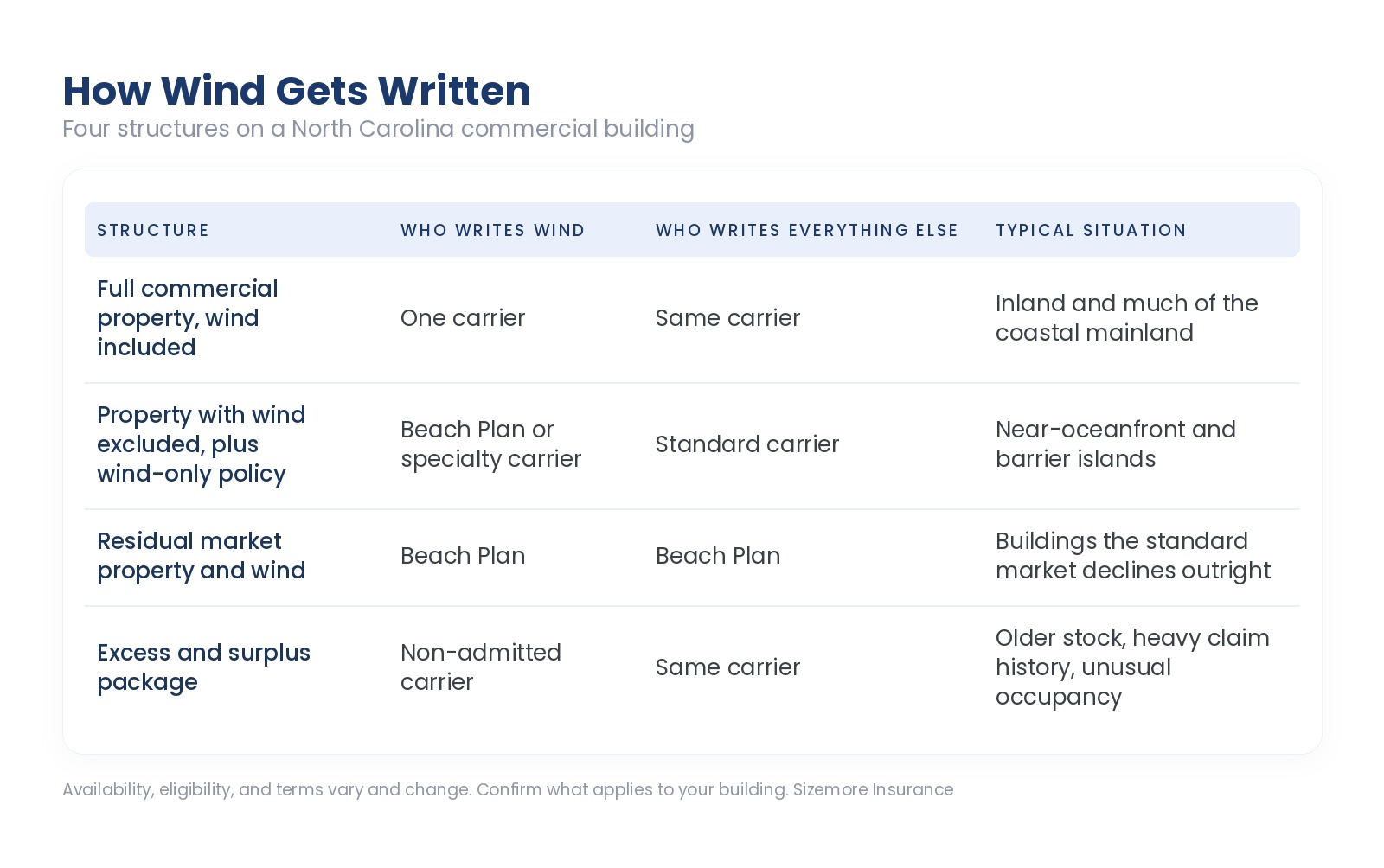
The takeaway: two coastal quotes are not comparable until you know whether wind is included and who is writing it. Premium alone tells you nothing about which structure you are buying.
Availability, eligibility, and terms vary and change. Confirm what applies to your building with your advisor.
What the Beach Plan Does and Does Not Do
What it does. It provides windstorm and hail coverage, and in some cases broader property coverage, on commercial buildings in territories the standard market has retreated from. It is a functioning market backstop and it pays claims.
What it does not do. It is not built to be as broad as a well-constructed standard commercial policy. Coverage limits are capped, which on a larger commercial building means the residual market alone may not reach your replacement cost. Business income and rental value coverage is more limited than what a standard carrier offers. And a wind-only policy generally carries no liability coverage, so that has to come from the companion policy.
What it is not. It is not a judgment about your building. Well-maintained, well-built commercial property sits in the Beach Plan for no reason other than location.
What we aim for. The standard market first, every time, because a single carrier writing the whole risk is simpler at renewal and much simpler at claim time. When two policies cover one building, a storm that produces wind damage and interior water damage involves two adjusters and an argument about which policy owns which damage. Where the standard market will not take the risk, the residual market is the correct answer and we place it there deliberately rather than reluctantly.
Where This Gets Complicated
Limit caps leave a layer uncovered. On a commercial building whose replacement cost exceeds the residual market’s maximum, the difference has to be covered by an excess wind policy in the surplus lines market. Owners who assume the Beach Plan covers the building in full frequently discover the cap at a total loss.
Business income and rental value need attention. Coverage for lost rent following a wind loss is more restricted in the residual market. On a leased commercial building this is a large exposure and it is worth understanding before a storm rather than after.
Two policies mean two deductibles. The wind policy carries its own deductible, frequently a percentage, and the companion property policy carries its own. A single storm can trigger both.
Wind-driven rain is the recurring dispute. Rain entering through an opening the wind created is generally covered. Rain entering through a pre-existing gap or a maintenance failure generally is not, and the difference is established by evidence. Dated photographs of your roof, flashing, and openings taken before a storm are worth more than any argument afterward.
Roof condition drives eligibility, not just price. In much of eastern North Carolina, roof age, material, and attachment method determine whether any carrier will write the building. A roof replacement is frequently the difference between having options and having one.
Liability can fall through the gap. If you end up with a wind-only policy plus a separate property policy, confirm that lessor’s risk only liability sits in one of them. It is not automatic on a wind form.
Flood is neither of these. Standard property and wind policies do not cover rising water or storm surge. Flood is a separate policy with a 30-day waiting period.
Common Questions
Is wind and hail included in my commercial property policy?
Inland, usually. On the coast, frequently not. Look for a windstorm and hail exclusion on the form and for a separate wind policy in your documents.
What is the difference between the Beach Plan and the FAIR Plan?
The Beach Plan, run by the North Carolina Insurance Underwriting Association, serves the beach and coastal areas. The FAIR Plan, run by the Joint Underwriting Association, serves the rest of the state. Both are residual markets.
Does the Beach Plan write commercial buildings?
Yes, subject to eligibility and to limit caps that matter on larger buildings.
Is residual market coverage worse than a standard policy?
It is narrower by design and capped. It is real coverage that pays real claims. Where a standard carrier will write your building, that is usually the better structure.
Can I get back into the standard market?
Sometimes, and roof work is usually the path. When an owner replaces a roof to enhanced wind standards, we re-market the risk. It does not always succeed and it is worth attempting at every renewal.
What if my building is worth more than the residual market will insure?
You layer excess wind coverage above it, typically in the surplus lines market. That structure needs to be built deliberately, because a gap between the two layers is invisible until a total loss.
The Bottom Line
- Confirm whether wind and hail is in your policy. If it is excluded and there is no separate wind policy, that is an immediate problem rather than a renewal item.
- If you are in the residual market, check the limit against your replacement cost. If there is a gap, layer excess wind above it.
- Verify where your liability coverage lives when the structure involves two policies.
- Look at your business income and rental value terms on the wind side specifically. This is where residual market coverage is narrowest and where a leased commercial building is most exposed.
- Photograph your roof and openings now, dated, before the next storm. It is the cheapest claim preparation available.
- Ask us annually whether the standard market has opened up. Markets move, and a new roof moves them faster.
Sizemore Insurance is an independent insurance company that has been placing coverage in North Carolina since 1977. We place coastal commercial property in the standard market where it will go and structure the residual market layers correctly where it will not. Insurance made just for you.
Coverage, availability, eligibility, limits, and residual market terms vary and are subject to change. Review your own policy or talk to your advisor.