There is no single answer, and that is not a dodge. What a trucking operation needs depends on four things: whether you have your own authority, what you haul, how far you run, and who else is in the truck or on the payroll.
Here is the full list, with the ones that are not optional marked as such.
The Core
Auto liability. Injury and property damage the truck causes to others. This is the coverage the federal filing attaches to and it is the one that determines whether you can legally haul. Interstate carriers are subject to federal minimum financial responsibility requirements that vary by weight and commodity, and most brokers and shippers require more than the federal minimum regardless.
Motor truck cargo. Your legal liability for the freight in your care. Subject to a commodity schedule, theft warranties, and exclusions. Most brokers require it.
Physical damage. Your own truck and trailer. Not federally required, generally required by lenders, and on equipment you could not replace out of pocket it is not optional in any practical sense.
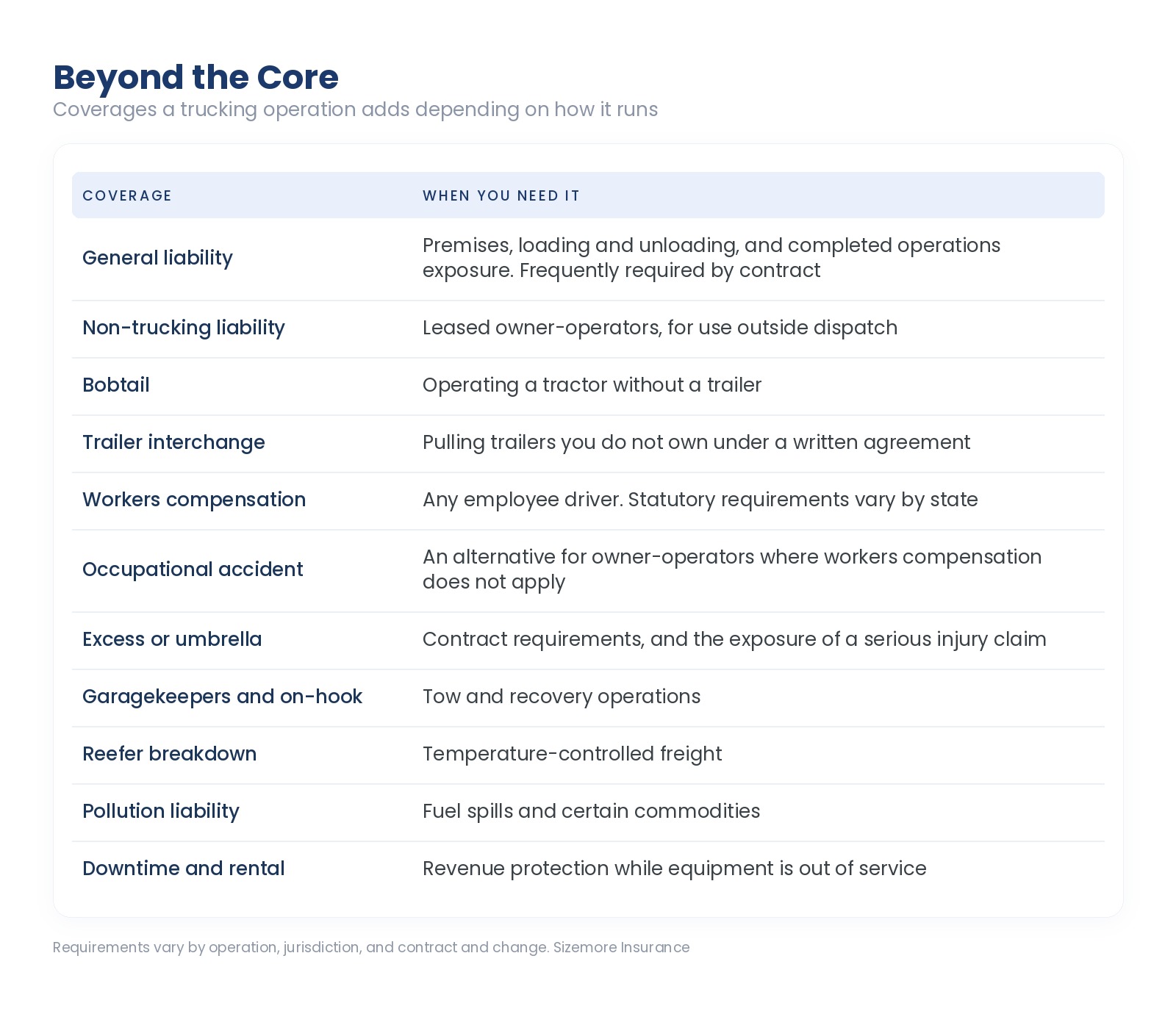
The takeaway: the three core coverages get you legal, and the contract requirements are usually what determine the rest.
Requirements vary by operation, jurisdiction, and contract and change. Confirm current requirements with FMCSA and the applicable state agency.
The Filings
Coverage and filings are different things and both have to be right.
The public liability filing, made by your insurer with FMCSA as evidence of your auto liability coverage at the required limit.
The MCS-90 endorsement, which guarantees payment to the public even where the policy would not respond. It is not coverage for you and it gets its own article.
The process agent filing, designating an agent for service of legal documents in each state where you operate.
Cargo filing, where applicable, depending on your operation and commodity.
Registration and tax filings including your USDOT number, the biennial update, apportioned registration, and fuel tax reporting, which are compliance rather than insurance and which sit next to it.
If a filing lapses, your authority is at risk. That is covered separately and it is the fastest way to shut down an operation.
How It Changes by Operating Model
A leased owner-operator. The motor carrier’s policy generally covers you while under dispatch. You typically need non-trucking liability, physical damage on your own tractor, and either occupational accident or workers compensation. What the carrier’s policy does and does not cover should be in the lease and it should be read.
An owner-operator with your own authority. You buy and file all of it. Auto liability, cargo, physical damage, and generally general liability, plus the filings.
A small fleet. Everything above, plus workers compensation on employee drivers, a driver approval process, and generally an excess layer as contract requirements rise.
Where This Gets Complicated
Broker and shipper contracts frequently require more than the federal minimum, commonly a higher auto liability limit and a specific cargo limit. Read the contract before you assume your program qualifies.
Your commodity schedule has to match what you actually haul. Hauling outside it is one of the most common ways a cargo claim fails.
Your radius has to match how you actually run. It is rated and frequently warranted.
Every driver has to be listed and approved. An unlisted driver is one of the fastest ways to lose a large claim.
Trailer interchange is not automatic. If you pull other people’s trailers, that coverage has to be there specifically.
Intrastate operations have their own requirements in both North Carolina and South Carolina alongside the federal ones.
A package from one carrier versus monoline coverages from several is a real decision with claim coordination consequences.
Common Questions
What is the minimum insurance required for a trucking company?
Interstate carriers are subject to federal financial responsibility minimums varying by weight and commodity. Most brokers and shippers require more, so the practical minimum is usually contractual rather than federal.
Do I need cargo insurance?
Practically yes. Most brokers require it, and it is your liability for the freight regardless.
Is physical damage required?
Not federally. Lenders generally require it, and on equipment you could not replace it is not optional in practice.
What is the difference between coverage and a filing?
Coverage is what the policy does. A filing is your insurer telling FMCSA that the coverage exists. Both have to be right.
Do I need workers compensation?
For employee drivers, statutory requirements apply and they vary by state. Owner-operators frequently use occupational accident instead, which covers less.
What happens if I haul something not on my schedule?
A cargo claim on that load can fail. Ask us to broaden the schedule before you take the freight.
The Bottom Line
- Get auto liability at the limit your contracts require, not just the federal minimum.
- Match your cargo limit and commodity schedule to what you actually haul.
- Confirm your radius reflects how you actually run.
- List and approve every driver before they are in the seat.
- Watch the filings as closely as the coverage, because a lapse threatens the authority itself.
- Read the broker contract before you haul, because that is where the real requirements live.
Sizemore Insurance is an independent insurance company founded in North Carolina in 1977, writing in both North Carolina and South Carolina. Send us your declarations pages and a recent broker packet and we will tell you whether your program meets what you have agreed to. Insurance made just for you.
Requirements, filings, and limits are set federally, by state, and by contract and are subject to change. Coverage varies by carrier and form. Nothing here is legal advice. Confirm current requirements with FMCSA and the applicable state agency, and review your own policies with your advisor.