A commercial property policy is not a warranty on a building. It is a contract that responds to defined causes of loss, subject to a stated limit, a valuation basis, a coinsurance requirement, and a list of exclusions.
Four settings decide what you actually collect. Most owners can name the limit and nothing else.
The Four Settings
The causes of loss form. Special form or named perils. This decides which events are covered at all and, just as importantly, who bears the burden of proof at claim time.
The valuation basis. Replacement cost or actual cash value. This decides whether depreciation is subtracted before payment.
The coinsurance percentage. Commonly 80, 90, or 100 percent. This decides whether you receive the full covered amount or a reduced share of it.
The limit. What the policy pays at most, and the number every other setting operates against.
Change any one of those four and the same fire produces a different check.
What Is Covered
The building. The structure, permanently installed fixtures, machinery and equipment permanently installed, and outdoor fixtures. Typically includes maintenance equipment and materials used to service the premises.
Business personal property. Contents you own. For a landlord this is usually modest: maintenance equipment, appliances, common-area furnishings. Tenants insure their own.
Property of others in your care. Limited coverage for property belonging to others while in your custody, subject to a sublimit.
Additional coverages built into most forms. Debris removal, preservation of property, fire department service charges, pollutant cleanup subject to a small annual sublimit, and increased cost of construction at a modest limit that is not a substitute for full ordinance and law coverage.
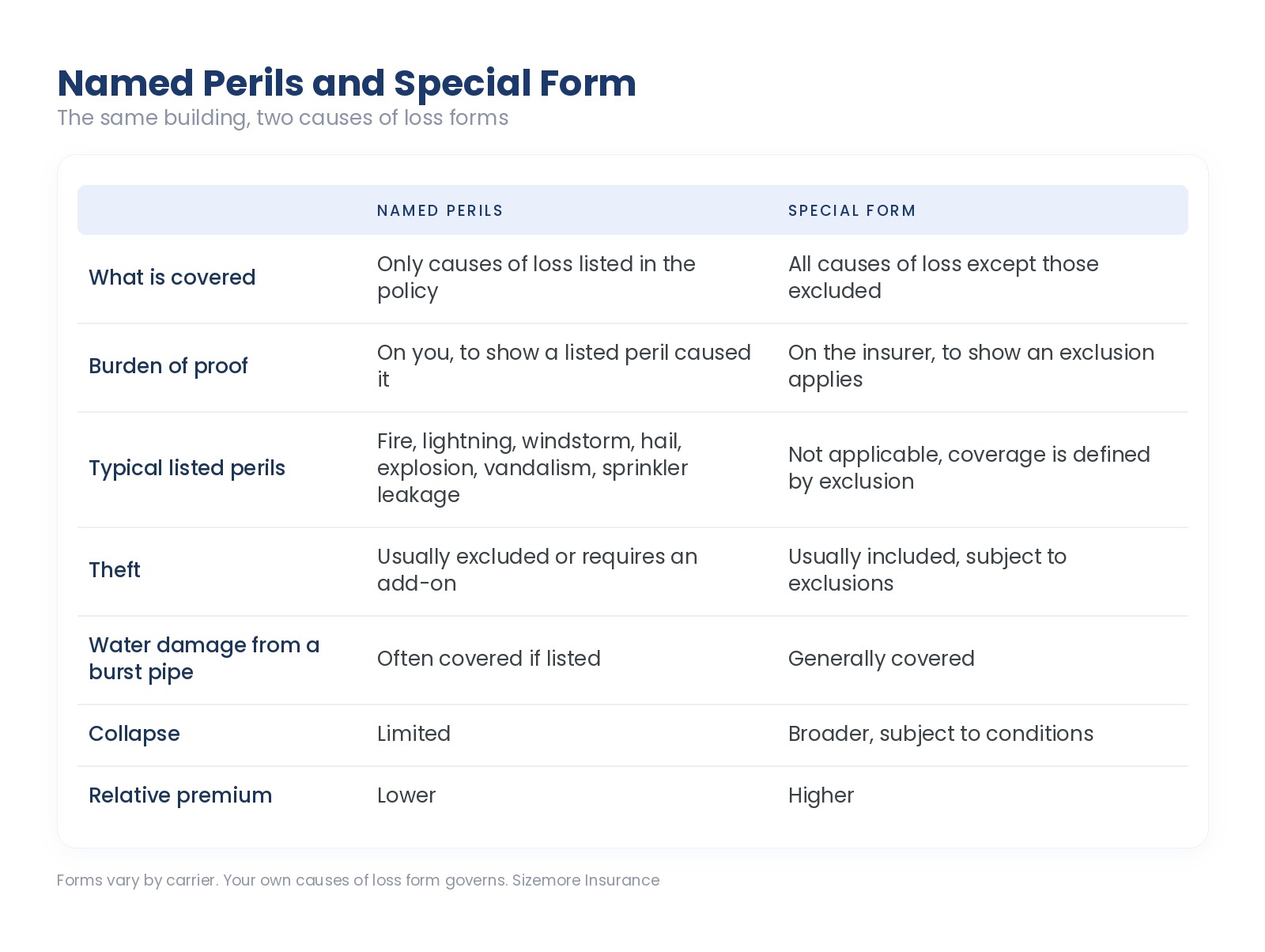
The takeaway: the burden of proof shift is worth more than the peril list. On a loss with an ambiguous cause, named perils puts the work on you and special form puts it on the insurer.
Forms vary by carrier. Your own causes of loss form governs. Review it with your advisor.
Special form is the right default on nearly any commercial building an owner intends to keep. Named perils shows up on older stock, vacant buildings, and risks the standard market has restricted, where it is sometimes the only option available.
What Is Not Covered
The exclusion list is where policies actually differ from one another. These are the ones that produce claims disputes on North Carolina commercial property.
Flood and surface water. Excluded categorically on standard commercial property policies. Rising water, storm surge, and mudflow require a separate flood policy. NFIP non-residential limits cap at $500,000 building and $500,000 contents, with a 30-day waiting period.
Earth movement. Settlement, sinkhole, landslide, and earthquake. Available by endorsement or separate policy.
Wear, tear, and deterioration. A roof at the end of its service life is not a claim. Gradual deterioration, rust, corrosion, and decay are maintenance.
Mechanical breakdown of the building’s own systems. HVAC, boilers, elevators, and electrical distribution failing on their own. Equipment breakdown coverage fills this and it is a separate endorsement or policy.
Ordinance and law. The base policy pays to rebuild what was there. It does not pay to bring the structure to current code. Most forms include a small increased cost of construction allowance that does not begin to cover the exposure on an older building.
Water damage from continuous seepage. Sudden discharge is generally covered. Slow leakage over weeks or months is not, and the resulting damage is frequently disputed.
Mold and fungus. Restricted to a low sublimit and generally only following an otherwise covered loss.
Pollution. Beyond a small cleanup sublimit, environmental exposure requires separate coverage.
Vacancy beyond the stated period. Not technically an exclusion but it functions as one. See below.
Where This Gets Complicated
Vacancy quietly rewrites the policy. Most commercial forms restrict coverage once a building has been vacant beyond a set period, commonly 60 days. Vandalism, sprinkler leakage, glass breakage, water damage, and theft typically drop out entirely, and remaining covered losses are reduced by a stated percentage. A building can meet the definition of vacant while partially leased, depending on how much of the square footage is being used for customary operations. Read the definition, not the word.
The roof may settle differently from the building. A roof payment schedule endorsement pays roof damage on an actual cash value basis by age, inside a policy that otherwise settles at replacement cost. Cosmetic damage exclusions separately carve out hail dents that affect appearance but not function. Both are frequently seen in North Carolina and both sit in the endorsement list rather than on the declarations page summary.
Replacement cost arrives in two payments. The carrier typically issues the actual cash value amount first and releases the remaining depreciation after the work is completed and documented. If you do not complete the repair, the holdback is generally not paid, which converts a replacement cost policy into an actual cash value outcome.
Named storm and wind deductibles are separate from the everyday deductible. Frequently a percentage of the building limit. A loss below that threshold produces no recovery regardless of coverage.
Tenant improvements are contested territory. Whether the landlord’s policy or the tenant’s policy rebuilds a buildout after a loss depends on the lease and on how each policy is written. Assuming the other party has it handled is how both parties end up uncovered.
A theft loss on a vacant unit is the classic denial. Copper, HVAC condensers, and appliances disappear from empty space, the vacancy provision has already removed theft coverage, and the owner learns both facts at the same time.
Common Questions
Does commercial property insurance cover flood?
No. Standard commercial property policies exclude it. Flood requires a separate policy, and NFIP carries a 30-day waiting period plus non-residential limits of $500,000 building and $500,000 contents.
Does it cover my tenants’ property?
No. Tenants insure their own contents and their own improvements, subject to what the lease assigns. Your policy covers the building and your own business personal property.
What is the difference between special form and named perils?
Named perils covers only what is listed. Special form covers everything except what is excluded, and it shifts the burden of proof to the insurer.
Does it cover the roof if it is just old?
No. Wear and deterioration are excluded. Storm damage to a roof is covered, subject to your deductible and to any roof payment schedule in the policy.
What happens if my building sits vacant?
Most forms restrict coverage past a set vacancy period, commonly 60 days. Several perils drop out and remaining losses are reduced. A vacancy permit endorsement or a vacant building policy addresses it, arranged before the vacancy.
Is equipment breakdown included?
Generally not in a base property policy. Sudden mechanical or electrical failure of the building’s systems requires equipment breakdown coverage.
The Bottom Line
- Find your causes of loss form. If it says named perils on a building you intend to hold, ask what special form costs.
- Verify the valuation basis on the building and on the roof separately. They are frequently different.
- Read the endorsement list, not the coverage summary. The declarations page tells you your limits. The endorsements tell you what the policy actually does.
- Add ordinance and law on anything predating current code. The built-in increased cost of construction allowance is not sufficient on older stock.
- Add equipment breakdown on any building with rooftop HVAC, a boiler, or an elevator.
- Buy flood if there is any water exposure, and buy it outside hurricane season because of the waiting period.
Sizemore Insurance is an independent insurance company that has been placing coverage in North Carolina since 1977. Bring us your declarations page and endorsement list and we will tell you which of the four settings above are working against you. Insurance made just for you.
Coverage, forms, exclusions, and endorsement availability vary by carrier. Your own policy language governs. Review your declarations page or talk to your advisor.