

The hardest conversation I have on an auto claim is not about coverage. It is about value.
A car gets totaled, the carrier offers a number, and it is less than the client expected. Almost always the policy is working correctly and the expectation was built on the wrong number.
A personal auto policy pays actual cash value, meaning what your vehicle was worth immediately before the loss.
It does not pay what you paid for it. It does not pay what you still owe. It does not pay what a replacement costs at a dealer today. It pays what yours was worth, in its condition, with its mileage, in this market.
That is why gap coverage exists, and why a loan balance above the vehicle's value is a real exposure on any financed car.
A vehicle is generally declared a total loss when the cost to repair it, sometimes combined with its salvage value, exceeds a threshold relative to its value. North Carolina also defines when a vehicle must receive a salvage title based on damage relative to value.
Thresholds and titling rules are set by state law and carrier practice and are subject to change. Confirm current rules with NCDMV.
The practical point: a car can be totaled while still looking repairable, particularly an older vehicle where the repair cost is high relative to a modest value.
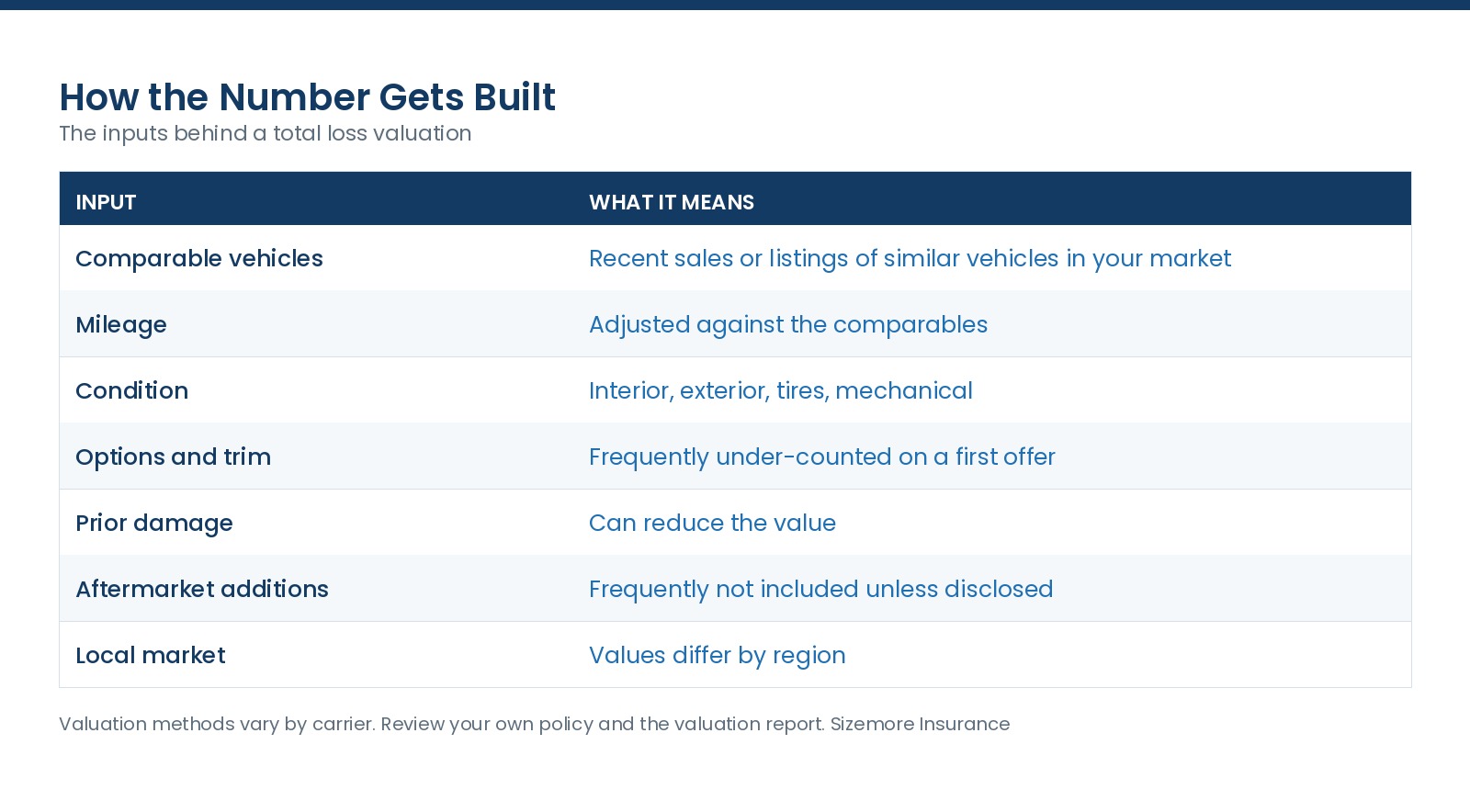
The takeaway: the offer is built from comparables, and comparables are contestable. That is where a challenge starts.
Valuation methods vary by carrier. Review your own policy and the valuation report.
Ask for the valuation report. You are entitled to see how the number was built, including which comparable vehicles were used.
Check the comparables. Are they actually comparable in trim, mileage, drivetrain, and condition? Are they from your market? Are the mileage adjustments reasonable?
Find better comparables yourself. Recent listings for the same year, trim, and mileage in your area. Print them.
Document the condition and the options. New tires, recent maintenance, a trim package, a tow package, upgraded wheels. Photographs and receipts.
Disclose aftermarket additions. They are frequently not included unless someone raises them, and coverage for them varies by policy.
Ask about taxes and fees. In many situations a total loss settlement includes applicable sales tax and title and registration fees, since those are part of replacing the vehicle. Ask specifically.
Be reasonable and be documented. Adjusters adjust numbers on evidence, not on frustration.
Gap coverage fills the loan shortfall. If you owe more than the car is worth, the policy pays the value and gap coverage addresses the difference. Without it, that difference is yours and the car is gone.
You can sometimes retain the salvage. The settlement is reduced by the salvage value and the vehicle receives a branded title. That has consequences for future insurability and resale, so think it through.
Your deductible applies on a collision or comprehensive total loss, and it generally comes back if the other party is found at fault and their carrier pays.
Rental coverage runs on a clock. Total loss claims frequently take longer than repairs, and rental reimbursement has limits.
Diminished value is a different claim and it applies to a repaired vehicle rather than a totaled one.
A leased vehicle has its own math, and the lease agreement governs what you owe. Gap coverage is frequently built into a lease and it is worth confirming rather than assuming.
Prior damage matters both ways. Undisclosed prior damage can reduce the offer, and documented repairs can support the condition.
How is my car's value determined?
From comparable vehicles in your market, adjusted for mileage, condition, options, and trim.
Why is the offer less than I owe?
Because the policy pays what the car was worth, not what you owe. That difference is what gap coverage addresses.
Can I dispute the offer?
Yes. Ask for the valuation report, check the comparables, and provide better ones with documentation.
Do I get sales tax back?
In many situations a total loss settlement includes applicable sales tax and fees. Ask specifically.
Can I keep the car?
Sometimes, with the settlement reduced by salvage value and a branded title. Consider the resale and insurability consequences.
Does my deductible come back?
Generally, if the other party is found at fault and their carrier pays.
Sizemore Insurance is an independent insurance company serving North Carolina since 1977. Send me the valuation report and I will read the comparables with you. Insurance made just for you.
Valuation methods, total loss thresholds, titling rules, and settlement practices vary by carrier and state law and are subject to change. Nothing here is a coverage determination. Review your own policy or talk to your advisor.