

After Florence I stood in a house where the roof was gone over the back bedroom and there was a mud line four feet up the walls on the first floor.
Two losses, one storm, two policies, two adjusters, and a genuine question about which damage belonged to which.
The homeowner thought of it as hurricane damage. The policies do not have a category called hurricane damage. Understanding how this gets divided before a storm is what determines how much of it gets paid afterward.
Wind is your homeowners or windstorm policy. Roof damage, siding, windows, trees down, and rain that entered through an opening the wind created.
Water that rose is your flood policy. Storm surge, a creek or sound out of its banks, and water flowing across the ground into the house.
That is the entire test: did the water fall from above or rise from below.
It sounds simple and it is the source of most post-hurricane disputes, because after a storm a house frequently has both and the physical evidence gets cleaned up before anyone documents which was which.
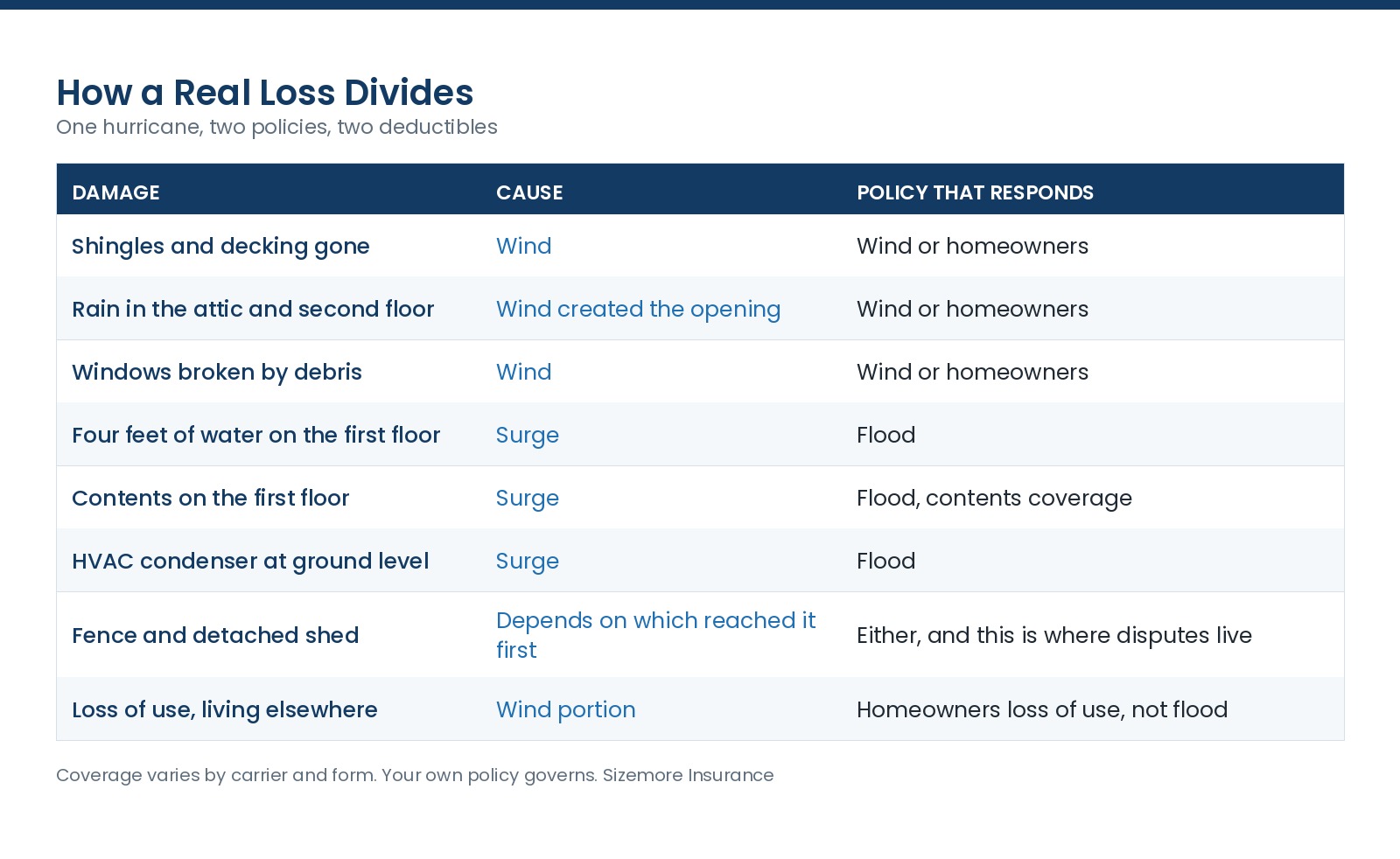
The takeaway: the same house produces two claims with two deductibles, and neither policy covers the other's damage. A house with no flood policy and four feet of surge has an uncovered first floor no matter how good the homeowners policy is.
Coverage varies by carrier and form. Your own policy governs.
That loss of use line deserves attention. The federal flood program does not pay additional living expense on a residential policy. If your house is uninhabitable because of surge rather than wind, the cost of living somewhere else may not be covered anywhere. Some private flood policies include it, which is one of the better reasons to look beyond the federal program.
This is the provision that decides the hard cases, and homeowners have generally never heard of it.
Most policies contain language addressing what happens when a covered cause and an excluded cause combine to produce a loss. Where flood is one of the causes, that language frequently resolves in favor of the exclusion.
Practically, that means a portion of a house damaged by both wind and rising water can end up outside the wind policy. It is not a reason to argue after a storm. It is a reason to carry flood coverage so the question is about which policy pays rather than whether anything does.
Evidence, and most of it has to exist before the storm.
Two deductibles apply. Your named storm deductible on the wind side, frequently a percentage of the dwelling limit, and your flood deductible. Both come out of your pocket in the same event.
Contents get divided too. Belongings damaged by wind-driven rain upstairs and belongings destroyed by surge downstairs are on different policies with different limits and different valuation rules. The federal program pays residential contents at actual cash value.
Mold follows both and is restricted on both. Coverage turns heavily on how quickly drying began, which is why mitigation in the first day or two matters more than any argument later.
Your ground level may be largely uncovered. On an elevated coastal home, the federal program covers very little in an enclosed area below the flood elevation. Contents down there are generally not covered.
Adjusters after a regional storm are working volume. The homeowner who arrives organized, with photographs and a timeline, is settled faster and more completely. That is not a criticism of adjusters. It is arithmetic.
Flood has a 30-day waiting period. Which means the decision about whether you will have a flood claim was made a month before the storm was named.
Is storm surge covered by homeowners insurance?
No. Surge is rising water, which is flood, and no homeowners policy covers it.
Is wind-driven rain covered?
Generally yes if wind created the opening it came through, and generally not if it entered through a pre-existing gap or a failed roof.
Do I pay two deductibles after a hurricane?
If you have both a wind claim and a flood claim, yes.
Does flood insurance pay for a hotel?
The federal residential program generally does not include additional living expense. Some private flood policies do. Your homeowners loss of use coverage responds to the wind portion.
What if the adjusters disagree about which damage is which?
This is why the mud line photograph and a written timeline matter. Documentation resolves what argument cannot.
I do not have flood insurance and the water rose. What now?
There is no coverage for that portion. It is the most painful conversation in this business, and the 30-day waiting period means the only fix is before the season.
We have been an independent insurance company in North Carolina since 1977, and I have handled more of these split claims than I would like to count. Call us when it happens and we will help you divide it correctly. Insurance made just for you.
Coverage, exclusions, and program terms vary by carrier and form and are subject to change. Nothing here is a coverage determination. Review your own policy or talk to your advisor.