Restaurants get surprised by workers compensation audits more than any other class of business I work with.
The reason is structural. Premium is estimated at binding on projected payroll, and it is trued up at year end on actual payroll and actual classifications. A restaurant that grew, or that classified payroll incorrectly, gets a bill. Sometimes a large one, arriving at a moment when nobody planned for it.
How the Premium Is Built
Payroll, by classification.
Class codes, which assign a rate per hundred dollars of payroll. Kitchen and service roles classify differently, and the rates differ meaningfully.
The experience modifier, which adjusts your premium up or down based on your claims history compared to similar businesses.
Applicable credits and adjustments.
Estimated at the start, actual at the end. The audit reconciles them.
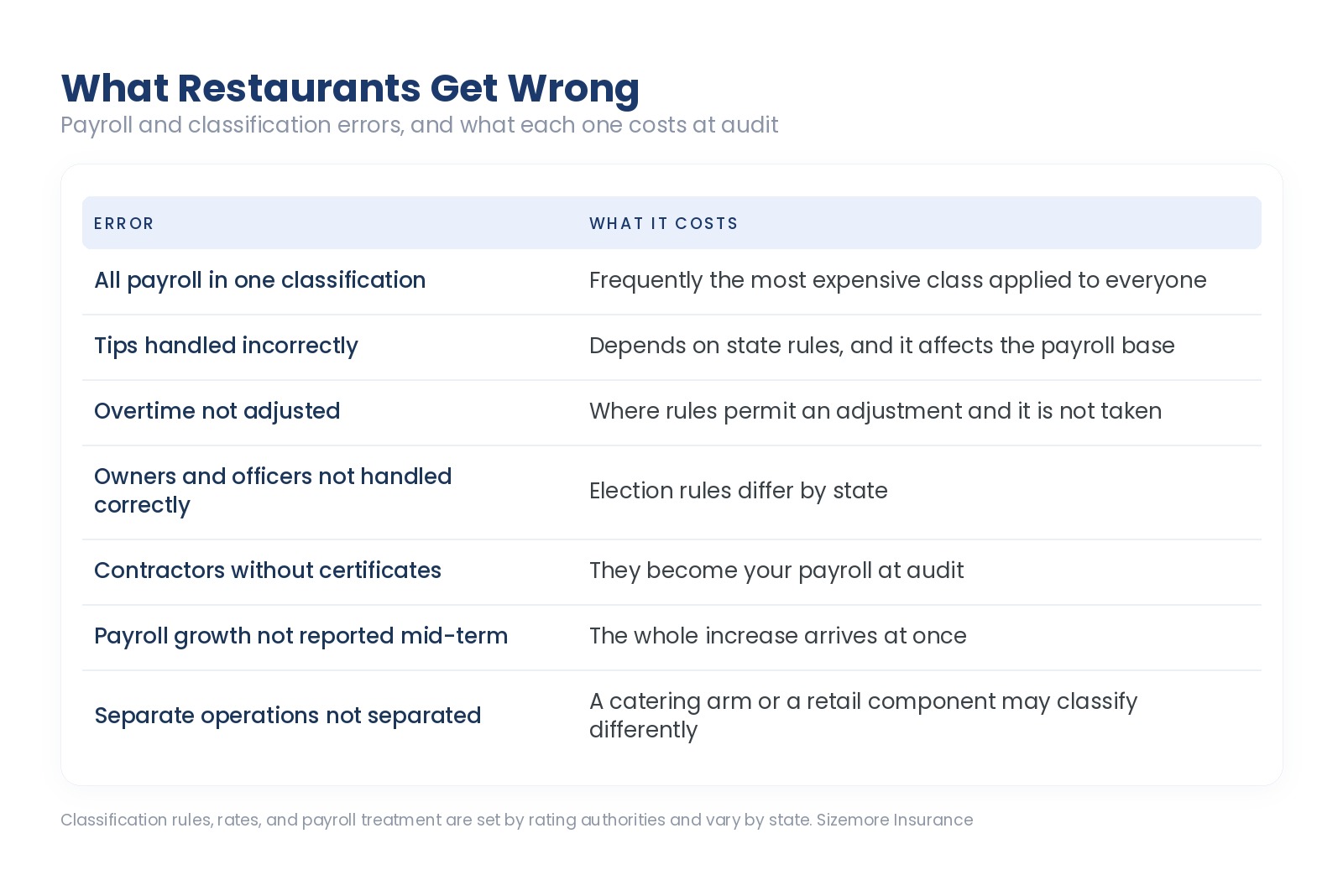
The takeaway: putting all payroll in one class code is one of the most expensive and most common errors, because the auditor applies the classification that fits rather than the one you assumed.
Classification rules, rates, and payroll treatment are set by rating authorities and vary by state and are subject to change. Confirm with your advisor.
Uninsured Contractors Become Your Payroll
This one catches restaurants regularly.
If you use a contractor and cannot produce a current certificate of insurance showing their workers compensation coverage, that contractor’s payments can be treated as your payroll at audit and charged accordingly.
A cleaning crew, a handyman, a delivery contractor, a musician, or a maintenance vendor. Any of them without a certificate becomes an audit line item.
Collect certificates before the work, file them, and track expiration dates. That habit is free and it prevents a specific and avoidable charge.
Preparing for the Audit
Keep payroll records by classification throughout the year rather than reconstructing them.
Separate kitchen from service payroll in your records if the classifications differ.
Document overtime so any permitted adjustment can be taken.
Collect and file certificates from every contractor.
Report payroll growth mid-term rather than absorbing it at audit. A midterm adjustment is manageable and a year of growth arriving at once is not.
Review the audit before you pay it. Auditors make errors, classifications get applied broadly, and a review is worth doing.
Ask us to sit in. We can review the results and dispute what is wrong.
Where This Gets Complicated
Officers and owners have election and inclusion rules that differ between North Carolina and South Carolina.
Tipped wages are treated according to rules that vary, and getting the payroll base wrong affects the whole calculation.
A disputed audit has a process and it has deadlines.
The experience modifier lags, which means a good year improves your position later rather than immediately, and a bad year does the same.
Pay-as-you-go programs tie premium to actual payroll each period, which reduces the audit surprise. They fit seasonal and variable payroll well and they have their own considerations.
Seasonal operations should expect the audit to reflect the season rather than an average, and estimating on an average produces a year-end bill.
Common Questions
Why did I get a bill after my policy ended?
The audit reconciled estimated payroll against actual. If payroll grew or classifications were wrong, the difference is billed.
What is the most common error?
Putting all payroll in one classification. Kitchen and service roles classify differently.
Do tips count as payroll?
Treatment varies by rule and by state. Confirm how yours are handled, because it affects the base.
What happens if my contractor has no insurance?
Their payments can be treated as your payroll at audit and charged accordingly.
Can I dispute an audit?
Yes, and there is a process with deadlines. Have us review it.
How do I avoid a surprise?
Keep records by classification, report growth mid-term, and collect contractor certificates.
The Bottom Line
- Keep payroll records by classification all year rather than at audit time.
- Collect a certificate from every contractor before the work, and track expirations.
- Report payroll growth mid-term, because a year of it arriving at once is the surprise.
- Review the audit before paying it, and ask us to look at it with you.
- Confirm how officers and tips are handled in your state.
- Ask about pay-as-you-go if your payroll is seasonal or variable.
Sizemore Insurance is an independent insurance company founded in North Carolina in 1977, writing in both North Carolina and South Carolina. Send us your audit before you pay it and we will tell you whether the classifications are right. Insurance made just for you.
Classification rules, rates, payroll treatment, and dispute procedures are set by rating authorities and vary by state and are subject to change. Nothing here is legal or accounting advice. Review your own situation with your advisor.