Most restaurants lease their space, which means the property conversation splits into two parts and the second one gets undervalued routinely.
The building is the landlord’s. Everything you put into it is yours.
What Your Policy Covers
Business personal property. Equipment, furniture, fixtures, small wares, inventory, and the point of sale system.
Tenant improvements and betterments. The buildout. Kitchen infrastructure, hoods, walk-ins, plumbing, electrical, flooring, finishes, bar construction, and everything else you paid to install in a space you do not own.
Signage, subject to how it is written and where it is located.
Outdoor property, with its own frequently modest sublimits.
Under most commercial leases the improvements you paid for are your insurable interest even though they are physically part of the landlord’s building.
Why the Buildout Gets Undervalued
Three reasons, all of them ordinary.
Owners think of it as the landlord’s building. It is attached, so it feels like theirs. It is not.
The number is large and easy to round down. A full restaurant buildout runs into serious money and a rough estimate is frequently low.
It gets set at opening and never revisited. Construction costs rose substantially and a limit set four years ago does not reflect what it would cost to rebuild today.
The consequence is coinsurance, and it has its own article, and it is worth stating here: coinsurance reduces claim payments proportionally when you are underinsured, and it applies to partial losses rather than only total ones. Most restaurant claims are partial.
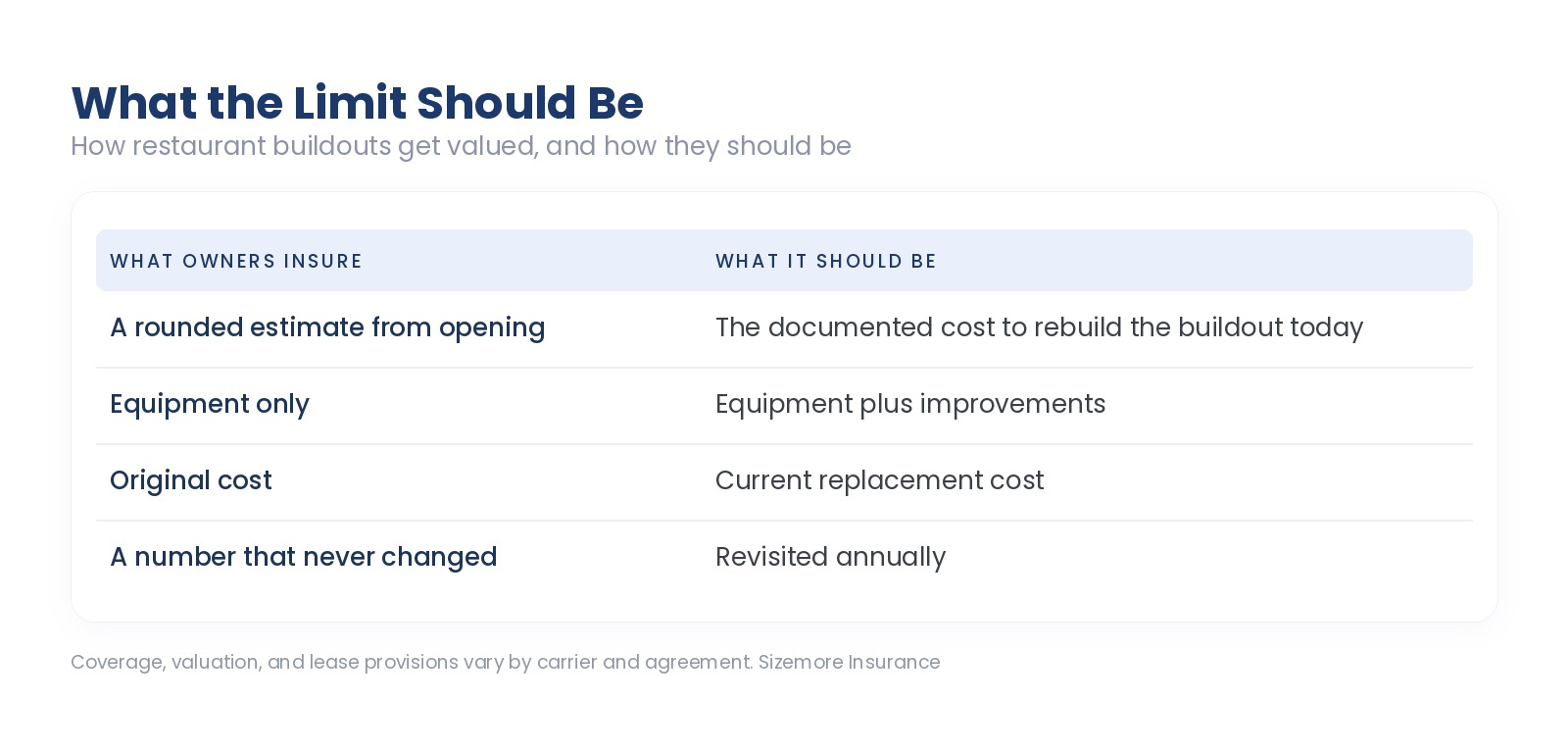
The takeaway: keep your buildout invoices and use them, because the documentation is what makes the number defensible.
Coverage, valuation, and lease provisions vary by carrier and agreement. Read your own lease and policy.
The Settings That Matter
Replacement cost versus actual cash value. Replacement cost pays to replace without depreciation. Actual cash value depreciates, and on kitchen equipment that is a substantial difference.
Special form versus named perils. Special form covers everything not excluded. Named perils covers only what is listed, and the burden of proving the cause shifts to you. That comparison has its own article and special form is generally worth the difference.
Agreed value, which suspends the coinsurance requirement where available. On a buildout that is hard to value precisely, this is a real solution and it is worth asking about.
Inflation guard, which increases the limit automatically and which lags actual construction cost movement.
The deductible, which on a restaurant is worth setting deliberately.
Where This Gets Complicated
The lease may require you to insure things you did not expect, including in some cases the landlord’s building or specific improvements. Read it.
Landlord improvements versus tenant improvements is a distinction the lease draws, and knowing which is which matters at a claim.
Equipment you lease rather than own raises a question about whose coverage applies.
Leasehold interest coverage addresses the value of a favorable lease you would lose if the building were destroyed, which is a real exposure in a rising rent market and few tenants carry it.
Signage sublimits are frequently low relative to what a restaurant sign costs.
Outdoor seating, patios, and fencing carry their own sublimits.
A total loss of a leased space raises the question of whether you rebuild, and business income and leasehold interest both come into it.
Common Questions
Do I have to insure my buildout?
Under most commercial leases the tenant improvements are your insurable interest. Yes.
How do I value it?
From your buildout invoices, adjusted to what it would cost to rebuild today.
What happens if I underinsure it?
Coinsurance reduces claim payments proportionally, including on partial losses.
Should I carry replacement cost?
On kitchen equipment and improvements, generally yes. Actual cash value depreciates substantially.
What is agreed value?
An option that suspends the coinsurance requirement. Worth asking about on a buildout.
Is my leased equipment covered?
It depends on the lease and the policy. Ask.
The Bottom Line
- Keep the buildout invoices and use them to set the limit.
- Insure improvements at current replacement cost, not at what you spent four years ago.
- Ask about agreed value to remove the coinsurance question.
- Choose special form over named perils unless there is a specific reason not to.
- Check your signage and outdoor sublimits.
- Revisit the limit annually, because construction costs moved.
Sizemore Insurance is an independent insurance company founded in North Carolina in 1977, writing in both North Carolina and South Carolina. Send us your buildout costs and your lease and we will set the property limits correctly. Insurance made just for you.
Coverage, valuation options, sublimits, and lease provisions vary by carrier and agreement and are subject to change. Nothing here is legal advice or a coverage determination. Review your own lease and policy or talk to your advisor.