The walk-in compressor fails on a Saturday night. Sunday morning there is eight thousand dollars of product on the floor and a cooler that needs a new compressor.
Property coverage handles neither of those, and that surprises people every time.
Why Property Does Not Respond
Commercial property policies cover damage from external causes. Fire, wind, water, theft, impact.
They generally exclude mechanical breakdown, meaning equipment failing on its own. A compressor that quits, a motor that burns out, an electrical arc inside a panel. Those are the machine failing rather than something happening to it.
That exclusion is why equipment breakdown coverage exists.
The Two Coverages
Equipment breakdown covers the sudden and accidental breakdown of equipment: refrigeration, cooking equipment, HVAC, electrical systems, water heaters, and building systems. It pays to repair or replace the failed equipment and frequently covers resulting damage.
Spoilage covers the food and inventory lost as a result. It is a separate coverage with its own limit, and it can respond to both an equipment failure and a power outage depending on how it is written.
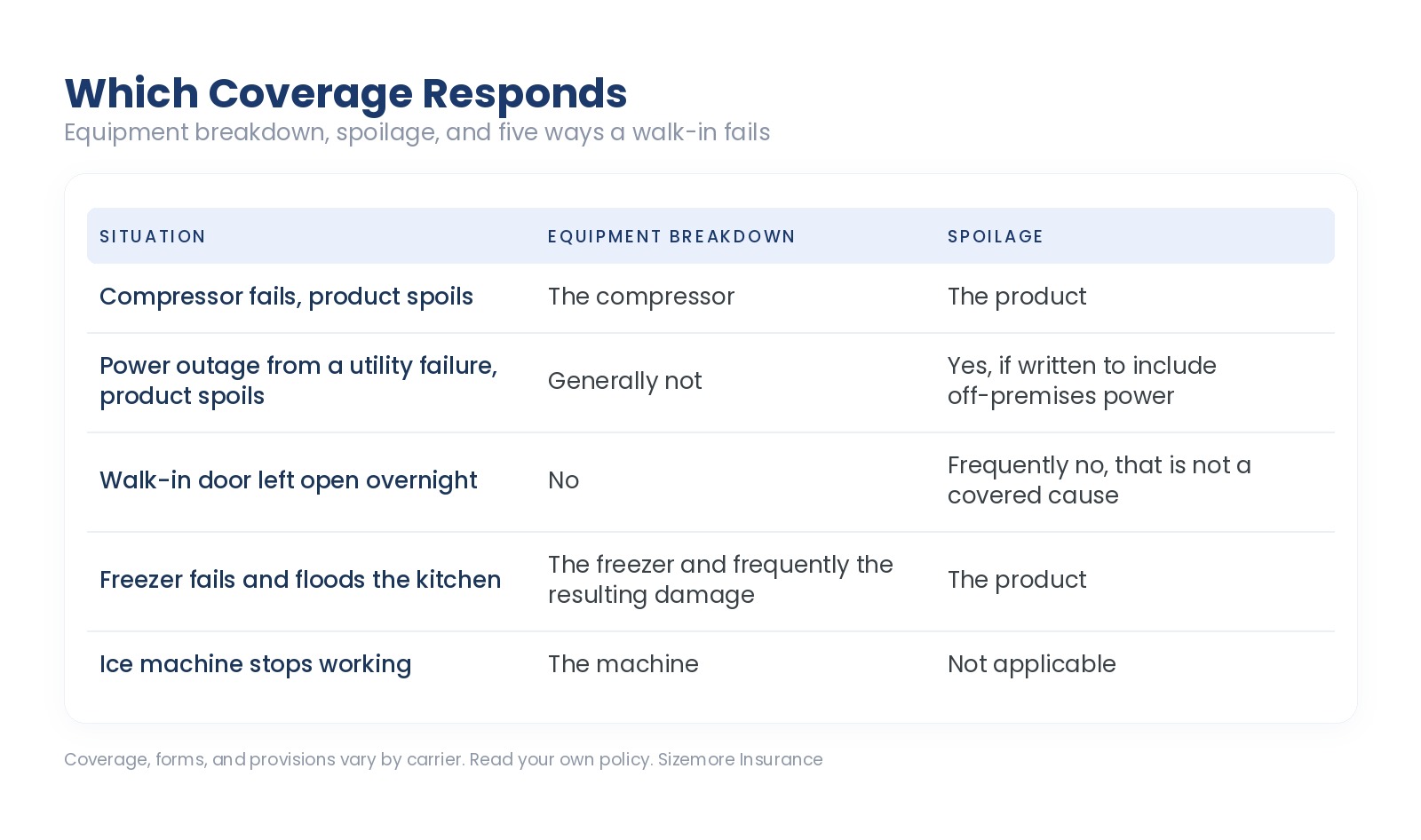
The takeaway: equipment breakdown covers the machine, spoilage covers what was inside it, and both are add-ons rather than standard.
Coverage, forms, and provisions vary by carrier. Read your own policy.
The Settings That Matter
Whether spoilage includes off-premises power failure. This is the important one. A utility outage is not an equipment breakdown, and whether your spoilage coverage reaches it depends on how it is written. In a state with the storm exposure this one has, that question matters.
The spoilage limit. A full walk-in and freezer of product is more than owners estimate. Count it.
Whether refrigeration maintenance is a condition. Some forms require it.
Whether business income is included. Equipment breakdown forms frequently include business income and extra expense for a covered breakdown, which is a meaningful benefit and worth confirming.
The deductible, which can be separate from your property deductible.
Where This Gets Complicated
Utility interruption is a third coverage. Business income losses from an off-premises utility failure require utility interruption coverage, which is separate from spoilage. A power outage can produce both a product loss and a closure, and they are covered by different things.
Wear and tear is excluded either way. Equipment that reached the end of its life is a capital expense.
Older equipment may face conditions or exclusions with some carriers.
Rented and leased equipment raises a question about whose coverage applies.
Refrigeration monitoring with alerts is inexpensive and it prevents the overnight failure that produces the largest spoilage claims.
A breakdown that closes you brings business income into it, and whether it comes from the equipment breakdown form or the property form matters.
Documentation of the loss is a product count, and doing it before disposal is what supports the claim.
Common Questions
Does property insurance cover equipment breakdown?
Generally not. Mechanical breakdown is excluded and it requires a separate coverage.
Is spoilage included in equipment breakdown?
They are separate coverages that work together. Confirm you have both.
Does spoilage cover a power outage?
Only if it is written to include off-premises power failure. Ask specifically.
What limit should I carry on spoilage?
Count a full walk-in, freezer, and dry storage at replacement cost. It is frequently more than owners estimate.
Does equipment breakdown cover lost income?
Many forms include business income and extra expense for a covered breakdown. Confirm yours.
What prevents the biggest claims?
Refrigeration monitoring with alerts, which catches an overnight failure before the product is gone.
The Bottom Line
- Add both coverages, because property covers neither.
- Confirm spoilage includes off-premises power failure.
- Count your actual inventory and set the limit to it.
- Ask whether business income is included in the equipment breakdown form.
- Install refrigeration monitoring with alerts, which is inexpensive loss control.
- Document the product before disposal, because that is the claim.
Sizemore Insurance is an independent insurance company founded in North Carolina in 1977, writing in both North Carolina and South Carolina. Tell us what is in your walk-in and we will size the coverage to it. Insurance made just for you.
Coverage, forms, provisions, and limits vary by carrier and are subject to change. Nothing here is a coverage determination. Review your own policy or talk to your advisor.