A kitchen fire closes a restaurant for four months.
The property coverage rebuilds the kitchen. The rent keeps running, the key staff have to be paid or they go somewhere else, the loan payment does not pause, and the revenue is zero.
Business income is what covers that gap, and on the margins most restaurants operate at, it is frequently the coverage that determines whether the restaurant reopens at all.
What It Covers
Lost net income you would have earned during the period of restoration.
Continuing expenses that do not stop when you close: rent, loan payments, insurance, and the payroll you choose to maintain.
Extra expense, which is a related coverage paying the additional costs of getting back faster or staying partially open. A temporary location, expedited equipment, rented replacement equipment, or a food truck operating while the dining room is rebuilt.
Extra expense frequently earns its premium many times over, because reducing the closure by six weeks is worth more than the coverage costs.
The Three Settings
The limit. How much coverage you have.
The period of restoration. How long it pays, which runs from the loss until the property should be repaired with reasonable speed, subject to any stated maximum.
The structure. How the limit is made available, and there are three common approaches.
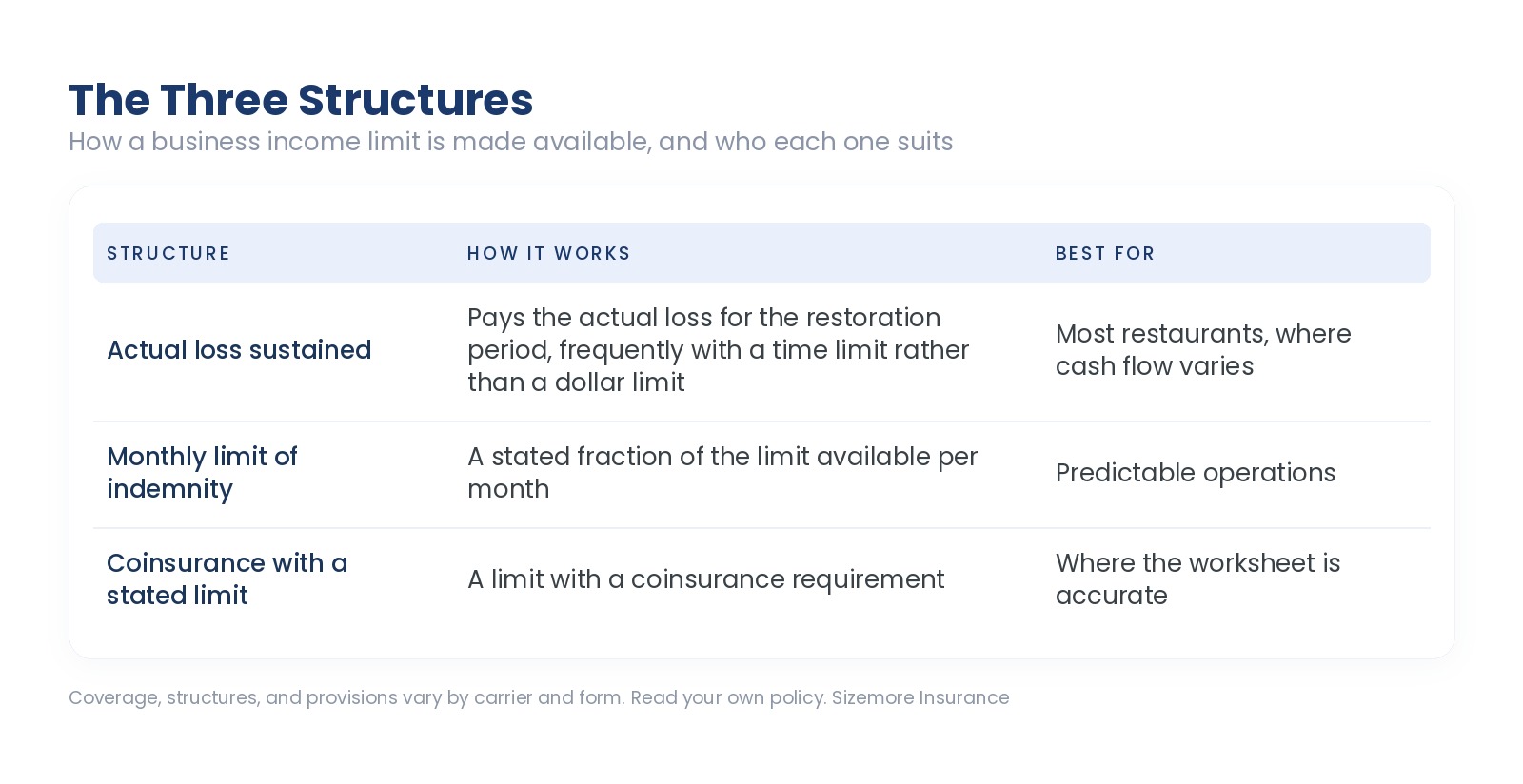
The takeaway: actual loss sustained is generally the friendliest structure for a restaurant, and the worksheet is what makes any of them work.
Coverage, structures, and provisions vary by carrier and form. Read your own policy.
The Worksheet
Insurers provide a business income worksheet and it is one of the most valuable hours an owner spends on insurance.
It walks revenue, cost of goods, continuing expenses, and payroll to produce the exposure figure the limit should reflect.
Common errors:
- Using last year rather than projecting forward.
- Omitting payroll you would actually maintain to keep key staff.
- Forgetting rent, which is the largest continuing expense for most restaurants.
- Underestimating the restoration period, which for a kitchen rebuild with permits and equipment lead times is longer than owners think.
- Failing to adjust for growth.
- Failing to adjust for seasonality, which is covered separately and which is a common error in coastal and college town restaurants.
Where This Gets Complicated
Seasonality breaks an annual average. A restaurant earning most of its revenue between May and September, closed by a fire in July, loses far more than a twelve-month average suggests. Seasonality endorsements exist and they have to be asked for.
The period of restoration is not how long you were closed. It is how long repair should reasonably take. Delays you cause do not extend it.
Extra expense is separate and worth having.
Civil authority coverage may respond where an authority prohibits access to your premises, subject to conditions that generally include damage to nearby property. Hurricane closure without damage to your building is the case people expect it to cover and frequently it does not.
Utility interruption requires its own coverage where the failure originates off your premises.
Dependent property coverage addresses a loss at a supplier or at a business that draws customers to you, including an anchor tenant.
Payroll decisions during a closure determine whether you have staff when you reopen, and the limit should contemplate keeping key people.
Common Questions
What is business income coverage?
It replaces lost net income and pays continuing expenses while you are closed after a covered loss.
How much do I need?
Fill out the worksheet. It should reflect projected revenue, continuing expenses, and a realistic restoration period.
What is the period of restoration?
The time repair should reasonably take, not the time you were actually closed.
Does it cover a hurricane closure with no damage?
Generally not. Business income requires physical damage, and civil authority coverage has its own conditions.
What is extra expense?
Coverage for the additional cost of reopening faster or staying partially open. Frequently worth more than it costs.
What if my business is seasonal?
An annual average underpays a peak-season loss. Ask about a seasonality endorsement.
The Bottom Line
- Fill out the worksheet properly, because it is one of the highest-value hours in this category.
- Include rent and the payroll you would maintain, because both continue.
- Set the restoration period realistically, allowing for permits and equipment lead times.
- Add extra expense, which frequently pays for itself.
- Ask about a seasonality endorsement if your revenue is concentrated.
- Revisit it annually, because revenue grows and the limit does not follow on its own.
Sizemore Insurance is an independent insurance company founded in North Carolina in 1977, writing in both North Carolina and South Carolina. Send us a profit and loss statement and we will build the worksheet with you. Insurance made just for you.
Coverage, structures, provisions, and endorsement availability vary by carrier and form and are subject to change. Nothing here is a coverage determination. Review your own policy or talk to your advisor.