

Here is a piece of how North Carolina auto insurance works that almost no driver in this state knows about, including many who are in it.
North Carolina requires insurance companies to write essentially every eligible applicant. A carrier cannot simply decline a driver because the record is poor. That is unusual, and it is a large part of why this state has very few genuinely uninsurable drivers.
The mechanism that makes it possible is the North Carolina Reinsurance Facility, and understanding it explains several things about your policy that otherwise make no sense.
Because carriers must accept applicants, they need somewhere to put the risks they do not want to keep.
The Reinsurance Facility is that place. A carrier writes the policy, services it, and handles the claims, and separately cedes the risk to the Facility. The Facility is funded by the premiums ceded to it, and when those premiums do not cover the losses, the shortfall is recouped through the market.
From your seat, several things follow.
You still deal with your own company. The policy, the bill, the service, and the claim all run through the carrier whose name is on it. Being ceded does not change who answers the phone.
You may not be told. There is no requirement that a driver be notified they have been ceded, and many are not.
The rate can be different. Ceded business is rated under the Facility's structure rather than the carrier's own, which frequently produces a higher premium for the same driver.
A recoupment component exists. Where Facility losses exceed Facility premiums, the difference is recouped, and that shows up in the market broadly rather than only on ceded policies.
Structures, rates, and recoupment mechanics are set by statute and administered by the Facility under Department of Insurance oversight, and they change. Confirm current details with the Reinsurance Facility or the Department of Insurance.
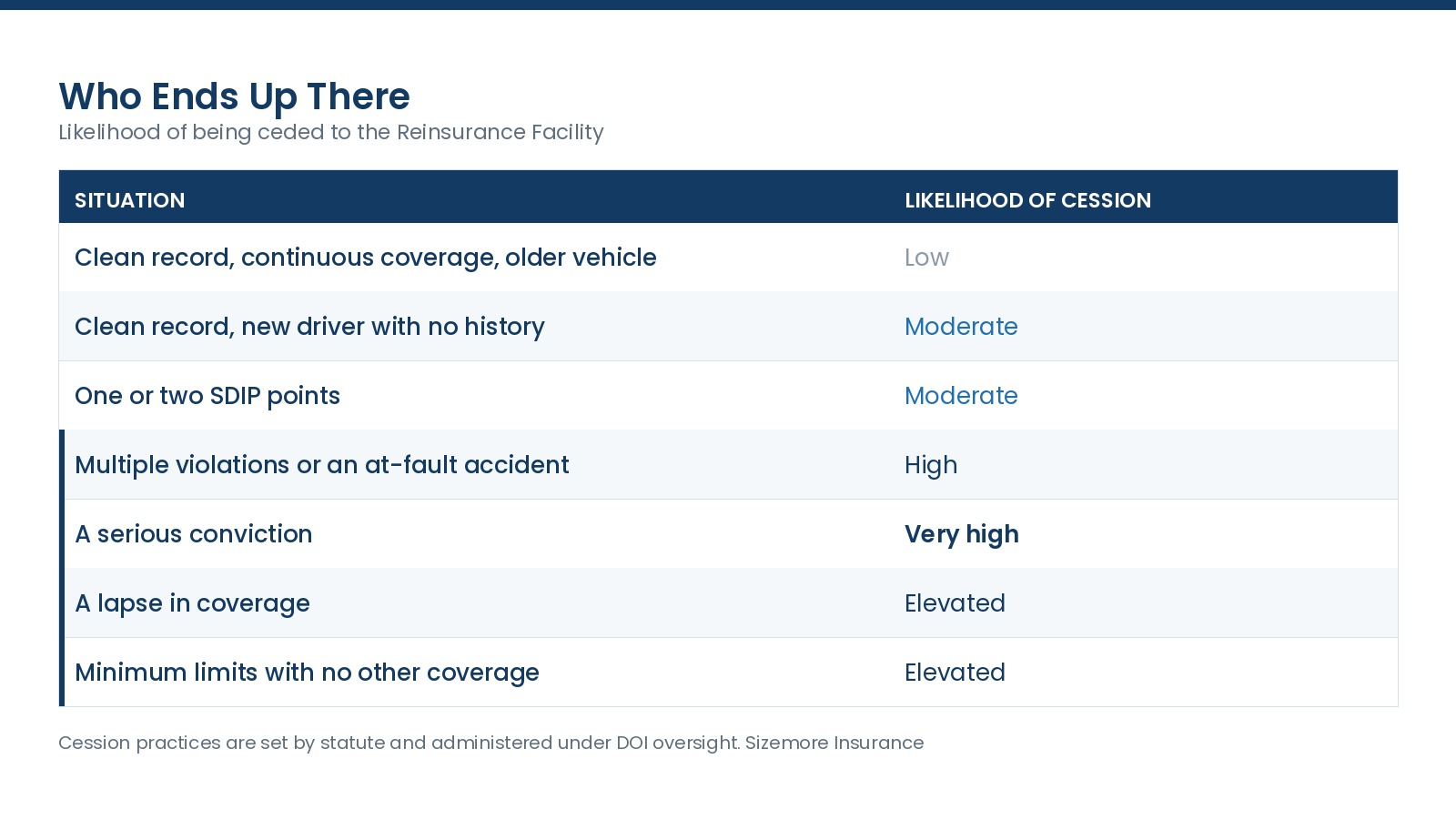
The takeaway: the Facility is not only for bad drivers. New drivers with no record and drivers carrying minimum limits with no continuous history can end up there too.
Ask. Your advisor can tell you whether a quote is ceded. Many drivers have never asked and many have never been told.
Shop, and understand what shopping does. Because SDIP surcharges are standardized statewide, changing carriers does not remove a surcharge. What it can change is the base rate the surcharge multiplies against, and whether a particular carrier is willing to retain the risk rather than cede it. Carrier appetite for retaining business varies considerably, which is exactly why an independent company can help here.
Let time work. Points come off on a schedule. Convictions assigned four or more SDIP points occurring on or after July 1, 2025 carry a five-year surcharge period rather than three, and everything below that stays on the shorter clock. Know your dates.
Maintain continuous coverage. A lapse is one of the fastest ways into the Facility and one of the slowest to recover from.
Consider your limits. Minimum-limits drivers as a group present differently than drivers carrying higher limits and full coverage, and the difference in how a carrier views the account can exceed the premium difference.
This is not the same as a high-risk or non-standard company. Non-standard carriers are private companies choosing to specialize in harder risks. The Facility is a statutory mechanism operating behind ordinary carriers.
It is also not the same as the residual markets on the property side. The Beach Plan and the FAIR Plan are property mechanisms. This is auto, and it works differently.
Being ceded is not a mark on your record. It is a decision made between your carrier and the Facility, and it does not follow you the way a violation does.
Coming out of it is gradual. As points expire and coverage history builds, more carriers become willing to retain the risk. That is a renewal-by-renewal process rather than a single event.
Re-shopping at the right moment matters more here than almost anywhere. The month after a significant surcharge expires is one of the highest-value times to re-market a North Carolina auto policy.
What is the North Carolina Reinsurance Facility?
A statutory mechanism allowing insurance companies to cede auto risks they do not wish to retain, while still writing the policy, which is what makes the state's take-all-comers requirement workable.
How do I know if I am in it?
Ask your advisor. There is generally no notice, and many drivers have never asked.
Does being ceded change my coverage?
The policy and the service run through your carrier. The rating structure can differ.
Can I get out of it?
Over time, as points expire and continuous coverage builds, and by re-marketing to carriers willing to retain the risk.
Does switching companies help?
It cannot remove a standardized SDIP surcharge. It can change the base rate and whether a carrier retains rather than cedes the business.
Is it the same as high-risk insurance?
No. Non-standard carriers are private companies. The Facility is a state mechanism operating behind ordinary ones.
Sizemore Insurance is an independent insurance company that has been placing coverage in North Carolina since 1977. Send us your declarations page and we will tell you where you sit, what it is costing, and when it changes. Insurance made just for you.
Structures, rates, cession practices, and recoupment mechanics are set by statute and administered under Department of Insurance oversight and are subject to change. Review your own policy or talk to your advisor.