An owner holds a 14,000 square foot retail strip built in 1974. Four tenants: a dry cleaner, a nail salon, an insurance office, and a vacant end unit that has been empty since February.
That single building triggers eight distinct coverage decisions. The dry cleaner changes the liability classification and may change the carriers willing to write it. The 1974 construction date puts current code well beyond what was built, which is an ordinance and law question. The vacant unit is approaching the vacancy provision. The rent roll sets the rental value limit. The roof age determines whether the policy settles it at replacement cost or actual cash value. And the lease structure decides which of those exposures belongs to the owner at all.
None of that is unusual. It is what a normal commercial building looks like. This guide is the full stack, in the order it should be built.
The Core Stack
Six coverages carry most of the exposure on a commercial building. The first four are not optional in any practical sense.
Commercial property. The building itself, plus any business personal property you own in it. This is where valuation, coinsurance, and the causes of loss form live, and it is the coverage that determines what you collect after a fire or a storm.
General liability, usually written as lessor’s risk only. Your liability as the owner of premises other people use. A tenant’s customer falls on an exterior stair, a delivery driver is injured in the parking lot, water from a common-area pipe damages a tenant’s inventory.
Rental value, sometimes called business income for landlords. When a covered loss makes space untenantable, this replaces the rent while the building is repaired. Owners under-buy this coverage frequently.
Ordinance and law. The added cost of rebuilding to current code. Optional on paper. Not optional on a building constructed before the code that now governs it.
Equipment breakdown. Sudden mechanical or electrical failure of the building’s own systems. A standard property policy excludes it, which surprises owners with rooftop HVAC serving tenants who have temperature-dependent operations.
Commercial umbrella. Excess limits above the general liability. On a building with public foot traffic, primary limits alone do not reflect what a serious injury claim looks like.
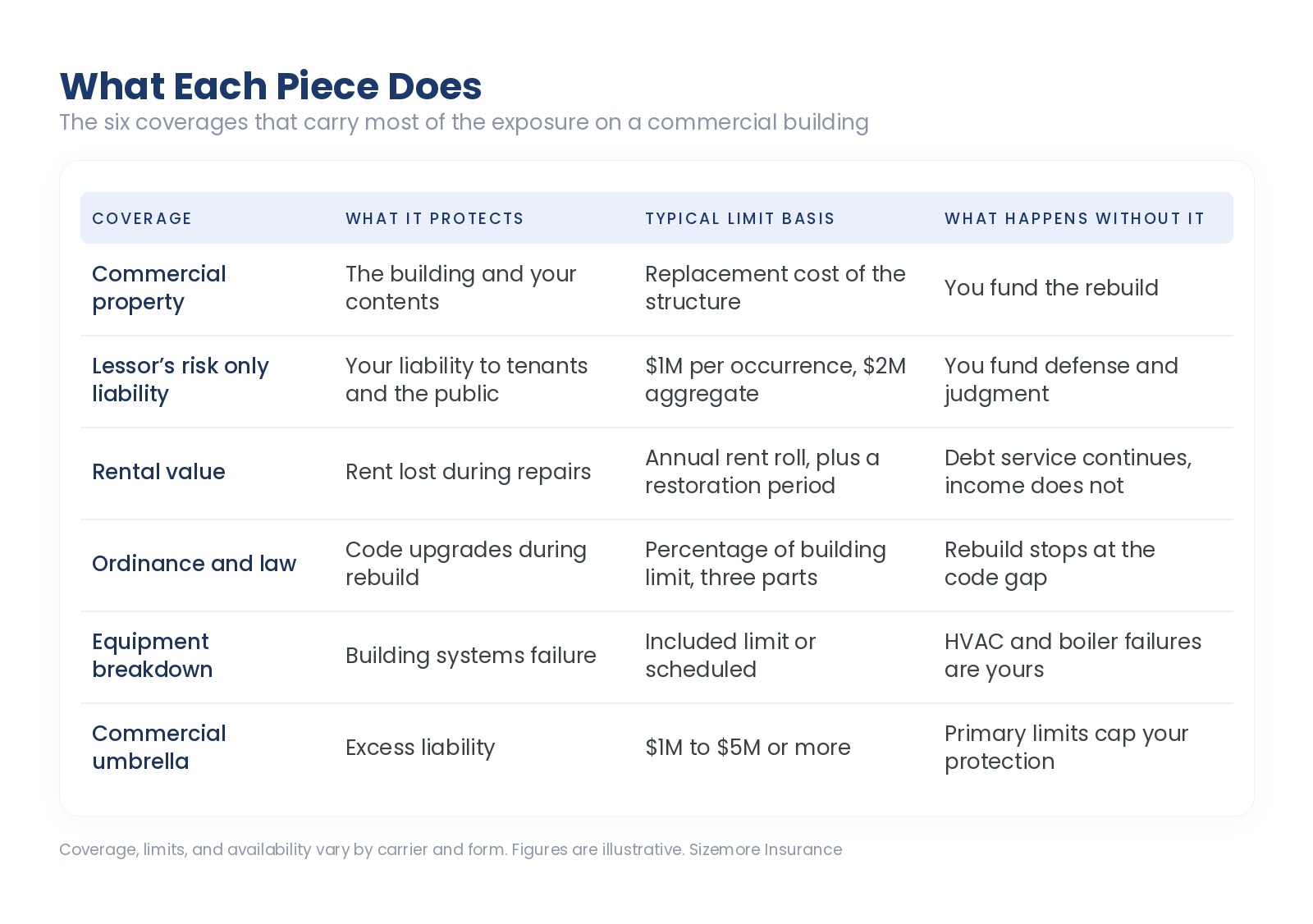
The takeaway: the first four are the difference between a covered loss and a funded one. A building policy without rental value and ordinance and law is a policy that pays for part of a rebuild you cannot afford to pause.
Coverage, limits, and availability vary by carrier and form. Your own policy language governs. Talk to your advisor about your specific building.
The Three Numbers That Decide Everything
The building limit, and the coinsurance percentage attached to it. Your limit should equal current replacement cost of the structure, not purchase price, not tax value, and not the loan amount. Most policies then require you to carry a stated percentage of that value, commonly 80, 90, or 100 percent. Fall below the requirement and the policy reduces your claim in proportion, on partial losses as well as total ones. This is one of the most common and most expensive errors I find on North Carolina commercial property.
The rental value limit and the period of restoration. The limit should reflect your actual annual rent roll, not the roll from the year you bought the building. The period of restoration is the window during which the coverage responds, and it runs from the date of loss until the property should reasonably be repaired, which is not the same as how long the repair actually takes. An extended period of indemnity endorsement covers the additional time it takes to re-tenant.
Your deductibles, all of them. There is an everyday deductible. In much of eastern North Carolina there is also a separate wind and hail or named storm deductible, and it is frequently a percentage of the building limit rather than a flat amount. Two percent of a $3 million building is $60,000. Know that figure in dollars before you need it.
How the Stack Shifts
The core six are the baseline. Four factors move it.
Building age. Older construction raises the ordinance and law exposure and narrows the carrier list. Electrical service, plumbing type, and roof age drive eligibility, not just price. On a building predating current code, ordinance and law moves from optional to essential.
Tenant mix. The tenants rate the building. A restaurant with a commercial kitchen, a dry cleaner with solvents, an auto shop with lifts and waste oil, each changes the classification and can move the whole building’s cost. One high-hazard tenant in an otherwise clean strip affects every unit’s pricing.
Lease structure. A triple net lease shifts insurance cost to the tenant. It does not shift your interest in whether the coverage is correct, whether the tenant actually maintains it, or whether you are properly named on it. A gross lease leaves the obligation with you outright.
Location. In coastal counties, wind and hail may be excluded from the property policy and written separately, sometimes through the North Carolina Insurance Underwriting Association, which people call the Beach Plan. Inland, Helene demonstrated that flood exposure is not a coastal-only question. Flood is excluded from standard commercial property policies and requires a separate policy in either case.
Where This Gets Complicated
Flood is not included. Standard commercial property policies do not cover rising water. NFIP non-residential limits cap at $500,000 for the building and $500,000 for contents, so a building above that replacement cost needs private or excess flood coverage. NFIP also carries a 30-day waiting period, which means it cannot be bought once a storm has a name.
Vacancy changes the policy. Most commercial property forms restrict coverage once a building has been vacant beyond a set period, commonly 60 days. Several perils drop out entirely, including vandalism, water damage, and theft, and remaining covered losses are reduced. A partially leased building can still trigger this depending on how the form defines vacancy. Address it before the space sits empty.
Your roof may not settle at replacement cost. Many carriers write the building at replacement cost while scheduling the roof at actual cash value based on age. That endorsement sits inside a replacement cost policy and most owners do not know it is there until a storm.
A certificate of insurance is not coverage. A tenant COI proves a policy existed on the day it was issued. It does not prove the policy is still in force, that the additional insured wording is correct, or that the limits meet your lease. Untracked tenant certificates are one of the most reliable ways an owner inherits someone else’s liability.
North Carolina applies contributory negligence. A claimant who contributed to their own injury may be barred from recovering. That is favorable to a building owner as a defense, and it makes the specific facts of a premises claim matter enormously, which is an argument for documentation and maintenance records rather than for lower limits.
How you hold title affects the policy. If the building sits in its own LLC, that entity should be the named insured. Mismatches between the deed, the loan, and the policy show up at closing and at claim time.
Common Questions
What insurance do I need for a commercial building I lease to tenants?
At minimum: commercial property on the building, lessor’s risk only general liability, rental value, and ordinance and law if the building predates current code. Equipment breakdown and a commercial umbrella follow closely.
Does my tenant’s insurance cover my building?
No. A tenant’s policy covers the tenant’s property, their liability, and often their improvements. The building is yours to insure regardless of lease structure.
Is a triple net lease enough to shift the risk?
It shifts the cost of insurance. It does not shift your interest in whether the coverage exists, whether it is adequate, or whether you are correctly named on it.
How much rental value coverage do I need?
Enough to cover your actual annual rent roll through a realistic repair timeline, plus an extended period of indemnity for the time it takes to re-tenant. Owners routinely set this at purchase and never revisit it.
Do I need flood insurance if my building is not in a flood zone?
Flood zone designation determines what your lender requires. It does not determine whether the building can flood. Helene damaged property well inland, and North Carolina’s December 2024 assessment put statewide damage and needs above $59.6 billion.
What does commercial property insurance cost in North Carolina?
It varies enormously with building value, construction, occupancy, location, age, and claims history. The cost drivers article in this section ranks them, and we can price your specific building.
The Bottom Line
- Start with the building limit. If it does not equal current replacement cost, everything downstream is compromised, including partial claims. Get a valuation.
- Size rental value to your current rent roll, and add an extended period of indemnity.
- Add ordinance and law on anything predating current code. On older North Carolina commercial stock this is frequently worth more than raising the building limit.
- Find your named storm deductible in dollars if the building is anywhere in eastern North Carolina, and confirm whether wind and hail is in the policy at all.
- Track your tenant certificates, and verify the additional insured wording rather than the certificate.
- Address vacancy before a unit sits empty, not after a loss in it.
Sizemore Insurance is an independent insurance company that has been placing coverage in North Carolina since 1977. We read the settlement provisions rather than the brochure, run replacement cost valuations, and place buildings with carriers whose forms match how you actually own and lease the property. Insurance made just for you.
Coverage, forms, limits, and availability vary by carrier and are subject to policy language. Figures above are illustrative. Loss figures are estimates from published state reporting. Review your own declarations page or talk to your advisor.