Getting your own authority is a sequence, and the insurance sits in the middle of it rather than at the end.
Most of the problems I see come from people treating the policy as the last errand before they start hauling. The filing has to be made by your insurer, FMCSA has to process it, and none of that happens the afternoon you decide you are ready.
The Sequence
- Decide the operation. What you will haul, how far, and with what equipment. Every insurance answer depends on these and guessing produces a policy that does not match the business.
- Register with FMCSA and obtain your USDOT number and operating authority.
- Designate a process agent through the required filing.
- Bind the insurance. Auto liability at the required limit, cargo, and physical damage at minimum.
- Your insurer makes the public liability filing with FMCSA. This is not instant and it is not something you file yourself.
- FMCSA processes it, and the authority becomes active after the applicable period.
- Handle registration and tax: apportioned registration if you cross state lines, fuel tax reporting, and the annual carrier registration.
- You can haul.
Steps four through six are where the schedule slips. Build in time rather than discovering it.
Why Year One Costs Most
There is no information to price against.
No loss history. An underwriter cannot see how you handle equipment and drivers because there is nothing to see.
No operating record. No CSA data, no roadside inspection history, no crash record.
Statistical reality. A meaningful share of new authorities do not survive the first eighteen months, and pricing reflects that population rather than you individually.
The new entrant period. FMCSA subjects new carriers to a safety assurance process, and a carrier still inside it reads differently to an underwriter than one that has completed it.
None of that is personal and all of it is expensive. The useful response is to accumulate the information that makes you cheaper as fast as possible.
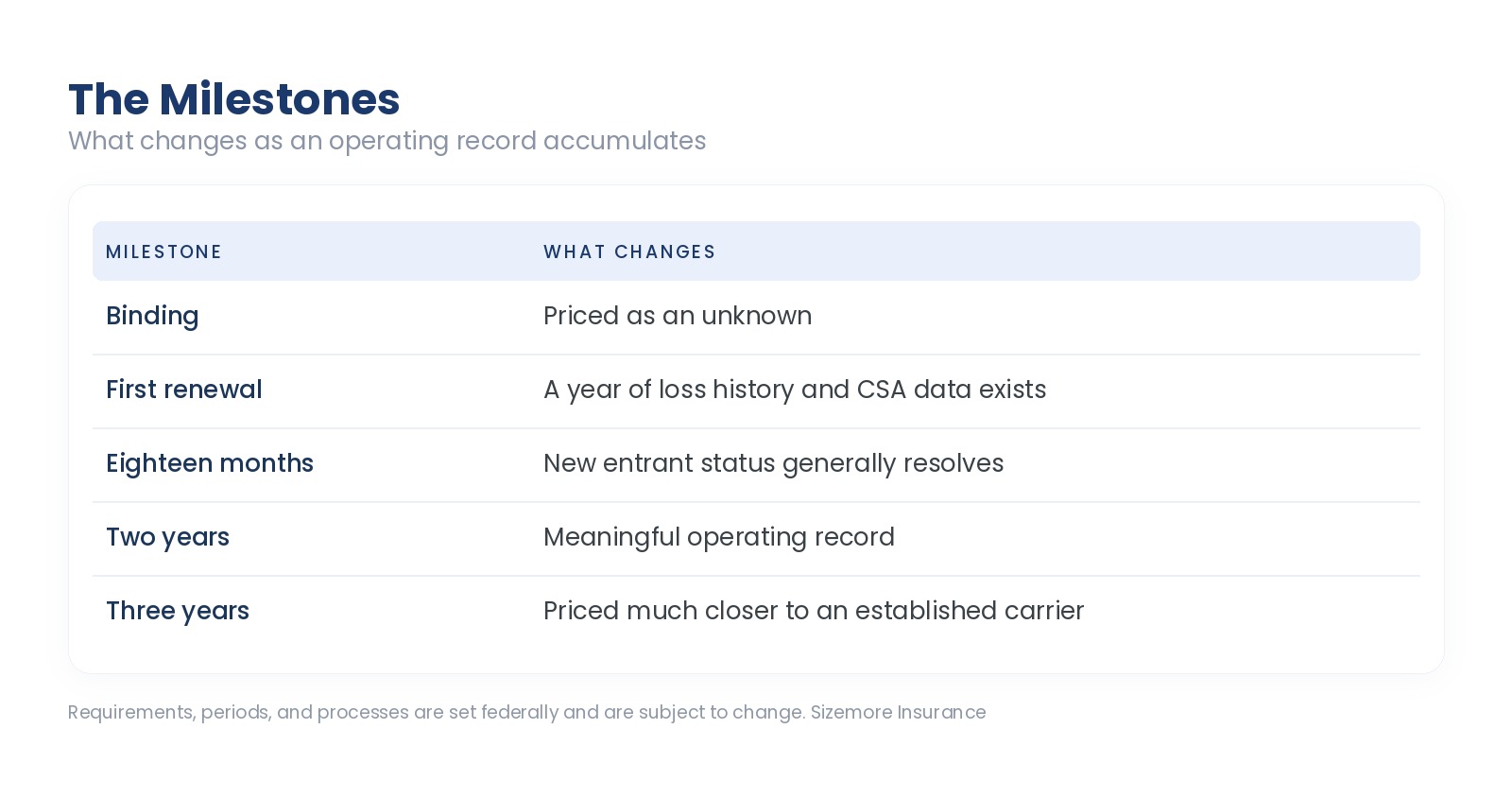
The takeaway: re-market at each of those milestones rather than once a year out of habit. The reductions are real and no carrier volunteers them.
Requirements, periods, and processes are set federally and are subject to change. Confirm current requirements with FMCSA.
What to Get Right in Year One
A clean CSA record. Roadside inspections in the first year carry outsized weight because there is nothing else on file. One bad inspection is a large share of what an underwriter sees.
Driver records. If you are hiring, hire on motor vehicle records rather than availability. This is one of the most controllable inputs you have.
Accurate radius and commodity. Set them to reality, because a claim outside either can be denied and because overstating costs money.
No claims. Obvious, and worth stating because a year one claim is disproportionately expensive going forward.
No lapse. A payment problem that cancels the policy cancels the filing and starts a clock on the authority. That is covered separately and it is the fastest way to lose everything you just built.
Documentation habits. Driver files, maintenance records, and inspection reports. You will need them at a renewal and at an audit.
Where This Gets Complicated
Down payments are substantial and premium finance is common. Understand the missed payment consequence before you sign, because it reaches the filing.
A true new venture program is different from a standard market with a surcharge. Both exist and they behave differently at renewal. Ask which one you are in.
Broker requirements may exceed the federal minimum, and finding that out after committing to a lane is expensive.
Prior authority history follows you. If you or a partner previously held authority, that record is visible and an underwriter will ask. Present it directly rather than hoping.
Leased-on experience does not fully transfer. Time under someone else’s authority helps and it is not the same as your own operating record.
Cheapest in year one is frequently most expensive by year three, if the program was assembled without cargo limits your contracts require or without a market that will renew you.
Common Questions
How long does it take to get insurance in place for new authority?
Binding is fast and the filing and FMCSA processing are not. Build in time rather than planning around the last day.
Why is new authority insurance so expensive?
There is no loss history, no operating record, and no CSA data. You are priced as an unknown.
When does it come down?
Meaningfully at the first renewal, again around eighteen months, and again at two years, with a clean record.
Can I file with FMCSA myself?
The public liability filing is made by your insurer. Other filings you handle.
What is the biggest year one mistake?
A lapse. It cancels the filing and puts the authority at risk.
Does leased-on experience help?
It helps and it is not the same as your own operating record.
The Bottom Line
- Start the insurance conversation before you file for authority, not after.
- Build in time for the filing and processing.
- Hire on motor vehicle records, because it is the input you most control.
- Set radius and commodity to reality.
- Never miss a payment, because the consequence reaches your authority.
- Re-market at the milestones, not once a year by habit.
Sizemore Insurance is an independent insurance company that has been placing coverage in North Carolina since 1977. Tell us what you plan to haul and how far and we will build the program and handle the filing. Insurance made just for you.
Requirements, filings, processing times, and programs are set federally and by carriers and are subject to change. Nothing here is legal advice. Confirm current requirements with FMCSA and review your own situation with your advisor.