A $4,200,000 mixed-use building in a coastal county. Roof damage and interior water intrusion from a tropical storm. The repair estimate comes to $310,000.
The owner knows the deductible is 5 percent and has been treating that as a manageable number.
Five percent of $4,200,000 is $210,000. The claim pays roughly $100,000 on a $310,000 loss, and the policy is working exactly as written.
The percentage is the number on the declarations page. The dollars are the number that matters, and most owners have never done the multiplication.
Your Policy Has More Than One Deductible
Commercial property policies in eastern North Carolina commonly carry a layered deductible structure.
All other perils. The everyday deductible. Fire, theft, a burst pipe, a vehicle into the storefront. Usually a flat dollar amount.
Wind and hail. Applies to wind and hail damage generally, whether or not a storm has been named. Frequently a percentage in coastal territories, sometimes a flat amount inland.
Named storm. The highest of the three, applying when the damage comes from a storm the National Hurricane Center has named. Almost always a percentage.
When an owner says “my deductible is $10,000,” they are usually reading the first line and the storm loss will be settled against the third.
What the Percentage Costs in Dollars
The percentage applies to the building limit, not to the size of the claim.
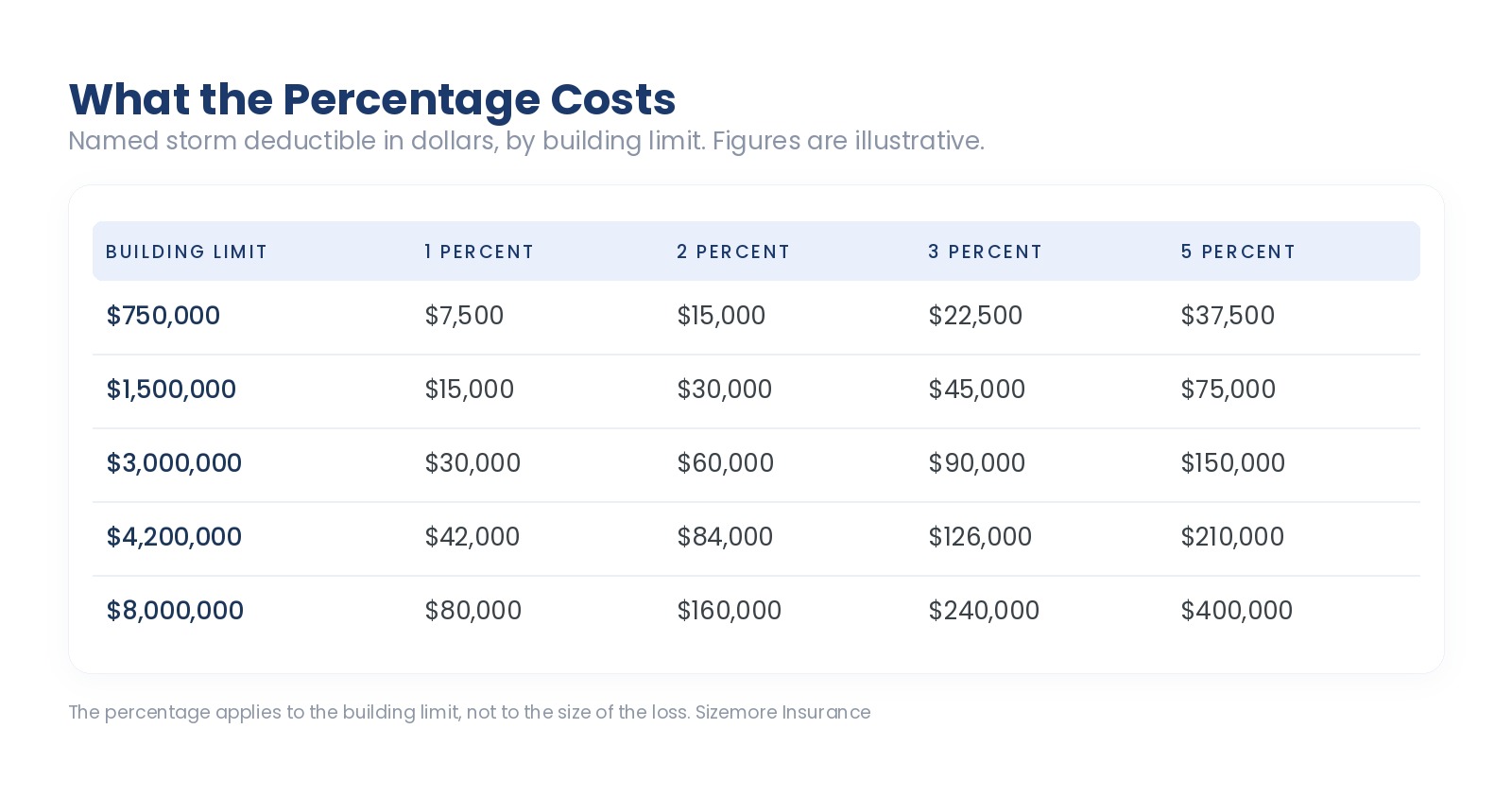
The takeaway: your named storm deductible grows every time your building limit is adjusted for inflation, and nobody notifies you when it does. An owner whose limit rose from $3,000,000 to $4,200,000 over several years also raised a 5 percent deductible by $60,000 without being asked.
Deductible structures, percentages, and application vary by carrier and form. Some policies apply the percentage per building, some per occurrence across scheduled locations. Your own policy language governs.
What Triggers the Higher Deductible
This varies more between carriers than the percentage does, and it matters more.
Most named storm provisions activate when the National Hurricane Center names a storm and it affects your area. Beyond that, forms differ on several points:
- Whether the trigger requires hurricane status or applies to any named storm, including tropical storms
- Whether it is tied to a watch or warning being issued for your county
- Whether it runs from the time a warning is issued until a set number of hours after it is lifted
- Whether sustained wind speed at the location is a factor
Two policies showing the same 2 percent produce different answers to the same weather. When we compare coastal quotes, the trigger language is one of the first things we read, and it is never in the marketing material.
Where This Gets Complicated
Per building or per occurrence. On a scheduled portfolio, some forms apply the deductible separately to each damaged building. A storm that touches four of your properties can produce four deductibles. Others apply one deductible per occurrence across the schedule. That distinction can be worth several hundred thousand dollars in a single event and it sits in the endorsement, not the declarations page.
It applies to more than the building. Depending on the form, the same deductible can apply against the building, business personal property, and in some cases the rental value claim. Confirm which coverages it reaches.
Two named storms in one season means two deductibles. In an active year that is a real exposure, and it argues for a percentage you could absorb twice rather than once.
Loan documents frequently cap the deductible. Many commercial loans specify a maximum property deductible, either in dollars or as a percentage. A 5 percent named storm deductible on a coastal building can exceed that cap, which is a conversation to have before binding rather than during lender review.
A low coastal premium frequently means a high deductible. When one quote comes in well under the others on a coastal building, the deductible structure is frequently why. Comparing coastal quotes on premium alone tells you very little.
Wind may not be in the policy at all. In parts of the coast, windstorm and hail is excluded from the property policy and written separately, sometimes through the North Carolina Insurance Underwriting Association. If the premium looks unusually favorable, check whether wind is included before you check the deductible.
Common Questions
How is a named storm deductible calculated?
As a percentage of the building limit, not of the loss. Two percent of a $3,000,000 building is $60,000 regardless of whether the damage is $80,000 or $800,000.
What is the difference between a hurricane deductible and a named storm deductible?
A hurricane deductible typically requires the storm to reach hurricane strength. A named storm deductible applies to any storm the National Hurricane Center has named, including tropical storms, which means it applies more often.
Can I get a flat dollar deductible instead?
Sometimes, depending on carrier and territory. Closer to the water, percentage deductibles are frequently the only structure offered. It is always worth asking, because where a flat option exists it is usually better for the owner.
Does the deductible apply to my rental income claim too?
Business income and rental value typically use a time-based waiting period rather than a dollar deductible, but forms vary on how the two interact. Confirm it on your policy.
If a storm damages three of my buildings, do I pay three deductibles?
Under a per-building application, yes. Under a per-occurrence application, no. Check which one your form uses, because it is one of the larger differences between two otherwise similar policies.
Why did my deductible go up when I did not change anything?
Because it is a percentage of the building limit and the limit rose with your inflation adjustment. The percentage stayed the same. The dollars did not.
The Bottom Line
- Calculate your named storm deductible in dollars today and write it down. That figure is what you need available before hurricane season, and most owners have never produced it.
- Find out whether it applies per building or per occurrence. On a portfolio this is one of the largest variables in the structure.
- Ask what a lower percentage costs, and price it against raising your all other perils deductible. Trading a higher everyday deductible to move from 5 percent to 2 percent on the storm side is available more often than owners realize, and the dollars are much larger on the storm side.
- Read the trigger language, not just the percentage. Named storm and hurricane are different words with different reach.
- Check your loan documents for a deductible cap before you bind or renew.
- Confirm wind and hail is actually in the policy if the building is anywhere in eastern North Carolina.
Sizemore Insurance is an independent insurance company that has been placing coverage in North Carolina since 1977. Send us your declarations page and endorsement list and we will tell you what your storm deductible costs in dollars, how it applies across your buildings, and what the alternatives price out to. Insurance made just for you.
Deductible structures, trigger definitions, application, and availability vary by carrier, territory, and form. Figures above are illustrative. Review your own policy or talk to your advisor.