Start with the thing carriers most often have backwards.
Motor truck cargo is not insurance on the freight. It is insurance on your legal liability for the freight. The distinction sounds academic until a claim, when the question becomes whether you were legally responsible for the loss rather than whether the freight was damaged.
Everything else follows from that.
What It Covers
Your liability for loss or damage to freight in your care, while it is in transit and generally while it is in temporary storage incidental to transit.
Debris removal in many forms, at a sublimit.
Pollutant cleanup from a covered cargo loss, at a sublimit.
Earned freight charges in some forms.
For interstate movements, your liability is largely governed by federal law, which imposes a demanding standard on carriers with narrow defenses. That is why cargo coverage exists and why brokers require it.
The Commodity Schedule
Your policy contemplates specific commodities. That schedule is a rated item.
Hauling outside it is one of the most common ways a cargo claim fails, and it happens innocently. A dry van carrier takes a load of electronics because the rate was good. A general freight carrier moves a load of liquor. Both are outside a typical schedule and both create a problem.
Commonly excluded or restricted commodities include:
- Alcohol and tobacco. Theft targets.
- Electronics and consumer goods. Theft targets.
- Pharmaceuticals.
- Live animals.
- Money, securities, jewelry, and fine art.
- Contraband, and property in the course of illegal transportation.
- Hazardous materials, which need their own treatment.
The fix is not to avoid the freight. It is to call before you take it and get the schedule broadened.
The Warranties Carriers Rarely Read
A cargo policy frequently contains protective safeguard warranties, which are conditions rather than suggestions. Violating one can defeat a claim entirely.
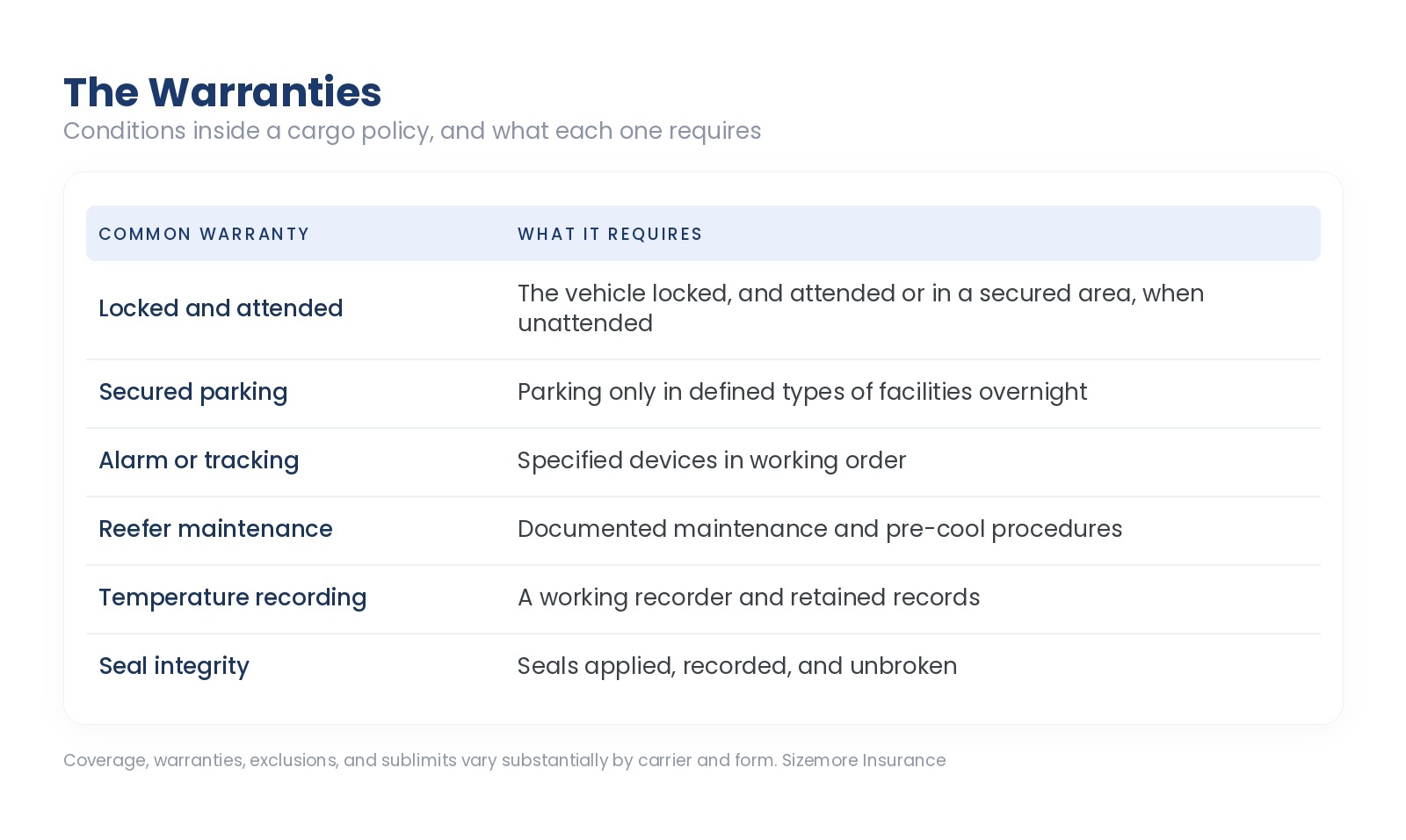
The takeaway: the warranties are where a paid claim and a denied claim diverge, and many carriers have never read theirs.
Coverage, warranties, exclusions, and sublimits vary substantially by carrier and form. Read your own policy.
Reefer Breakdown
Standard cargo coverage generally excludes spoilage caused by mechanical breakdown of the refrigeration unit.
That is one of the largest gaps in temperature-controlled hauling and it is closed by a reefer breakdown endorsement, which typically comes with its own conditions: documented maintenance, a working temperature recorder, and pre-cool procedures.
If you haul temperature-controlled freight and do not have the endorsement, a compressor failure on a load of produce is your money.
Where This Gets Complicated
The limit has to match the loads you actually take. A hundred thousand dollar limit does not cover a hundred and forty thousand dollar load, and brokers frequently specify a minimum.
Trailer interchange is separate. Cargo covers the freight. The trailer you do not own is a different coverage.
Refused or rejected freight raises questions about when your liability ends.
Loading and unloading is a gray area between cargo, general liability, and auto liability depending on who did the work and how the loss occurred.
Theft is one of the dominant severe losses, and it concentrates on specific commodities, specific corridors, and specific parking situations. I-95 has a known profile.
Shipper’s interest coverage is a different product purchased by the freight owner, and the gap between the two is where disputes live.
Deductibles on cargo can be substantial, and on a high-frequency low-value operation the deductible structure matters more than the limit.
Common Questions
Does motor truck cargo cover everything I haul?
No. It covers your legal liability for freight on your commodity schedule, subject to warranties and exclusions.
What is a commodity schedule?
The list of freight types your policy contemplates. Hauling outside it can defeat a claim.
Is reefer breakdown included?
Generally not. It is a separate endorsement with its own maintenance and temperature conditions.
What is a protective safeguard warranty?
A condition in the policy, commonly about locking, parking, alarms, or seals. Violating one can defeat a claim.
How much cargo coverage do I need?
Enough for the highest value load you will take, and at least what your broker contracts require.
What if I want to haul something not on my schedule?
Call before you take the load. Broadening the schedule is routine and a denied claim is not.
The Bottom Line
- Read your commodity schedule and compare it to what you actually haul.
- Read the warranties, particularly around parking, locking, and seals.
- Add reefer breakdown if you haul anything temperature-controlled.
- Match the limit to your highest value load and to your broker requirements.
- Call before taking freight outside the schedule, every time.
- Understand it is liability coverage, which means the question at a claim is whether you were responsible.
Sizemore Insurance is an independent insurance company that has been placing coverage in North Carolina since 1977. Send us your cargo policy and tell us what you actually haul, and we will tell you where the two do not match. Insurance made just for you.
Coverage, warranties, exclusions, sublimits, and legal standards vary by carrier, form, and jurisdiction and are subject to change. Nothing here is legal advice or a coverage determination. Review your own policy or talk to your advisor.