A guest drinks at your restaurant, drives home, and causes an accident.
That claim comes back to you, and your general liability policy generally does not respond to it. That is not an oversight in the form. It is a deliberate exclusion, and it is why liquor liability exists as a separate coverage.
The Exclusion
Standard general liability forms contain a liquor liability exclusion that applies to businesses in the business of manufacturing, distributing, selling, serving, or furnishing alcoholic beverages.
If that describes you, alcohol-related claims are outside the policy. Not limited. Excluded.
The exclusion generally reaches claims based on causing or contributing to the intoxication of a person, furnishing alcohol to someone under the legal drinking age or already intoxicated, and violating a statute governing alcohol. That last one matters, because it means a regulatory violation and a liability claim can arrive together.
What Liquor Liability Covers
Bodily injury and property damage arising from your service of alcohol, including harm caused by an intoxicated patron after they leave.
Defense costs, which in these claims are substantial and which are frequently the larger part of a defended claim.
Statutory liability where a state imposes it on the server.
It is a distinct policy or a distinct coverage part, with its own limit, its own aggregate, and its own exclusions.
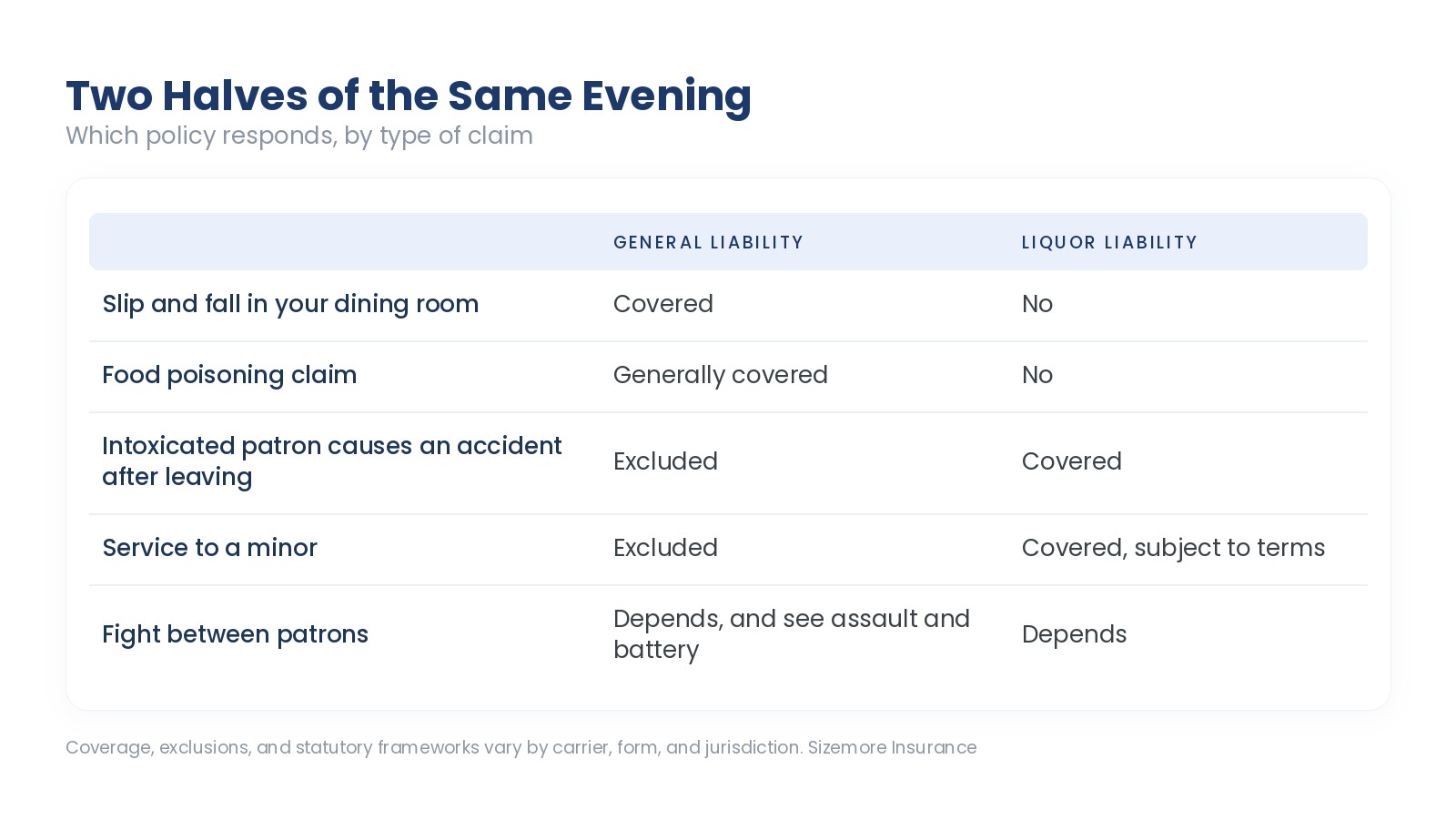
The takeaway: the two policies cover different halves of the same evening, and a restaurant with alcohol needs both.
Coverage, exclusions, and statutory frameworks vary by carrier, form, and jurisdiction and are subject to change. Nothing here is legal advice.
Host Liquor Is Not the Same Thing
This distinction catches people.
Host liquor liability is limited coverage available to businesses that serve alcohol but are not in the business of selling it. An office holiday party, a client event, a retail store with a wine tasting.
Liquor liability is for businesses that sell it.
A restaurant selling alcohol needs the second one. Host liquor coverage on a business that sells alcohol does not close the gap, and the gray zones, including BYOB arrangements and catered events, get their own article in this section.
Where This Gets Complicated
Dram shop frameworks differ between the states, and North Carolina and South Carolina each have their own rules around service to underage and intoxicated persons and the liability that follows. That has its own article and it is worth reading before you rely on anything general.
North Carolina is a control state for spirits, with the ABC Commission and local ABC boards governing permits and purchasing. That structure affects your permit, your operations, and in some respects your liability picture. Confirm current requirements with the ABC Commission.
Your alcohol percentage drives the pricing more than the presence of alcohol does. Fifteen percent of sales and eighty percent of sales are different risks.
Closing time matters. Late-night operations price differently and frequently sit in the surplus lines market.
Assault and battery is a separate exclusion question on many bar and nightlife policies, and it is among the most serious claims in this class.
Server training earns credit with many carriers and it also matters as evidence of reasonable practices.
An umbrella needs liquor liability scheduled underneath it, and confirming that is a real step.
Common Questions
Does general liability cover liquor claims?
Generally not for a business that sells or serves alcohol. There is a specific exclusion.
Do I need liquor liability if I only serve beer and wine?
Generally yes. The exclusion applies to serving alcohol rather than to a type of alcohol.
What is host liquor liability?
Limited coverage for businesses that serve but do not sell alcohol. It is not a substitute for liquor liability at a restaurant.
Is it required?
Leases, permits, and lenders frequently require it, and the liability exists regardless.
What drives the cost?
Alcohol as a percentage of sales, closing time, entertainment, security, and claims history.
Does server training help?
It earns credit with many carriers and it supports your position as evidence of reasonable practices.
The Bottom Line
- Carry liquor liability if you serve any alcohol, because general liability excludes it.
- Do not rely on host liquor coverage if you sell alcohol.
- Report your alcohol percentage accurately, because it drives the rating and misreporting has consequences.
- Confirm liquor liability is scheduled under your umbrella.
- Train servers and document it, because it earns credit and it supports your defense.
- Read the dram shop article for how North Carolina and South Carolina differ.
Sizemore Insurance is an independent insurance company founded in North Carolina in 1977, writing in both North Carolina and South Carolina. Tell us what you serve and how late you are open and we will place the liquor coverage properly. Insurance made just for you.
Coverage, exclusions, statutory frameworks, and permit requirements vary by carrier, form, and jurisdiction and are subject to change. Nothing here is legal advice or a coverage determination. Confirm current requirements with the applicable ABC authority and review your own policy with your advisor.