State law rarely requires you to insure a rental. Your lender almost always does, and their requirements are more specific than most borrowers expect.
Here is exactly what gets checked before funding.
The Seven Items
1. Replacement cost coverage on the dwelling. Not actual cash value. This is where a basic form policy gets rejected.
2. A dwelling limit at or above the loan amount, or at full replacement cost, depending on the lender. Some accept a replacement cost estimate below the loan where the estimate is documented, and many do not.
3. The correct mortgagee clause, with the lender’s exact name, loan number, and mailing address. Not approximately right. Exactly right.
4. The correct named insured, matching the borrower and the vesting on the deed. If an LLC is taking title, the policy names the LLC.
5. An effective date on or before closing. Not the day after.
6. Flood coverage where the property is in a mapped high-risk zone, which is a federal requirement for a federally regulated lender rather than a preference.
7. A deductible within their maximum, commonly a stated dollar amount or a percentage cap. A high deductible chosen to save premium can fail this test.
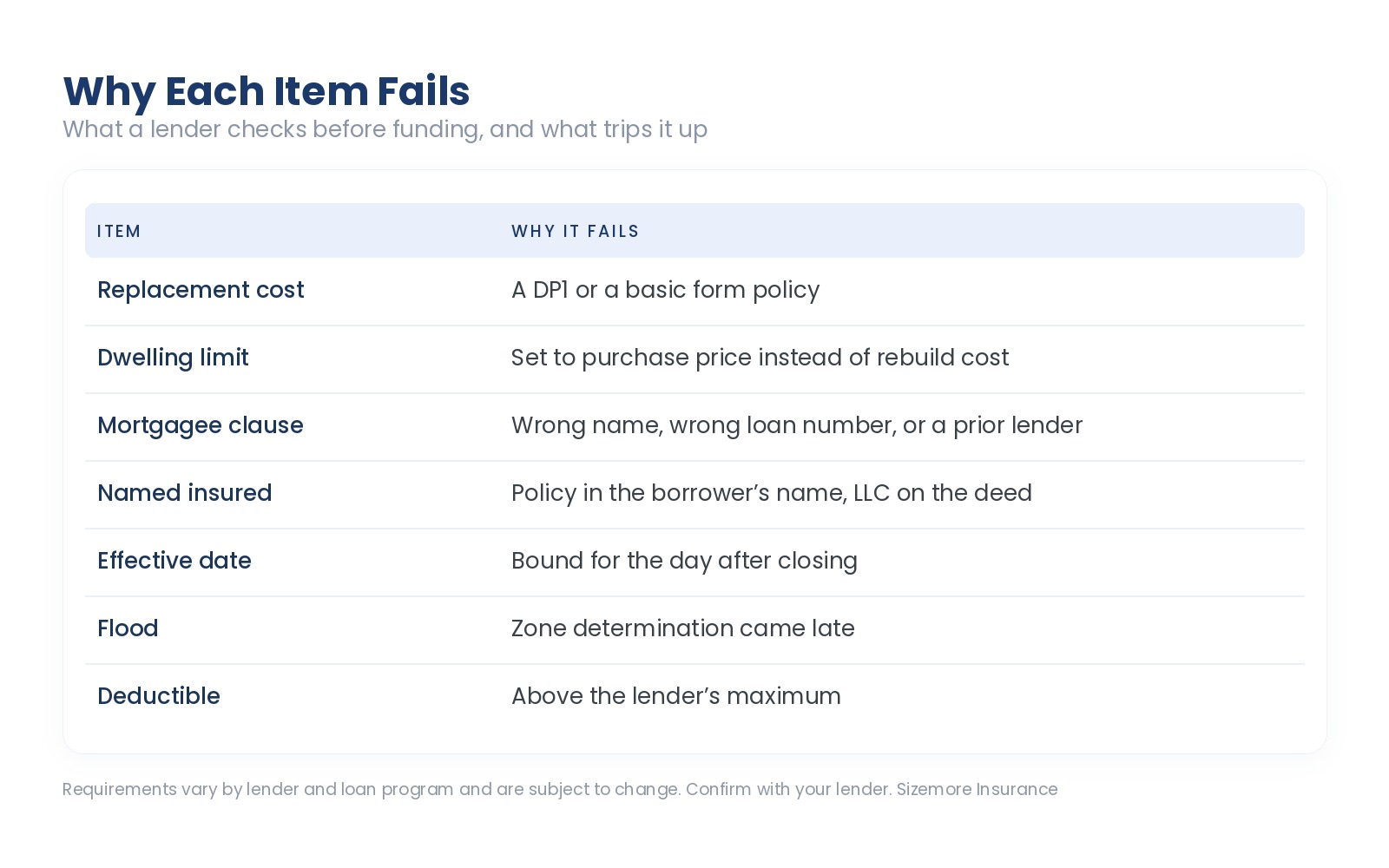
The takeaway: the mortgagee clause and the named insured cause more funding delays than anything else, and both are clerical rather than substantive.
Requirements vary by lender and loan program and are subject to change. Confirm with your lender.
Force-Placed Coverage
If you let coverage lapse, your lender can buy a policy protecting their interest and bill you for it.
It frequently costs substantially more than a policy you would buy.
It protects the lender, not you. No liability coverage, no loss of rents, and frequently no coverage for your interest in the building at all.
It is added to your loan or escrowed, which means you are paying interest on it in some structures.
Getting out of it requires proving coverage and it is not always immediate.
Force placement is entirely avoidable and it happens to investors who let a payment lapse on one property in a portfolio and did not notice.
What Slows a Closing
Four things, and every one is preventable with a week of lead time.
A late flood determination. If the property is in a mapped zone and nobody checked until three days out, a flood policy has to be issued and the waiting period question has to be resolved. For a loan closing, the waiting period is generally waived where flood insurance is required in connection with a loan, and confirming that beats assuming it.
A vesting change late in the deal. The borrower decides to take title in an LLC the week of closing, and the policy has to be rewritten with a new named insured.
An insurability surprise. The roof is twenty-five years old, the panel is a fuse box, or there are prior claims. Those are underwriting problems and they take time to solve.
A wrong mortgagee clause, which is frequently the most common of the four and the easiest to fix.
Where This Gets Complicated
DSCR and hard money loans have their own patterns, and both have their own articles in this section.
A portfolio loan may require coverage across multiple properties with schedules, which is a different documentation exercise.
A renovation loan raises builders risk rather than a landlord policy, and lenders vary on what they will accept.
Escrow versus direct pay affects who is watching the renewal, and escrowed policies still lapse when something goes wrong.
A refinance triggers the same review, and a policy that satisfied the original lender may not satisfy the new one.
Assumption of an existing policy is not how this works. The buyer needs their own.
Common Questions
Does the law require landlord insurance?
Rarely. Your lender almost always does.
What is a mortgagee clause?
The lender’s exact name, loan number, and address on the policy, protecting their interest. Getting it wrong stalls a funding.
What is force-placed coverage?
A policy your lender buys when yours lapses, billed to you. It frequently costs far more and it protects them rather than you.
Will a lender accept a DP1?
Frequently not, because lenders commonly require replacement cost.
Do I need flood insurance?
If the property is in a mapped high-risk zone and the lender is federally regulated, generally yes.
What most often delays a closing?
A wrong mortgagee clause, a late vesting change, a late flood determination, or an insurability surprise.
The Bottom Line
- Send us the lender’s requirements early, not the week of closing.
- Get the vesting decision made before we bind, because changing it late means rewriting.
- Confirm the mortgagee clause character for character.
- Order the flood determination early.
- Bind effective on or before the closing date.
- Never let a payment lapse, because force placement is expensive and it protects the wrong party.
Sizemore Insurance is an independent insurance company founded in North Carolina in 1977, writing in both North Carolina and South Carolina. Send us the address, the vesting, and the lender’s requirements and we will have evidence of insurance back the same day where the property is eligible. Insurance made just for you.
Requirements, programs, and regulatory provisions vary by lender and loan type and are subject to change. Nothing here is legal advice. Confirm requirements with your lender and review your own policy with your advisor.