Most first-time owners treat insurance as something you buy the week before opening.
Two pieces of it have to exist earlier than that, and one of them has to exist before you sign the lease.
The Sequence
- Before you sign the lease. Read the insurance section and price it. Landlords specify limits, additional insured status, waivers of subrogation, and sometimes coverages you had not planned on. Those are negotiable before signing and binding afterward. Send us the lease.
- During the buildout. Construction on a space you now control is a builders risk or installation exposure, and general liability during construction is a real question. If a contractor is doing the work, their coverage and yours both matter, and you should be an additional insured on theirs.
- Before hiring. Workers compensation attaches with employees, and North Carolina and South Carolina have their own thresholds and counting rules.
- Before the first delivery of equipment or inventory. Property coverage on equipment sitting in an unopened space.
- Before the alcohol permit. Liquor liability is frequently required as part of permitting, and the ABC process has its own timeline.
- Before opening day. General liability, property, business income, equipment breakdown, spoilage, and everything else in force.
- Before the first delivery run, if you deliver.
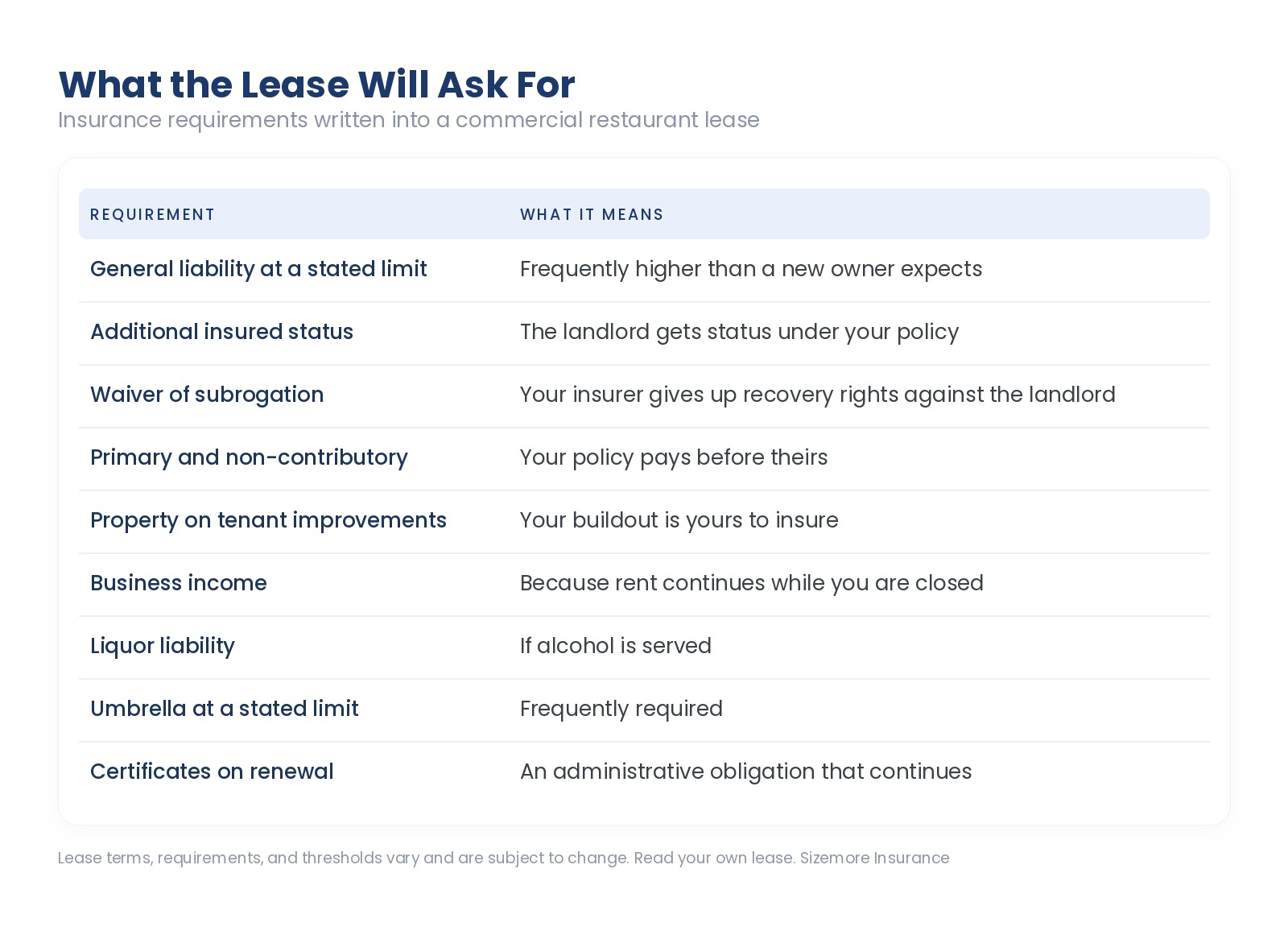
The takeaway: each of those has a cost, and the time to price them is before you sign.
Lease terms, requirements, and thresholds vary and are subject to change. Read your own lease.
The Buildout Is the Expensive Mistake
Tenant improvements and betterments are generally the tenant’s property to insure under a commercial lease, even though the work is attached to someone else’s building.
A restaurant buildout is expensive. Kitchen infrastructure, hoods, walk-ins, plumbing, electrical, finishes, and fixtures run into real money, and new owners routinely insure it at a fraction of what it cost.
That produces a coinsurance penalty, which reduces every claim proportionally rather than only a total loss. It has its own article and it is one of the most common expensive errors in this vertical.
Keep the buildout invoices. They are the documentation for the value.
Where This Gets Complicated
The permit timeline drives the insurance timeline. Alcohol permitting in particular takes time, and coverage is frequently part of it.
A new venture has no history, which means underwriters price on the concept, the location, the buildout, and your experience. Experience in the industry is worth stating in the submission.
Your business plan is underwriting information. Alcohol percentage, hours, delivery, and seating capacity all matter and they should be described accurately rather than optimistically.
Financing may require coverage with the lender named, on its own schedule.
A franchise agreement dictates requirements more specifically than a lease does, and the disclosure document has an insurance section worth reading closely.
Do not open on a certificate alone. A certificate confirms coverage exists. Read the actual policy for the warranty endorsements, because hood suppression requirements start the day you open.
Common Questions
When should I start the insurance conversation?
Before you sign the lease, because the lease specifies requirements you will be bound to.
What does a landlord typically require?
General liability at a stated limit, additional insured status, a waiver of subrogation, property on your improvements, and frequently business income and an umbrella.
Do I have to insure the buildout?
Under most leases yes, and undervaluing it creates a coinsurance penalty on every claim.
When does workers compensation attach?
With employees, subject to your state’s threshold and counting rules.
Do I need coverage during construction?
Yes, and the structure depends on who is doing the work. Address it before the buildout starts.
Can I open on a certificate?
A certificate confirms coverage exists. Read the policy for warranty endorsements before you open.
The Bottom Line
- Send us the lease before you sign it, because that is where the requirements are set.
- Keep every buildout invoice and insure the improvements at what they cost.
- Address the buildout period separately from the operating coverage.
- Start the alcohol permitting conversation early, because coverage is frequently part of it.
- Describe your concept accurately, including alcohol percentage and hours.
- Read the warranty endorsements before opening day, not after a fire.
Sizemore Insurance is an independent insurance company founded in North Carolina in 1977, writing in both North Carolina and South Carolina. Send us the lease and the concept and we will tell you what it costs before you are committed to it. Insurance made just for you.
Lease terms, requirements, permitting processes, and thresholds vary by jurisdiction, landlord, and agreement and are subject to change. Nothing here is legal advice. Review your own lease and policies or talk to your advisor.