A three-hundred-seat brewery and a forty-seat coffee shop are both restaurants and they are not close in price.
Concept drives this more than square footage or revenue does. Here is what actually moves the number.
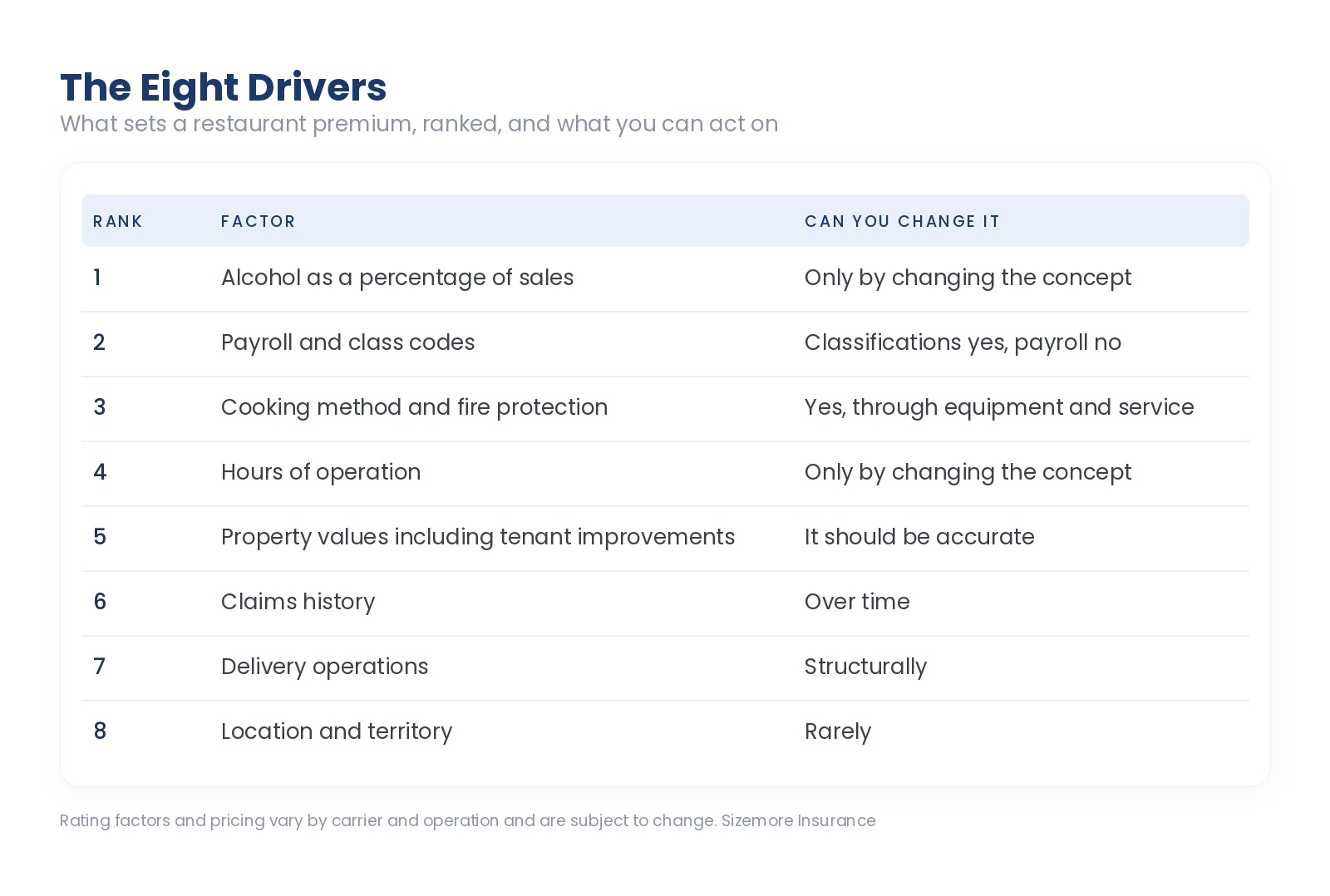
The takeaway: alcohol percentage and payroll are the two largest inputs, and neither is something you change without changing the business.
Rating factors and pricing vary by carrier and operation and are subject to change. Get a quote for your concept.
The Two Biggest
Alcohol percentage. Not whether you serve, but how much of your revenue it is. A restaurant at ten to fifteen percent alcohol is a standard market placement. A bar at seventy percent is a different market entirely, frequently surplus lines, with assault and battery as a defining question.
Payroll and classifications. Workers compensation is frequently the largest single line for a full-service restaurant, and it runs on payroll and class codes. Kitchen and service roles classify differently, and getting the split wrong produces a surprise at audit. That has its own article, and it is one of the most common ways a restaurant overpays without knowing it.
Cooking and Fire Protection
This is the one you can actually change.
Cooking method matters. Deep frying, charbroiling, and solid fuel or wood-fired cooking are treated differently from limited or no cooking, and the differences are substantial.
Hood and suppression systems are an underwriting requirement and frequently a policy condition.
Service contracts on hood cleaning and suppression testing are what turn the requirement into compliance, and they are cheap relative to what they protect.
Fire alarms and sprinklers matter as they do in any property.
A restaurant with a documented hood service contract and current suppression testing presents differently from one without, and it is among the most controllable inputs in the whole list.
Where This Gets Complicated
Late hours change the market. A venue open past midnight prices differently and frequently sits in surplus lines, with assault and battery becoming the defining exposure.
A cheap quote frequently reflects a narrower form. Named perils instead of special form, a low business income limit, or a missing equipment breakdown. Compare line by line.
Property valuation inflation raises premiums without anything changing on your end, because rebuild costs rose.
Audit results roll into the next renewal, so a payroll true-up affects two years rather than one.
Delivery has to be disclosed and it changes the auto exposure.
Lease and franchise requirements raise cost independent of risk, because a required limit is a required limit.
A new venture has no history, so year one prices on the concept rather than on performance.
Common Questions
How much does restaurant insurance cost?
It depends most on alcohol percentage, payroll, cooking method, and hours. A quote on your specific concept is the only meaningful number.
Why is my bar more expensive than a restaurant?
Alcohol percentage, hours, and assault and battery exposure. It is a different risk and frequently a different market.
What is the largest line item?
Workers compensation for most full-service restaurants, driven by payroll and classifications.
What can I actually change?
Classifications, cooking and fire protection documentation, property valuation accuracy, and claims over time.
Does a hood service contract matter?
Substantially, both for pricing and because it is frequently a condition of coverage.
Why did my premium go up with no claims?
Frequently audit results, property valuation inflation, or market conditions. Ask for the breakdown.
The Bottom Line
- Get quoted on your actual concept, including alcohol percentage and hours.
- Check your workers compensation classifications, because that is where restaurants most often overpay.
- Keep hood cleaning and suppression service current and documented.
- Value tenant improvements accurately, because it affects both premium and claims.
- Disclose delivery.
- Compare coverage line by line, because a cheap quote frequently left something out.
Sizemore Insurance is an independent insurance company founded in North Carolina in 1977, writing in both North Carolina and South Carolina. Tell us your concept, your alcohol percentage, and your hours and we will give you a real number. Insurance made just for you.
Rating factors, pricing, and market conditions vary by carrier and operation and are subject to change. Review your own situation with your advisor.