For as long as anyone in this business has been working in North Carolina, commercial property owners west of Charlotte have treated catastrophe coverage as a coastal problem. Named storms happened somewhere else. Flood was a thing you dealt with if you owned near the water.
Helene damaged buildings across the western part of this state, and a large share of it landed on buildings whose owners had never priced a flood policy. North Carolina’s December 2024 assessment put statewide damage and needs above $59.6 billion.
The point of this article is not the storm. It is the six specific gaps the storm exposed, all of which exist on inland commercial buildings today.
Gap One: No Flood Coverage at All
The most consequential and the most common.
Standard commercial property policies do not cover rising water. Owners outside mapped high-risk zones frequently carry no flood policy because no lender required one, and a lender requirement is the only prompt most owners ever receive.
Coverage outside a high-risk zone typically costs far less, which is the part that makes this gap frustrating rather than merely unfortunate. The premium on an inland commercial building is often modest relative to the building’s value.
Gap Two: Business Income That Does Not Cover Flood
Even owners who carried flood found this one.
The federal program does not cover lost rental income on a commercial building. A flood that displaces tenants for six or eight months produces an income loss NFIP will not pay, while debt service, taxes, and insurance continue.
Business income and rental value coverage for flood is available in the private market. It is a separate decision from buying the flood policy itself, and it is one of the largest uninsured exposures a leased inland commercial building carries.
Gap Three: A Period of Restoration Built for Normal Conditions
Rental value coverage responds through the period of restoration, which runs until the property should reasonably be repaired.
After a regional catastrophe, “reasonably” collides with reality. Contractors are booked. Materials are allocated. Permitting offices are processing a year of volume in a quarter. Roads and utilities may not be restored. A repair that would take four months in an ordinary year takes twelve.
Then, after the building is finished, re-tenanting takes months more in a market where every competing space is also being rebuilt.
Owners who carried the built-in extended period of indemnity discovered it is not a leasing cycle in normal conditions and is nowhere near one after a catastrophe.
Gap Four: Ordinance and Law on Older Buildings
Western North Carolina downtowns are full of masonry commercial buildings that predate current code by decades.
A substantially damaged building must frequently be repaired to today’s standards. Electrical service, egress, accessibility, structural connections, and in flood-affected areas elevation requirements. The base property policy pays to rebuild what was there.
Ordinance and law coverage has three parts, and the one owners most often lack is the increased cost of construction. It also has a time element component, which extends the rental income period when code-driven work extends the rebuild. Owners who bought the coverage frequently did not buy that part.
Gap Five: Underinsured Buildings Meeting a Coinsurance Penalty
Construction cost inflation has outrun the automatic increases on most policies. A building limit that satisfied the coinsurance requirement three years ago may not today.
Then demand surge after a catastrophe pushes local rebuild costs above even a current valuation. Owners who were marginally compliant became noncompliant at exactly the moment it mattered, and the penalty applied to partial losses as well as total ones.
Gap Six: Documentation That Did Not Exist
Claims turn on evidence. After a widespread event, adjusters are working volume and the owner who arrives with dated photographs, current leases, an accurate rent roll, and maintenance records is settled faster and more completely than the one reconstructing from memory.
Several owners could not establish pre-loss condition, which turned covered damage into a maintenance argument.
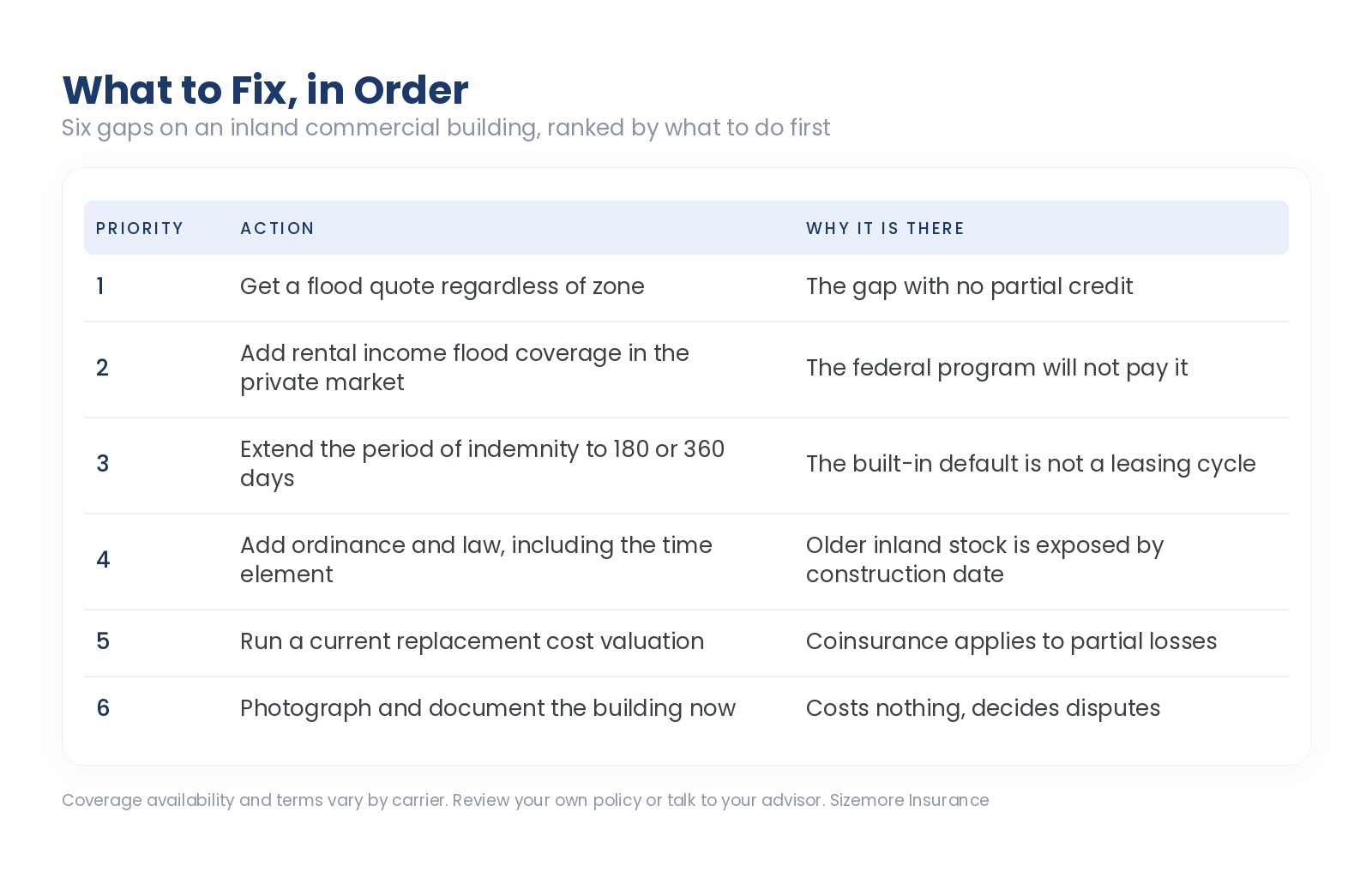
The takeaway: five of the six are purchasing decisions and the sixth is an afternoon with a camera. None of them require the building to change.
Coverage availability and terms vary by carrier. Review your own policy or talk to your advisor.
Where This Gets Complicated
Flood pricing inland is frequently low, which makes the decision feel unimportant. A small premium does not signal a small exposure. It signals a low probability against a total loss.
Not every private flood market will write a building after a regional event. Appetite tightens after losses. The window to buy is between events, not after one.
Ordinance and law limits are stated as a percentage of the building limit. If the building limit is already short, the code coverage is short by the same proportion. These two fixes compound.
Demand surge is not a covered cause of loss. It is a cost condition. The protection against it is an accurate limit plus extended replacement cost where available, not a claim argument.
Business interruption from access loss is separate. Some forms cover income loss when civil authority prevents access even without physical damage to your building, subject to conditions and a short duration. Worth confirming, and it is narrower than owners hope.
Common Questions
Does my commercial property policy cover flood?
No. Standard commercial property policies exclude it, inland and on the coast alike. Flood requires a separate policy.
I am not in a flood zone. Do I need flood insurance?
Zone designation determines what a lender requires. It does not determine whether the building can flood. Helene put water into buildings across western North Carolina that sat outside mapped high-risk zones.
Does flood insurance cover my lost rent?
Not under NFIP. Rental income coverage for flood is available in the private market and is a separate decision from the flood policy itself.
How long does business income coverage last?
Through the period of restoration, until the property should reasonably be repaired, plus whatever extended period you purchased. After a regional catastrophe, both run longer than the defaults contemplate.
Is my older downtown building at more risk than a newer one?
For ordinance and law exposure, yes, and substantially. The gap between what was built and what code now requires grows with the building’s age.
What is the cheapest thing I can do this week?
Photograph the building inside and out with dated images, and put a current rent roll and copies of your leases somewhere that is not in the building.
The Bottom Line
- Get a flood quote on every inland commercial building you own. The premium outside a high-risk zone is frequently modest and the exposure is not.
- Buy rental income coverage for flood in the private market if the building is leased.
- Extend the period of indemnity to at least 180 days. Helene made the case better than any argument could.
- Add ordinance and law with the time element on anything predating current code, which in most North Carolina downtowns is everything.
- Re-run your building valuation. Construction costs have moved and coinsurance applies to partial losses.
- Document the building now. Dated photographs, current leases, current rent roll, maintenance records, stored somewhere off site.
Sizemore Insurance is an independent insurance company that has been placing coverage in North Carolina since 1977. Send us your declarations page and we will tell you which of these six gaps is open on your building. Insurance made just for you.
Coverage, availability, and terms vary by carrier and form and are subject to policy language. Loss figures are estimates from published state reporting. Review your own policy or talk to your advisor.