Hard money and bridge deals are among the hardest insurance timelines in real estate, for two reasons that compound each other.
They close fast, sometimes in a week. And the property is frequently vacant, mid-renovation, or in condition that a standard landlord policy will not cover.
Fast plus hard to place is where closings slip.
The Coverage Question First
A hard money property is usually in one of three states, and each needs something different.
Vacant and not being worked on. A vacant property policy. Standard landlord forms restrict or exclude coverage on a vacant building, so this is not a matter of preference.
Under renovation. Builders risk, which covers the structure and frequently the materials during construction, with a policy period matched to the project.
Occupied and rented. A standard landlord policy, which is where the property ends up after the work.
Most investors need two of those three across the life of a single deal, and the handoff between them is where coverage gaps open.
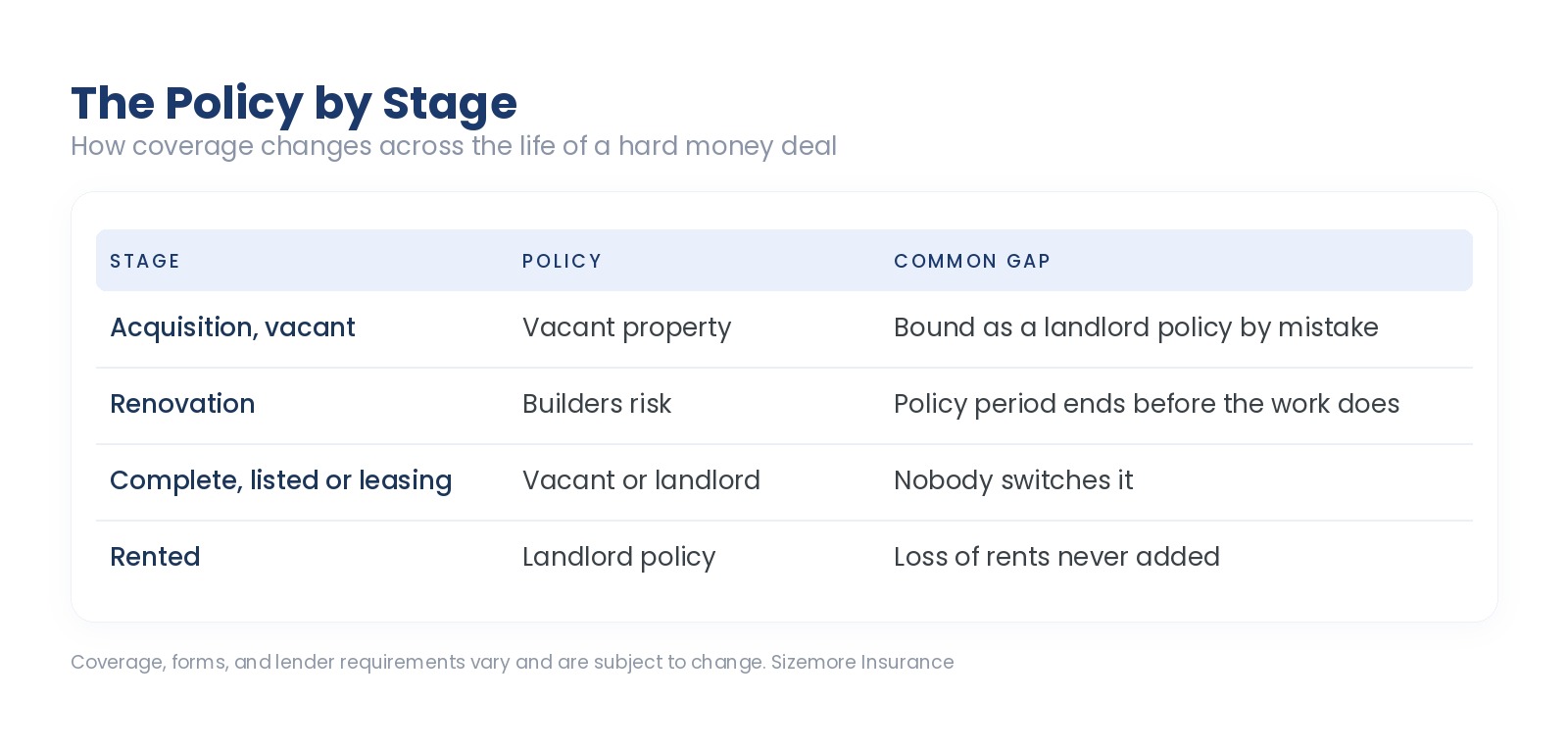
The takeaway: the policy has to change as the property does, and the moment nobody calls is the moment the coverage stops matching.
Coverage, forms, and lender requirements vary and are subject to change.
The Timeline
As soon as you have the address and the term sheet. Not the day before closing. Vacant and renovation risks take underwriting rather than a rate quote.
Two to three business days is a realistic target for a vacant or renovation placement where the information is complete. Faster is sometimes possible and it is not the plan.
Same-day is possible on a clean, eligible property with complete information, and a vacant house with a tarp on the roof is not that property.
Liability has to be in place from the moment you own it, because a vacant building with contractors coming and going is a liability exposure before it is a property exposure.
What Stalls These Deals
Condition. A roof at the end of its life, open structural work, missing systems, or fire damage. Underwriters need photographs and a scope, and getting those late costs days.
Vacancy plus condition. Either one alone is placeable. Together they narrow the market.
Scope and value mismatch. A builders risk limit should reflect the completed value or the construction cost depending on the form, and a limit pulled from the purchase price is frequently wrong.
Late entity formation. The LLC does not exist yet or its name is not final.
Lender requirements arriving late, particularly a required liability limit or a loss payee structure that differs from a conventional deal.
No liability quoted, because the borrower asked for property coverage only and the lender requires both.
Where This Gets Complicated
Builders risk policy periods end. A three-month policy on a six-month project leaves the back half uncovered, and extensions have to be requested before expiration rather than after.
Theft of materials is a real loss on an active renovation and coverage for it varies by form.
Contractor insurance is not your coverage. Verify certificates and be named as an additional insured, and carry your own liability regardless.
Acting as your own general contractor shifts exposure onto you and it has its own considerations.
The refinance at the end frequently converts to a DSCR loan, which triggers a new document review and a landlord policy with loss of rents.
A property that sits after the work is vacant again, which means the coverage changes again.
Loss payee versus mortgagee wording on a hard money loan can differ from a conventional mortgagee clause. Take it from the lender’s instructions.
Common Questions
Can I use a landlord policy on a vacant house?
Generally not. Standard forms restrict or exclude coverage on a vacant building.
What is builders risk?
Coverage for the structure and frequently materials during construction, with a policy period matched to the project.
How fast can this be placed?
Two to three business days is realistic on a vacant or renovation risk with complete information. Same day is possible on a clean, eligible property.
What do you need from me?
The address, the term sheet, photographs, the renovation scope and budget, the entity name, and the lender’s requirements.
Do I need liability during the rehab?
Yes. Contractors and visitors are a liability exposure from the day you own it.
What happens when the work finishes?
The policy changes again, to vacant if it sits or to a landlord policy with loss of rents when it rents.
The Bottom Line
- Call as soon as you have the address, not the day before closing.
- Send photographs and the scope, because condition drives the placement.
- Match the policy to the stage, vacant, renovation, or rented.
- Watch the builders risk expiration and extend before it lapses.
- Carry your own liability regardless of contractor certificates.
- Call again when the property changes, because it changes two or three times in one deal.
Sizemore Insurance is an independent insurance company founded in North Carolina in 1977, writing in both North Carolina and South Carolina. Send the address, the scope, and the term sheet and we will tell you the same day whether it is placeable and how fast. Insurance made just for you.
Coverage, forms, timelines, and lender requirements vary by carrier and lender and are subject to change. Nothing here is a coverage determination. Review your own policy or talk to your advisor.