

A bad two years on a driving record feels permanent while you are paying for it. It is not.
North Carolina prices records on a defined clock, and everything on that clock eventually expires. What determines how fast you recover is a short list of things you control, and one of them costs nothing but timing.
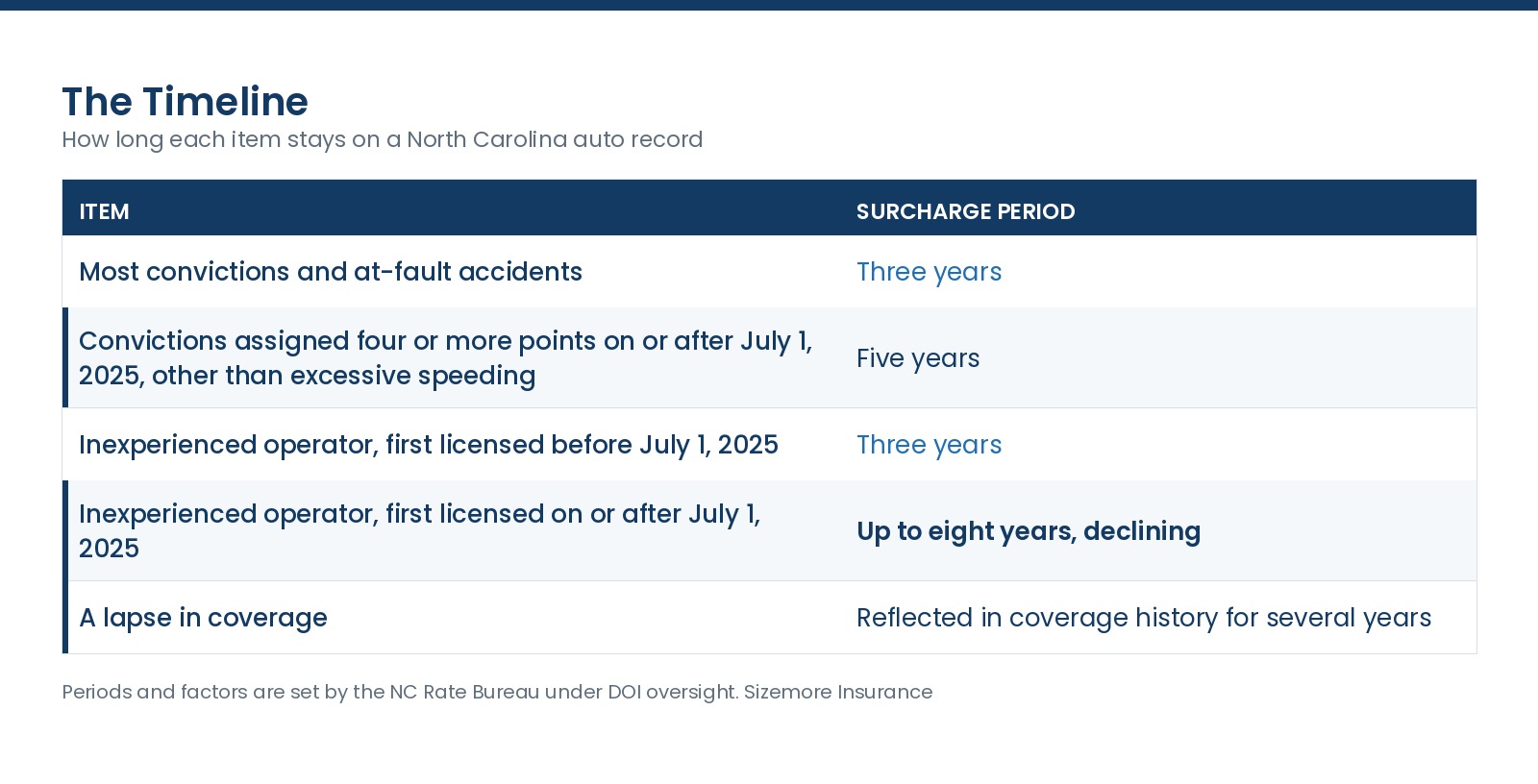
The takeaway: know your dates. One of the highest-value hours available to a surcharged North Carolina driver is re-shopping the month after the largest surcharge expires.
Periods and factors are set by the North Carolina Rate Bureau under Department of Insurance oversight and are subject to change.
Never let coverage lapse. This is the biggest one. A gap does two things at once: it produces its own penalties through DMV, and it removes the continuous coverage history that carriers use to evaluate you. On top of an existing surcharge it substantially extends the recovery.
Do not add anything new. Obvious and worth saying. Each additional conviction restarts a clock and compounds the effect.
Protect the household Prayer for Judgment allowance. One per household within the applicable window. If your record is already carrying a surcharge, that allowance is worth more, not less.
Consider your limits. Minimum-limits drivers with no physical damage coverage present differently than drivers carrying real limits and full coverage. Carrier appetite for retaining rather than ceding the risk reflects the whole account, not just the record.
Look at telematics. A usage-based program can demonstrate current driving behavior in a way a three-year-old conviction does not. Not every carrier offers one that helps here, and it is worth asking.
Keep the household clean. Carriers rate the household. A second driver with their own issues affects the account.
Not continuously. At specific moments.
The month a surcharge expires. This is the one. Calendar it now.
When a driver leaves the household. Removing a surcharged driver changes the account materially.
When a young driver crosses an experience threshold.
After a year of continuous coverage following a lapse.
When you add or change vehicles, because appetite differs by vehicle type.
Shopping outside those moments rarely changes much, because SDIP surcharges are standardized statewide and every carrier applies the same one.
Shopping cannot remove the surcharge. It can change the base rate the surcharge multiplies against, and it can change whether a carrier retains the risk or cedes it to the Reinsurance Facility. Both are worth something and neither is the surcharge itself.
Cession is not permanent. As points expire and continuous coverage builds, more carriers become willing to retain the business. That is a gradual, renewal-by-renewal change rather than a single event.
Non-standard carriers are a legitimate stop. Private companies specializing in harder risks exist and they are not the same as the Facility. On a difficult record they sometimes price better.
Do not cut coverage to survive the surcharge. Dropping to minimum limits saves money in the short run and can slow the recovery, because it affects how the account is viewed.
A named driver exclusion can help a household where one driver's record is the problem and that driver will genuinely not be operating a vehicle. It is a serious step with real consequences.
Continuous coverage matters even on a stored vehicle. If it stays registered in North Carolina, it needs coverage.
How long until my rate goes back to normal?
Three years for most items and five for serious convictions occurring on or after July 1, 2025. The clock runs from the conviction, not from when you noticed.
Can I do anything to speed it up?
Not the clock itself. You can avoid extending it, maintain continuous coverage, and re-shop at the right moment.
Will a defensive driving course help?
It does not remove SDIP points. It can be relevant to license points in some circumstances.
Should I switch to a cheaper company now?
Compare coverage as well as price, and understand that the surcharge follows you. The base rate is what differs.
What is the single most important thing?
Do not let coverage lapse, and calendar your expiration dates.
When do I call you?
The month before your largest surcharge expires, and any time a driver or vehicle changes.
Sizemore Insurance is an independent insurance company that has been placing coverage in North Carolina since 1977. Send us your record and we will map the expiration dates and tell you exactly when to call. Insurance made just for you.
Surcharge factors, periods, and eligibility rules are set by the North Carolina Rate Bureau under Department of Insurance oversight and are subject to change. Review your own policy or talk to your advisor.