General liability is the foundation of a restaurant program and the policy most owners assume covers more than it does.
It covers a great deal. Four things it does not cover are the four things most likely to happen in a restaurant.
What It Covers
Bodily injury to guests. Slips, falls, burns, and injuries on your premises. A common claim in the category.
Property damage to others. Damage you cause to a neighboring space, a customer’s property, or the landlord’s building.
Products and completed operations, which in a restaurant means food. A foodborne illness claim generally sits here.
Personal and advertising injury, including certain claims arising from your business communications.
Defense costs, generally in addition to the limit, which matters because defending a claim that pays nothing is still expensive.
Medical payments, a small no-fault amount that resolves minor guest injuries before they become claims.
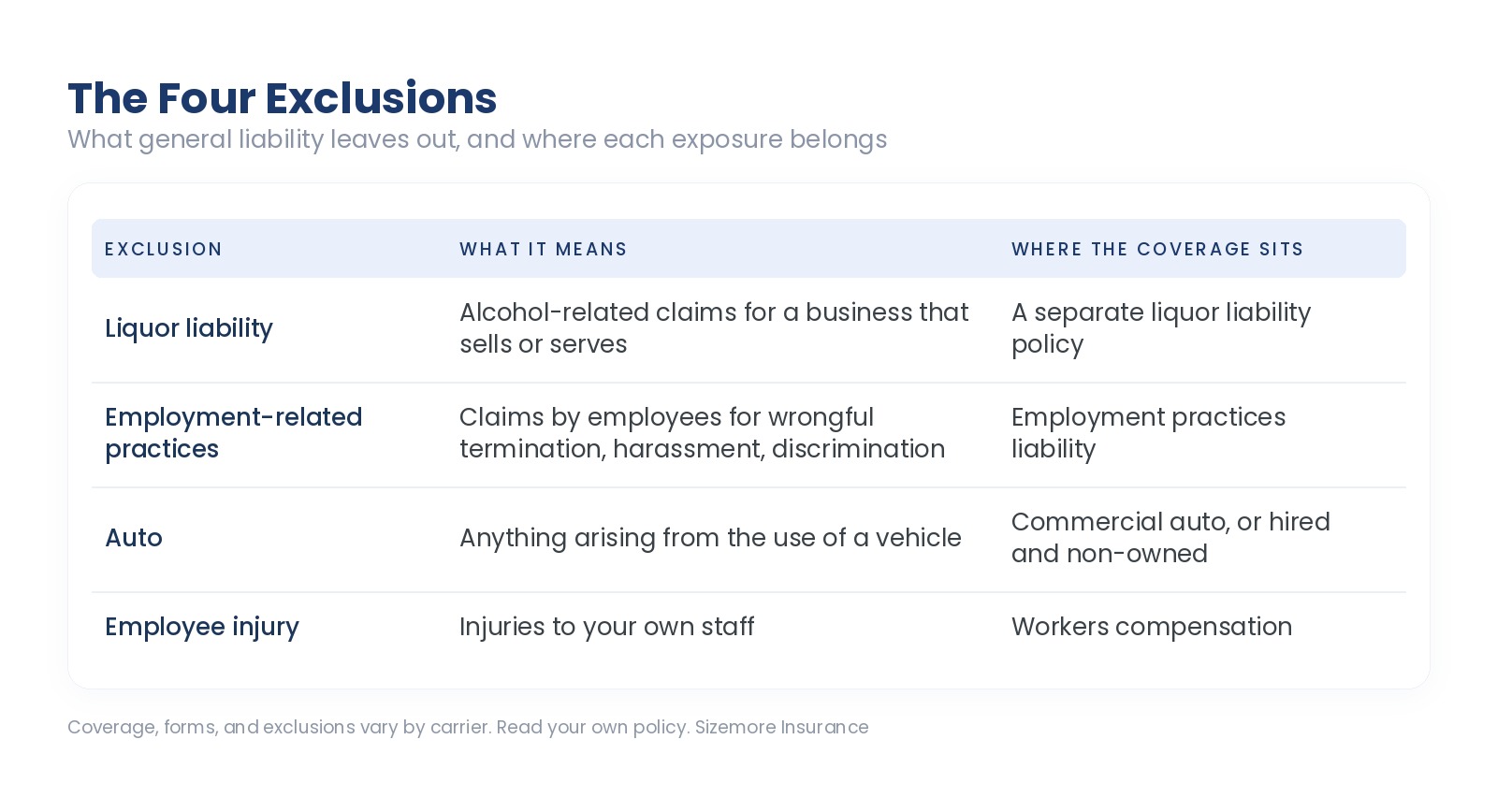
The takeaway: a restaurant with alcohol, employees, and delivery has three exposures general liability does not touch, and all three are common.
Coverage, forms, and exclusions vary by carrier. Read your own policy.
Assault and battery deserves separate mention. Many hospitality policies, particularly for bars and late-night venues, exclude or sharply sublimit it. That is among the most serious claims in a nightlife operation and it has its own article.
The Limit Structure
Per occurrence, the most paid for one claim.
General aggregate, the most paid across the policy period for most coverages.
Products and completed operations aggregate, a separate aggregate for food-related claims. This one is worth knowing exists, because a foodborne illness event producing many claims draws on it.
Damage to premises rented to you, a sublimit for fire and sometimes other damage to the space you lease. On a restaurant this sublimit is frequently too low relative to a kitchen fire in a leased building, and raising it is inexpensive.
That last one gets overlooked constantly and it is worth checking today.
Where This Gets Complicated
Your lease requires a specific limit and frequently additional insured status, a waiver of subrogation, and primary and non-contributory wording. Each is a separate request with a cost.
Food safety claims can produce many claimants from one event, which is where the products aggregate matters.
Catering and off-premises events extend your operations beyond the insured location, and whether that is contemplated is worth confirming.
Live entertainment changes the risk picture and frequently the market.
Outdoor seating and sidewalk areas may involve municipal permits and their own requirements.
An umbrella sits above it and needs the underlying limits maintained.
A certificate is not coverage. It confirms coverage existed on the day it was issued.
Common Questions
What does general liability cover for a restaurant?
Guest injuries, property damage you cause, food-related claims, and defense costs.
Does it cover alcohol claims?
Generally not for a business that sells or serves alcohol. That requires liquor liability.
Does it cover employee injuries?
No. That is workers compensation.
Does it cover a fight in my bar?
Depends on whether assault and battery is excluded or sublimited, which on many nightlife policies it is.
What is damage to premises rented to you?
A sublimit for damage to your leased space. It is frequently too low for a restaurant and it is inexpensive to raise.
Do I need general liability if I have a BOP?
A business owners policy includes general liability. It is the same coverage in a bundled form.
The Bottom Line
- Check the damage to premises rented to you sublimit, because a kitchen fire in a leased space can exceed it.
- Confirm your lease requirements are met, including additional insured and waiver wording.
- Add liquor liability separately if you serve alcohol.
- Ask about assault and battery if you run a bar or late-night venue.
- Confirm catering and off-premises work is contemplated if you do it.
- Add employment practices liability, because employee claims are excluded here.
Sizemore Insurance is an independent insurance company founded in North Carolina in 1977, writing in both North Carolina and South Carolina. Send us your declarations page and your lease and we will tell you whether the limits match what you signed. Insurance made just for you.
Coverage, forms, exclusions, and sublimits vary by carrier and are subject to change. Nothing here is a coverage determination. Review your own policy or talk to your advisor.