Three things close restaurants that have nothing to do with fire, and none of the three are covered by a standard property policy.
A health department closure. A contamination event. A power outage that lasts two days.
Food Contamination Coverage
This responds when a contamination event forces you to close or discard product.
What triggers it varies by form and typically includes a health department closure order, a foodborne illness event traced to your restaurant, or the discovery of contamination.
What it pays frequently includes lost income during the closure, the cost of discarding and replacing contaminated stock, cleaning and decontamination, employee medical testing where required, and in some forms public relations expense to address the reputational damage.
That last one matters more than it sounds. A restaurant named in a health department action loses business after reopening, and communication cost is a real part of recovery.
What it is not. This is separate from the products liability coverage under your general liability policy, which responds to a third party’s injury claim. Contamination coverage responds to your own loss.
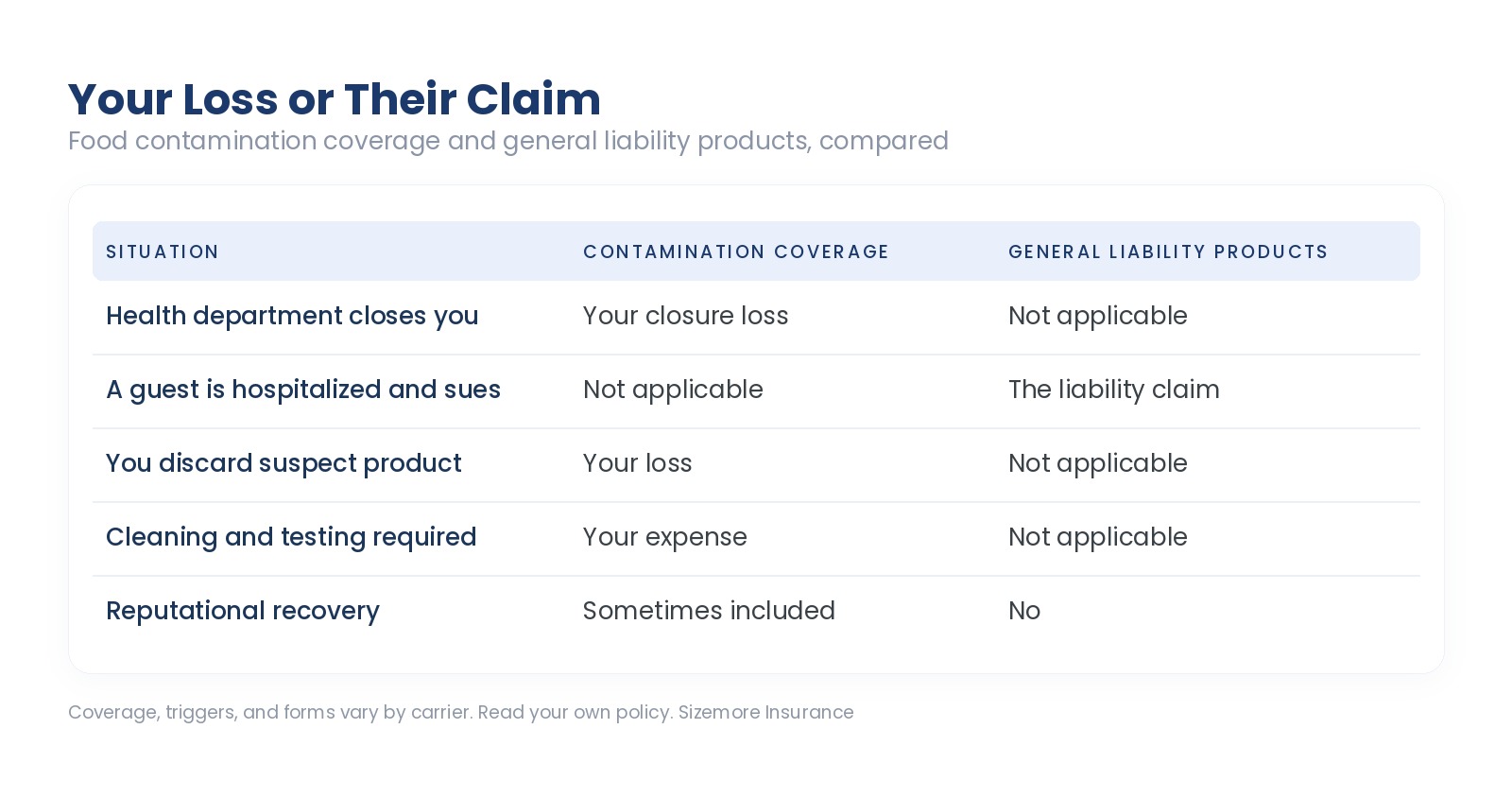
The takeaway: contamination coverage is your loss and products liability is their claim, and a foodborne illness event produces both.
Coverage, triggers, and forms vary by carrier. Read your own policy.
Recall
Related and distinct. Recall coverage addresses the cost of withdrawing product, which matters most for restaurants that package or distribute, breweries, and operations with a retail or wholesale component.
A single-location restaurant serving prepared food has less recall exposure and more contamination exposure. A brewery distributing to accounts has both.
Utility Interruption
A power failure originating off your premises is not damage to your property, and business income coverage generally requires direct physical damage.
Utility interruption coverage extends business income to losses caused by an off-premises failure of power, water, gas, or communications.
The settings that matter:
Whether overhead transmission lines are included. Many forms exclude damage to overhead lines, which in a storm is a common way power fails. Ask specifically, because this exclusion defeats the coverage in exactly the scenario you bought it for.
The waiting period, frequently a stated number of hours before coverage begins. A four-hour outage may produce no claim.
Which utilities are covered, because water and communications are sometimes separate from power.
Whether spoilage is included, since a power failure produces both a closure and a product loss and they can sit under different coverages.
Where This Gets Complicated
Storm outages are the common case in the Carolinas, and the overhead transmission line exclusion is the reason a claim fails.
A health department closure for a violation rather than a contamination event may not trigger contamination coverage. Read the trigger language.
Reporting is immediate. Contamination claims involve regulators and the sequence matters.
Supplier contamination may be a dependent property question rather than yours.
Documentation is the claim. Product counts, temperature logs, health department correspondence, and cleaning invoices.
Prevention is cheaper than any of it. Temperature logs, documented food safety practices, and staff training reduce both the frequency and the defensibility question.
Common Questions
Does my policy cover a health department closure?
Only with food contamination coverage, and the trigger language determines which closures qualify.
Is that the same as products liability?
No. Contamination covers your loss. Products liability under general liability covers a third party’s claim.
Does business income cover a power outage?
Generally not without utility interruption coverage, because there is no physical damage to your property.
What is the overhead transmission line exclusion?
A common exclusion that removes coverage when power fails because of damage to overhead lines, which is frequently how it fails in a storm. Ask about it specifically.
Is there a waiting period?
Frequently. A short outage may produce no claim.
Do I need recall coverage?
More if you package or distribute. A single-location restaurant has more contamination exposure than recall exposure.
The Bottom Line
- Add food contamination coverage and read what triggers it.
- Add utility interruption and ask specifically about overhead transmission lines.
- Confirm the waiting period and which utilities are included.
- Keep temperature logs and food safety documentation, because they are the defense.
- Report a contamination event immediately, because regulators are involved and sequence matters.
- Ask about recall if you package, distribute, or wholesale anything.
Sizemore Insurance is an independent insurance company founded in North Carolina in 1977, writing in both North Carolina and South Carolina. Tell us how you operate and we will tell you which of these three you actually need. Insurance made just for you.
Coverage, triggers, exclusions, and forms vary by carrier and are subject to change. Nothing here is a coverage determination. Review your own policy or talk to your advisor.