

Flood maps get revised. New engineering, new development, new elevation data, and a property that was outside a high-risk zone can find itself inside one.
When that happens, owners who already had a policy are frequently treated more favorably than owners who did not. That is one of the best arguments for buying coverage before anyone requires you to, and almost nobody makes it.
A property moves into a high-risk zone. The mandatory purchase requirement attaches on a federally backed loan, and the lender will notify you, generally with a deadline.
A property moves out. The requirement lifts, and the risk does not.
Base flood elevations change without the zone changing, which affects rating and construction requirements.
Newly mapped properties have a defined window in which purchasing coverage receives more favorable treatment. That window is short and it closes.
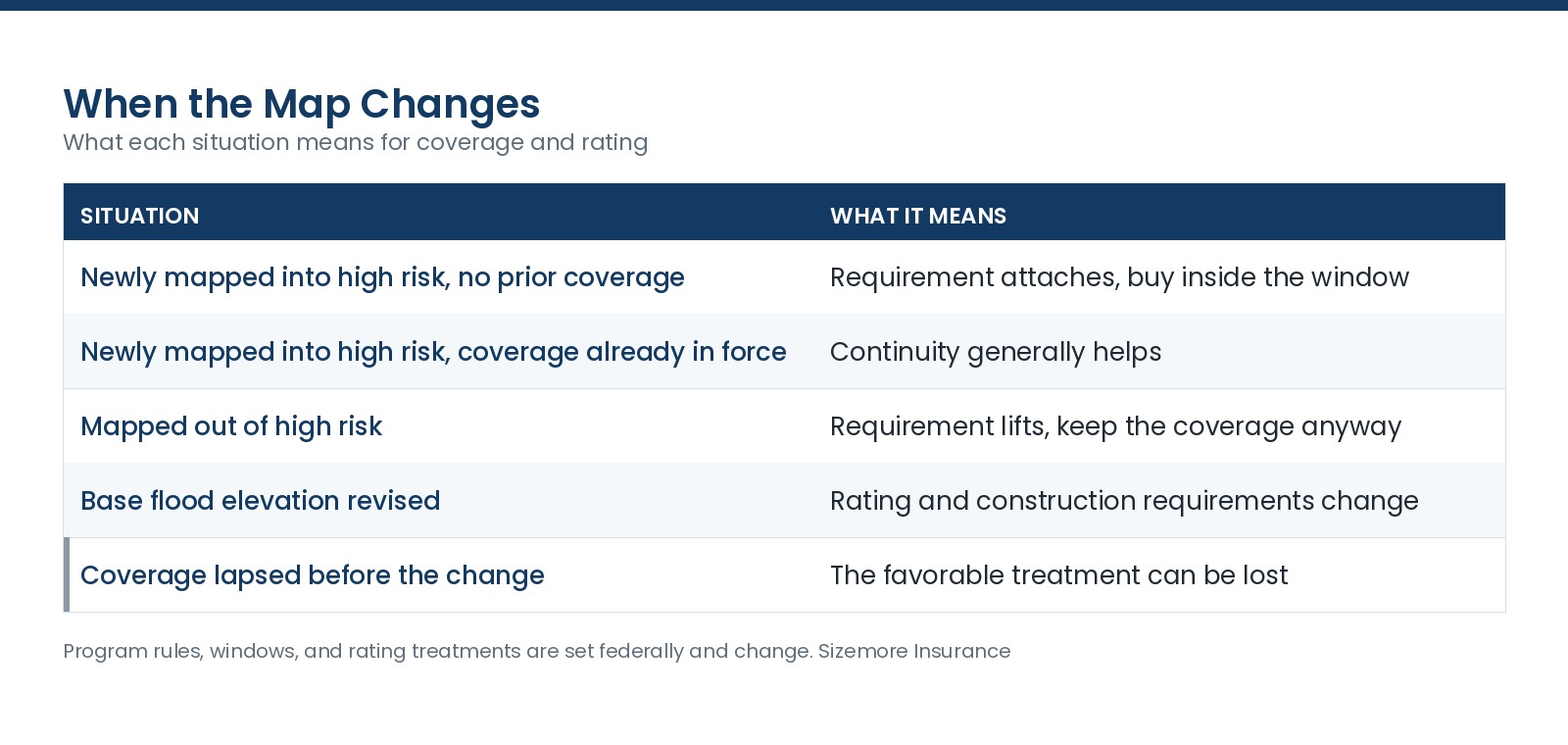
The takeaway: the favorable treatment attaches to continuity, and a lapse is what forfeits it.
Program rules, windows, and rating treatments are set federally and are subject to change. Confirm current rules.
Under current federal rating, maintaining coverage without interruption can affect how a property is treated, particularly across a map change. The specific mechanics have changed over the last several years and the principle has not: continuity is rewarded and a lapse is costly.
That means three practical things.
Do not cancel when a mandate lifts. An owner who is mapped out of a high-risk zone and cancels has traded a requirement for an exposure, and they lose the continuity if the map moves back.
Do not let it lapse for nonpayment. A cancelled policy reinstated later can be treated as a new purchase, with a new waiting period and without the continuity.
Buy before you are required to. An owner who bought voluntarily in a low-risk zone and is later mapped into a high-risk one is in a materially better position than a neighbor who waited.
The rules changed with the current rating methodology, and traditional grandfathering as it existed for decades works differently now. This is an area where general information ages quickly, so confirm your specific situation rather than relying on what was true five years ago.
The newly mapped window is short. If your community is going through a map revision, act during the window rather than after.
Community-wide revisions are announced in advance, and your floodplain administrator can tell you what is coming.
A lender notification is not the start of the process, it is the end of it. By the time the letter arrives, the map has changed.
Selling a property with a policy in force raises the assumption question, since a federal flood policy can frequently be assigned to a buyer, carrying the effective date and the continuity with it. That is a genuine benefit at closing and it is covered separately in this section.
Private flood does not participate in these federal mechanics, which is a consideration if you are thinking about leaving the federal program entirely.
What happens if my property is mapped into a flood zone?
The mandatory purchase requirement attaches on a federally backed loan, and there is a window in which buying receives more favorable treatment.
Should I cancel if I am mapped out?
No. The requirement lifted and the water did not, and you would lose the continuity if the map moves back.
Does having coverage already help?
Generally yes. Continuity is rewarded across map changes.
What happens if my policy lapses?
Reinstating later can be treated as a new purchase, with a new waiting period and without the continuity.
Do these rules still work the way they used to?
The mechanics changed with the current rating methodology. Confirm your specific situation rather than relying on older guidance.
How do I find out if a map change is coming?
Your community's floodplain administrator, and we watch for them too.
We have been an independent insurance company in North Carolina since 1977. Send us the address and we will tell you what your zone is now, what is coming, and what your continuity is worth. Insurance made just for you.
Program rules, rating treatments, and mapping procedures are set federally and are subject to change. Review your own situation with your advisor and your local floodplain administrator.