A 1998 office building, acquired in 2017, insured at $1,800,000. Current replacement cost is $2,900,000. The policy carries 90 percent coinsurance, a $10,000 deductible, and replacement cost valuation.
A fire in the mechanical room produces $400,000 in damage. Not close to a total loss. The owner expects $390,000.
The actual payment is roughly $276,000 before the deductible, and about $266,000 after. That is a shortfall of about $124,000 on a partial loss, and there is no dispute to appeal. The policy is working exactly as written.
This is one of the most expensive errors in commercial property insurance and it is almost entirely silent until a claim.
What Coinsurance Is
Coinsurance is not a coverage. It is a condition.
The insurer prices the policy on the assumption that you will insure the building to a stated percentage of its replacement cost, commonly 80, 90, or 100 percent. In exchange, you get a rate that reflects the full spread of small and large losses across the book.
If you insure below that percentage, you have been paying a rate built for a larger limit. The coinsurance clause corrects for that by reducing your recovery in proportion to how far short you fell.
The formula is straightforward. Divide the limit you carried by the limit you were required to carry. Apply that fraction to the loss. Then subtract the deductible.
The Math
Using the building above: $2,900,000 replacement cost, 90 percent requirement, $400,000 loss, $10,000 deductible.
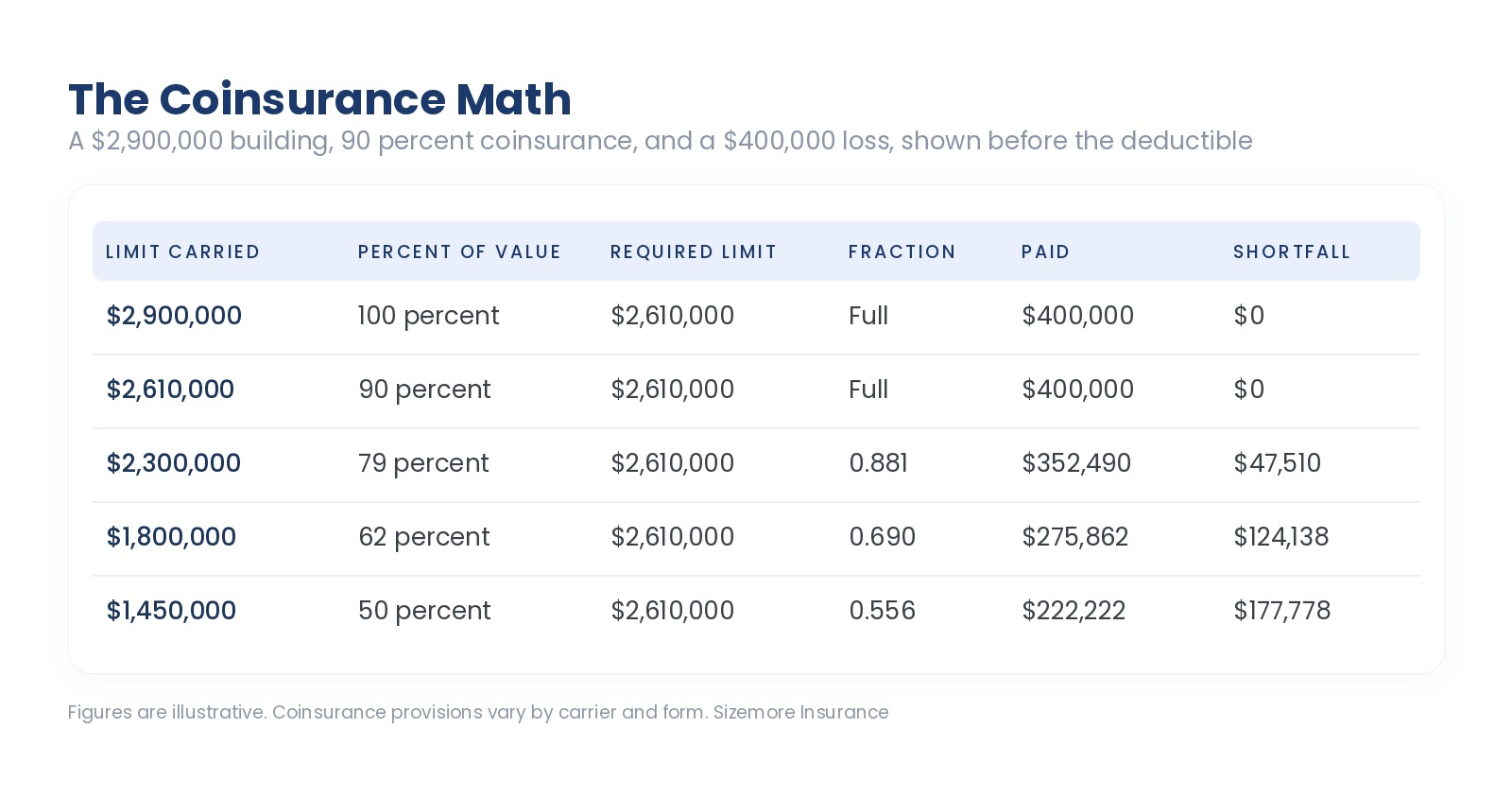
The takeaway: carrying exactly the required percentage pays the loss in full. Coinsurance is a threshold, not a sliding scale, until you drop below it. Above the line there is no penalty at all.
Coinsurance percentages, formulas, and settlement provisions vary by carrier and form. Figures above are illustrative. Your own policy language governs.
Note the third row. A building at 79 percent against a 90 percent requirement is only 11 points short and still gives up nearly $48,000 on a $400,000 loss. Small shortfalls are not proportionally small penalties.
Why It Applies to Partial Losses
This is the part that surprises owners, and it is the reason coinsurance matters more than people think.
Underinsurance feels like a total-loss problem. If the building burns to the ground and I only carried 60 percent, I collect 60 percent. That reasoning is intuitive and it is wrong about which losses are affected.
Coinsurance applies to every covered loss. A $40,000 water loss on a building at 62 percent of value pays roughly $27,600 before the deductible. Most commercial property claims are partial losses, which means the penalty is not a remote catastrophe scenario. It is the ordinary case.
How Limits Drift Below the Line
Nobody sets out to underinsure a building. Four mechanisms do it quietly.
Inflation guard undershoots. Most policies apply an automatic annual increase to the building limit, frequently 2 to 4 percent. Construction costs in North Carolina have moved faster than that in several recent years. A limit rising 3 percent against 7 percent actual cost inflation loses ground every year while appearing to keep pace.
The original number was never right. Limits set to the loan amount, the purchase price, or a quick figure at closing are frequently short from day one. A lender requires enough coverage to protect its collateral position, which is a different number from rebuild cost.
Improvements go unreported. A new roof, a build-out, an addition, upgraded mechanicals. Each raises replacement cost and none of them update the policy on their own.
Market value gets substituted for rebuild cost. On a property where the land carries significant value, market price and replacement cost diverge sharply. In a soft market the reverse happens and owners insure to a depressed market value.
Where This Gets Complicated
Agreed value suspends the clause. Many carriers will offer an agreed value option based on a signed statement of values. It removes the coinsurance penalty risk for the policy term, in exchange for agreeing on the value up front and usually a modest premium adjustment. On a building where valuation is uncertain, this is the cleanest fix available.
Blanket coverage does not automatically solve it. A blanket limit across several buildings helps, but many blanket policies carry a margin clause limiting recovery on any single building to a stated percentage of the value reported for it. That reintroduces the same problem at the building level. A stale statement of values under a margin clause is coinsurance by another name.
A stated 100 percent requirement is not safer than 80 percent. Higher requirements mean less room for error. On a building with uncertain valuation, an 80 percent requirement is more forgiving than a 100 percent one, though it also means a larger uncovered gap in a total loss. This is a real tradeoff worth discussing rather than defaulting.
Ordinance and law sits outside the calculation. Coinsurance is measured against the cost to rebuild what exists. Code upgrades are a separate exposure with a separate limit, and satisfying the coinsurance requirement does nothing for the code gap.
Business personal property has its own coinsurance. The building and the contents are typically separate items with separate limits and separate requirements. Satisfying one does not satisfy the other.
The value is measured at the time of loss, not at binding. A limit that satisfied the requirement at renewal can fall short nine months later after a year of cost inflation. This is why the check is annual rather than occasional.
Common Questions
What does 80 percent coinsurance mean?
It means you agreed to insure the building for at least 80 percent of its replacement cost. Insure below that and the policy reduces your claim in proportion.
Does coinsurance apply if my loss is small?
Yes. It applies to every covered loss, which is why partial losses are where owners most often discover it.
How do I know if I am underinsured?
Compare your building limit to a current replacement cost valuation. If the limit divided by replacement cost is below your coinsurance percentage, you are exposed today.
How much does it cost to raise the limit?
Frequently less than owners expect, because the rate applies per unit of coverage and the additional layers are not the most expensive part of the risk. Compare the premium difference against the shortfall in the table above and the decision is frequently clear.
Can I get rid of coinsurance entirely?
Agreed value suspends it for the policy term. Some carriers offer forms without a coinsurance condition. Both are worth asking about, particularly on a building where valuation is hard to pin down.
Is market value the same as replacement cost?
No. Market value includes land and reflects demand. Replacement cost is what a contractor would charge to rebuild the structure today. On many properties they are far apart in either direction.
The Bottom Line
- Get a current replacement cost valuation on every building you own. Not the tax value, not the purchase price, not the loan amount. If the limit divided by replacement cost is below your coinsurance percentage, you are already exposed on partial losses.
- Ask about agreed value. On a building where the valuation is uncertain, this is the most direct way to remove the risk.
- If you carry blanket limits, check for a margin clause and confirm your statement of values is current. Blanket coverage with a stale schedule is not the protection owners assume.
- Report improvements when they happen. Roofs, build-outs, additions, and mechanical upgrades all move replacement cost.
- Re-check annually. Construction cost inflation moves faster than automatic policy increases, which means a limit that was adequate last year may not be this year.
Sizemore Insurance is an independent insurance company that has been placing coverage in North Carolina since 1977. We run replacement cost valuations on your buildings, test your limits against the coinsurance condition in your own form, and price agreed value alongside it so you can see the tradeoff. Insurance made just for you.
Coinsurance provisions, valuation methods, and endorsement availability vary by carrier and form. Figures above are illustrative. Review your own policy or talk to your advisor.