Two facts govern flood coverage on a commercial building in this state, and most owners know neither.
The first is that standard commercial property policies do not cover flood. Not on the coast, not inland.
The second is that the federal program caps non-residential coverage at $500,000 for the building and $500,000 for contents. On a building with a $2,800,000 replacement cost, buying the maximum NFIP policy leaves $2,300,000 uncovered while producing a document that satisfies the lender.
Compliant and covered are two different conditions. Here is how to build for the second one.
What Counts as Flood
The distinction that decides which policy responds is where the water originated.
Your property policy handles: rain entering through an opening the wind created, a burst supply line, a failed water heater, a sprinkler discharge, a roof failure letting weather in. Water arriving from above or from inside the building.
Flood handles: rising water, storm surge, a river or creek out of its banks, surface water flowing across the ground and into the structure, mudflow.
After a hurricane, this is exactly how the claim gets divided. Wind damage to the roof goes to the property policy, subject to the named storm deductible. Water that rose into the ground floor goes to the flood policy, if one exists. One storm, two policies, two adjusters.
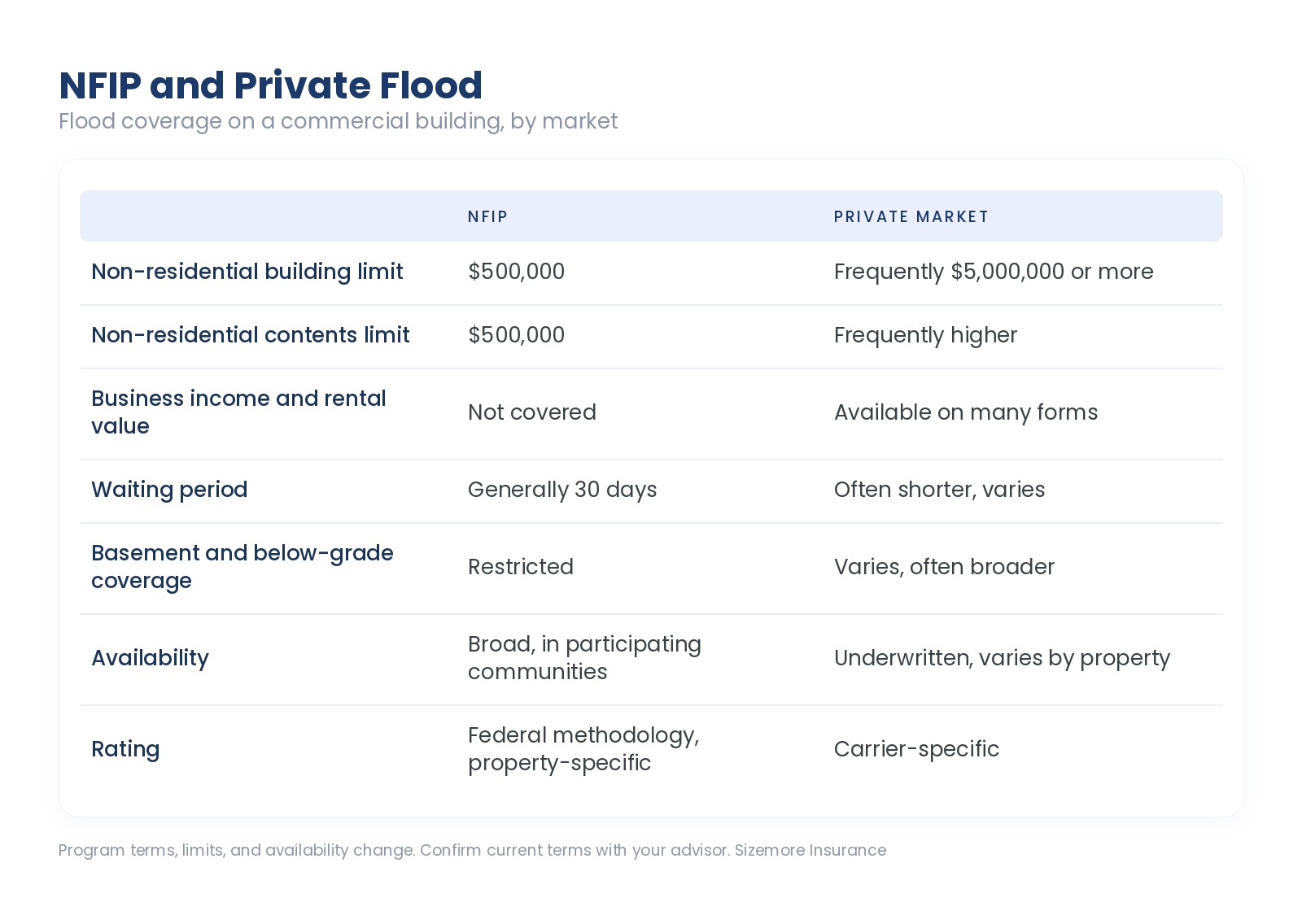
The takeaway: NFIP is a floor, not a program. On any commercial building above roughly $500,000 in replacement cost, the federal policy is the primary layer and private or excess flood is what actually covers the building.
Program terms, limits, and availability change. Confirm current terms with your advisor.
The business income line in that table deserves attention on its own. NFIP does not cover lost rental income. On a leased commercial building, a flood that displaces tenants for eight months produces an income loss the federal policy will not touch. That is frequently one of the largest uninsured exposures in a flood event and it is only solvable in the private market.
Why the Flood Map Is Not the Answer
Helene put water into buildings well inland, in places whose owners had never considered themselves at flood risk. North Carolina’s December 2024 assessment put statewide damage and needs above $59.6 billion, a large share of it in the western part of the state.
Three reasons the maps understate exposure.
Maps lag the watershed. Upstream development, new impervious surface, changed drainage, and a culvert sized for 1994 conditions all change how water moves. Map revisions do not keep pace.
Rainfall events have exceeded the design assumptions. The storms of the last decade have repeatedly delivered more water in less time than the infrastructure was built to carry.
Zone designations describe areas, not lots. Being outside a mapped high-risk zone says something about a broad area. It says very little about your grade, your parking lot, or the ditch behind your property line.
There is also a pricing argument. Coverage on a commercial building outside a high-risk zone is typically far less expensive than coverage inside one, which makes it one of the better value decisions available on an inland commercial property.
Where This Gets Complicated
Lender requirements are sized to the loan. For a federally regulated lender, flood coverage in a Special Flood Hazard Area is mandatory, and the required amount is generally the lesser of the loan balance, the replacement cost, or the maximum available under the program. That satisfies the loan. It does not rebuild the building.
The 30-day waiting period is absolute in practice. NFIP coverage generally does not take effect for 30 days, with narrow exceptions tied to loan closings. Flood cannot be purchased once a storm has a name. Every hurricane season somebody asks in the last week of August.
Basements and below-grade space are restricted. NFIP coverage for finished space and contents below grade is limited. On a commercial building with a below-grade level, understand those limits before assuming the space is protected.
Contents are a separate purchase. Building coverage and contents coverage are two decisions. A building-only flood policy leaves everything inside uncovered, including tenant property you may be responsible for.
Rebuilding may trigger elevation requirements. A substantially damaged building in a flood zone can be required to elevate or otherwise comply with current standards during repair. NFIP increased cost of compliance provisions address part of that, and ordinance and law coverage on the property policy addresses another part. Neither is automatic.
Excess flood sits above a required primary. Most excess flood markets require an underlying NFIP policy at the maximum available limit. Structuring it in the wrong order creates a gap.
An elevation certificate can change the price materially. Under current federal rating methodology, property-specific characteristics drive the premium. On a commercial building, obtaining an elevation certificate is frequently worth the cost.
Common Questions
Does commercial property insurance cover flood?
Standard commercial property policies exclude it. Flood requires a separate policy, whether federal or private.
How much flood insurance can I buy on a commercial building?
NFIP caps non-residential coverage at $500,000 building and $500,000 contents. Above that, coverage comes from the private or excess flood market.
Do I need flood insurance if I am not in a flood zone?
It is not required by a lender outside a mapped high-risk zone, and it typically costs far less there. Helene put water in places outside the mapped zones, across a wide area of this state.
Is storm surge covered by flood or by wind?
Flood. Surge is rising water regardless of what pushed it.
Does flood insurance cover lost rent?
Not under NFIP. Business income and rental value coverage for flood is available in the private market and is often the largest gap in a commercial flood program.
When should I buy it?
Outside hurricane season, because of the 30-day waiting period.
The Bottom Line
- Get a flood quote on every commercial building you own, mapped zone or not. Not a discussion about whether you need it. A quote, with a number.
- If replacement cost exceeds $500,000, plan for two layers. NFIP as primary, private or excess above it. Structure the order correctly.
- Buy business income and rental value flood coverage in the private market. On a leased building this is the exposure the federal program will not touch.
- Obtain an elevation certificate on any building where the rating is uncertain.
- Buy contents coverage separately, and confirm what you are responsible for under your leases.
- Do it before hurricane season. The waiting period does not make exceptions.
Sizemore Insurance is an independent insurance company that has been placing coverage in North Carolina since 1977. We quote your address, structure the primary and excess layers so there is no gap between them, and price the rental income coverage the federal program does not offer. Insurance made just for you.
Flood program terms, limits, waiting periods, and rating methodology are set federally and by private carriers and are subject to change. Loss figures are estimates from published state reporting. Review your own policy or talk to your advisor.