Chapel Hill, Boone, Raleigh, Greenville, Wilmington, Columbia, Clemson. This question comes up every August.
The short answer is that a parent’s policy frequently extends to a student away at school, and there are three specific situations where it stops.
Many homeowners policies extend some coverage to a dependent student living away at school, at a reduced limit.
Typically a percentage of the parent’s personal property coverage, which sounds like plenty and is capped lower than people expect.
The student generally has to qualify as a resident of the household, which usually means a dependent enrolled in school, sometimes with an age limit.
Liability coverage frequently extends as well, which is the more valuable part.
Ask your carrier for the specifics, because the percentage, the age limit, and the residency definition all vary and they decide the answer.
1. The student is no longer a dependent living away at school. Graduating, moving off the parents’ support, aging out of the policy’s definition, or taking time off can all end it.
2. The student moves off campus into a lease. This is the important one. Coverage may still extend depending on the form, and many carriers treat an off-campus apartment differently from a dorm, and the landlord will frequently require a policy in the student’s name regardless.
3. The deductible and the limit do not fit. Even where coverage extends, the parent’s deductible applies. A stolen laptop can fall below the parent’s deductible entirely, which means the coverage exists and pays nothing.
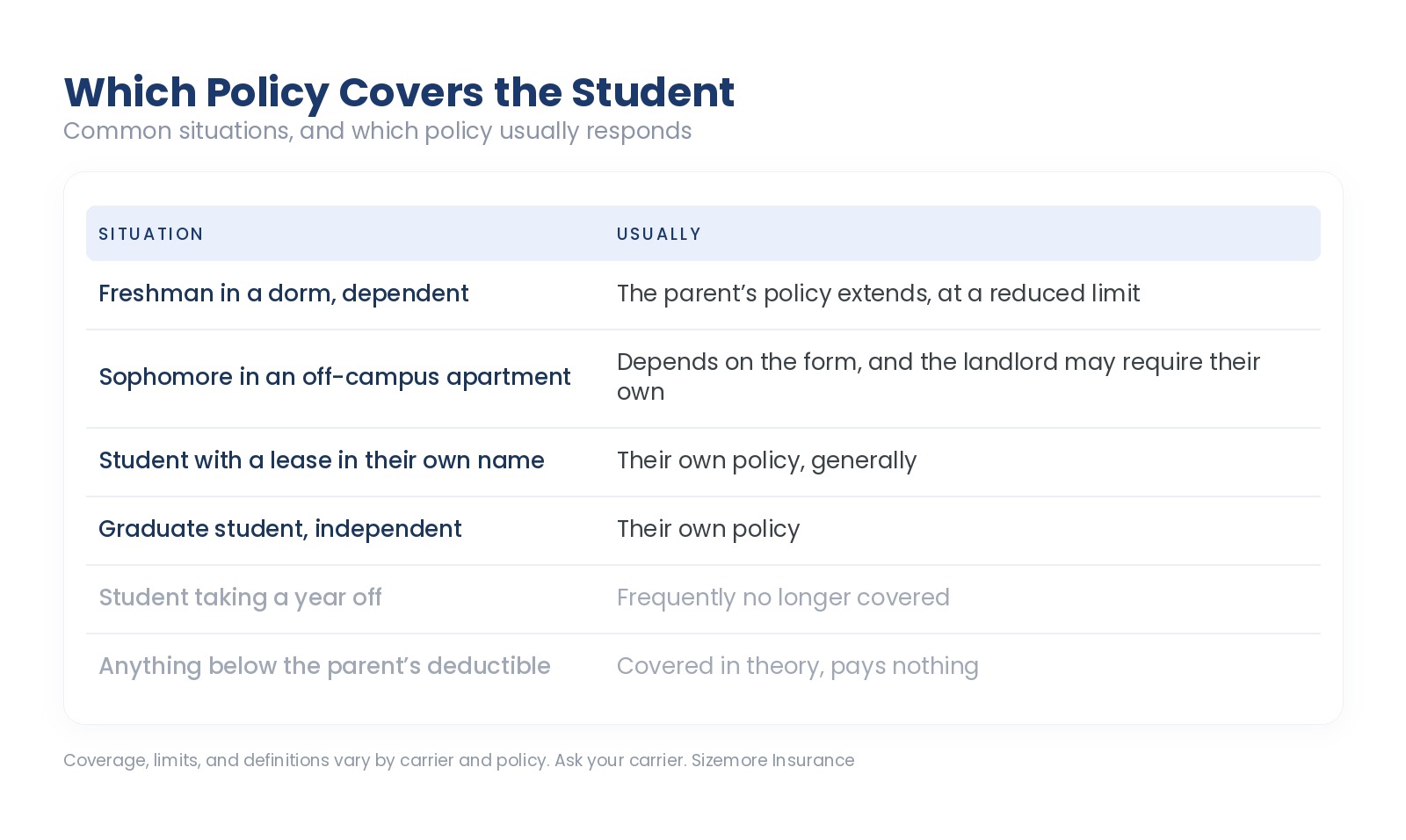
The takeaway: the deductible is the practical problem. A student’s typical loss is a laptop or a bike, and that is frequently below a homeowners deductible.
Coverage, limits, and definitions vary by carrier and policy. Ask your carrier.
A lower deductible appropriate to a student’s actual losses.
A separate limit rather than a percentage of the parent’s.
A claim does not affect the parent’s homeowners policy, which matters because a homeowners claim is more consequential than a renters claim.
The liability is their own, which matters once they are in an apartment with roommates and guests.
The landlord requirement is satisfied in the student’s name.
And it generally costs little, which is frequently the argument that settles it.
If there is one thing to take from this article, it is that moving off campus is the moment to make a decision rather than assume.
Check with the parent’s carrier about whether the form still extends.
Read the lease for the requirement.
Compare the deductible against what a student actually loses.
And decide deliberately, because assuming the parent’s policy still covers everything is where families get surprised.
Does my parents’ homeowners policy cover me at school?
Frequently, at a reduced limit, if you qualify as a dependent living away at school. Ask their carrier for the specifics.
What about an off-campus apartment?
It depends on the form, and many carriers treat it differently from a dorm. The landlord will frequently require a policy in your name anyway.
What is the practical problem?
The parent’s deductible. A stolen laptop is frequently below it.
Should I get my own policy?
Frequently yes, for the lower deductible, the separate limit, and to keep a claim off the parent’s homeowners policy.
Does my landlord require it?
Many do. Read the lease.
When should we decide?
When you move off campus, not after something happens.
Sizemore Insurance is an independent insurance company founded in North Carolina in 1977, writing in both North Carolina and South Carolina, two states full of college towns. Tell us the school and the housing and we will tell you what makes sense. Insurance made just for you.
Coverage, limits, definitions, and requirements vary by carrier, policy, and lease and are subject to change. Nothing here is a coverage determination. Confirm with the applicable carrier and review your own policy or talk to your advisor.