A fire takes out two units of a six-unit building. The building coverage works exactly as it should: valuation is current, coinsurance is satisfied, the check funds the rebuild.
Repairs take eleven months. Permitting in an older downtown, a supply delay on the electrical panel, and a code-driven change to the egress stair. The two displaced tenants terminate under the lease. The rebuilt space sits empty another five months before it is re-leased.
Rental value coverage was written at $120,000 with no extension. Actual lost rent across sixteen months was $284,000. Debt service ran the entire time.
The building was insured. The income was not.
What This Coverage Does
Business income coverage replaces income lost while a covered loss keeps a property from operating. For a building owner the relevant version is rental value, which replaces the rent you would have collected plus continuing expenses that do not stop when the building does.
Continuing expenses matter more than owners expect. Debt service, property taxes, insurance premiums, and management fees do not pause during a rebuild. Rental value coverage is what keeps a repair from becoming a liquidity event.
Three settings determine what it pays.
The limit. The maximum the coverage pays over the period.
The period of restoration. The window during which the coverage responds.
The extension. Whether coverage continues past the point repairs are finished.
Owners set the first one at purchase and never look at the other two.
The Period of Restoration Is Not “How Long Repairs Took”
This is the concept that produces most of the disputes.
The period of restoration runs from the date of loss until the date the property should reasonably be repaired, rebuilt, or replaced with similar quality. Not until it actually is. If a rebuild drags because of an owner’s financing delay or a contractor’s schedule, the coverage does not automatically follow.
Under standard forms the period for business income typically begins a stated number of hours after the physical loss, commonly 72, with many carriers amending it to 24. Confirm which applies on your policy, because on a short-duration loss that waiting period can consume a meaningful share of the claim.
It also ends when repairs should be complete, which is frequently before your tenants are back and paying. That is the gap the next section closes.
The Extension That Almost Nobody Buys
Extended period of indemnity continues the coverage past the completion of repairs, for the time it takes to restore income to where it would have been.
For a landlord this is the whole point. The building being finished is not the same as the building being leased. Re-tenanting commercial space takes months, sometimes longer on second-generation space that needs a new buildout.
Standard forms include a short extension, frequently 30 to 60 days depending on the form edition. That is not a leasing cycle. Available extensions typically run 60, 90, 180, or 360 days, and the premium difference is generally small relative to what it covers.
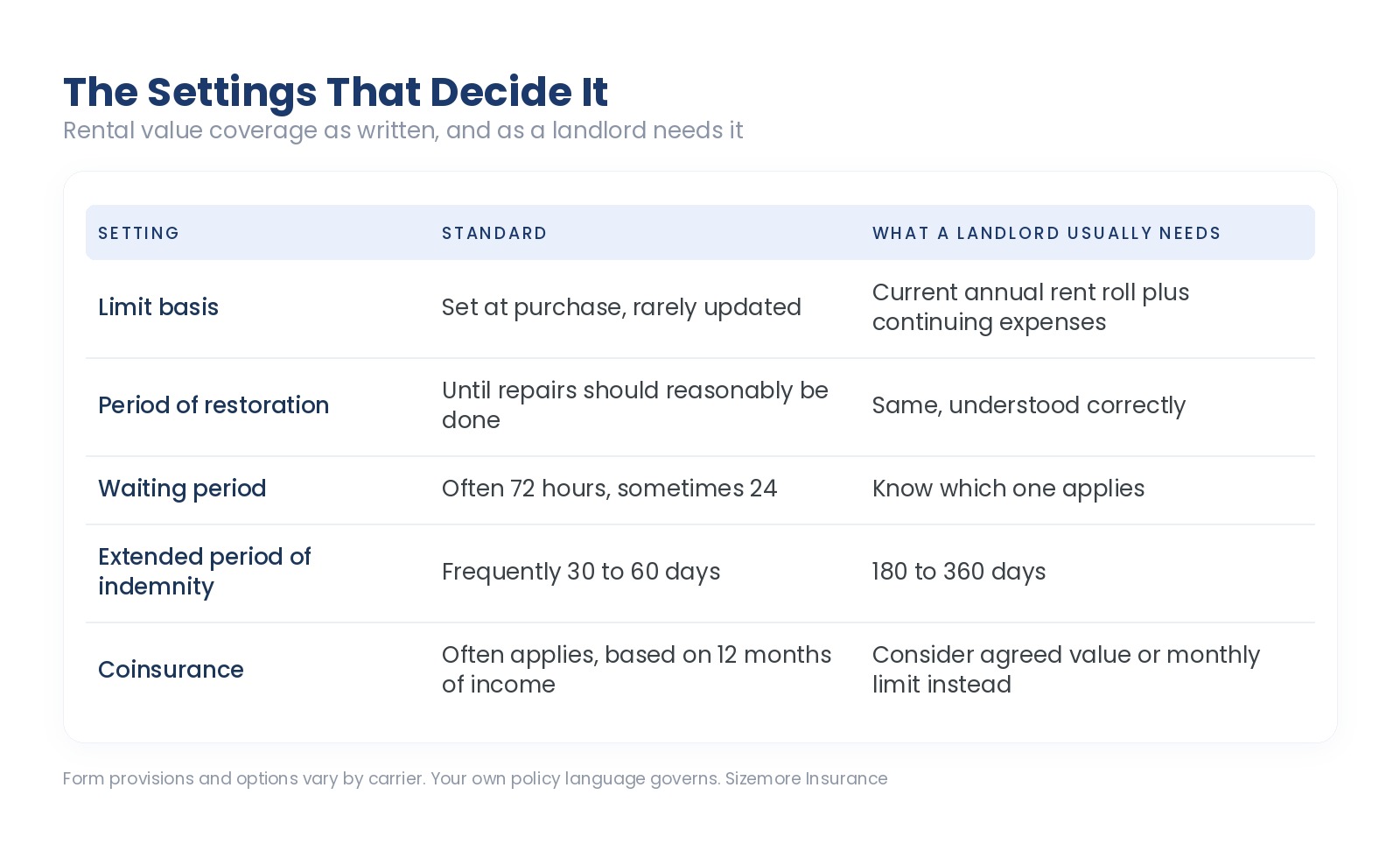
The takeaway: the limit is the setting owners think about and the extension is the setting that decides whether they are made whole. A correct limit with a 30-day extension still leaves a landlord funding the re-leasing period out of pocket.
Form provisions and options vary by carrier. Your own policy language governs.
How to Size the Limit
Work from the rent roll, not from memory.
Start with gross annual rental income at current rates, including any percentage rent or expense reimbursements you would lose.
Add continuing expenses. Debt service, property taxes, insurance, management, and any service contracts that continue during a shutdown.
Subtract expenses that genuinely stop. Utilities in vacated space, some maintenance. Be conservative here. Most expenses on a commercial building do not stop.
Multiply by a realistic timeline. Not the optimistic one. On an older building in a North Carolina downtown, permitting and code compliance add months that a modern suburban building does not face. A twelve-month assumption is common and frequently short.
Then add the extension period on top.
Where This Gets Complicated
Coinsurance applies to this coverage too. Business income coinsurance is typically measured against twelve months of income, and underinsuring triggers a proportional penalty in the same way the building coverage does. Alternatives exist: a monthly limit of indemnity, a maximum period of indemnity, or an agreed value option. Each is a different tradeoff and worth asking about specifically.
Proving the claim requires records you should already have. Leases, the rent roll, tax returns, operating statements, and evidence of collection history. A carrier cannot pay income you cannot document. Landlords with informal tenancies or unreported rent find this out at the worst time.
Space between tenants at the time of loss is difficult. If a unit was vacant when the fire started, there was no rental income to lose from it. Some forms address prospective leases signed but not yet commenced. Ask.
Ordinance and law interacts with this. If code upgrades extend the rebuild, the period of restoration may extend with it, but only if the policy contemplates it. Ordinance and law coverage has a time element component and it is frequently omitted.
A named storm deductible does not apply to this coverage the same way. Business income typically uses a time deductible, the waiting period, rather than a dollar deductible. On a coastal building where the property deductible is a percentage, the interaction is worth confirming.
Tenant lease terms determine whether you actually lose the rent. Some leases abate rent when space is untenantable and some do not. Some allow termination after a stated period. Read the casualty and abatement clauses, because they define your actual exposure.
Common Questions
What is rental value coverage?
The business income coverage written for a building owner. It replaces the rent lost while a covered loss makes space untenantable, plus continuing expenses.
How much rental value coverage do I need?
Your current annual rent roll plus continuing expenses, multiplied by a realistic repair timeline, plus an extended period of indemnity for the re-leasing period.
Does it pay if my tenant simply stops paying rent?
No. This coverage responds only to a covered physical loss to the property. Tenant default is a credit risk, not an insurance one.
What is the extended period of indemnity?
Coverage that continues after repairs are complete, for the time it takes to restore income. The standard inclusion is frequently 30 to 60 days, which is not a leasing cycle.
Does it cover my tenants’ lost income?
No. Your tenants carry their own business income coverage for their operations. Yours covers your rent.
How long does the coverage last?
Through the period of restoration, which runs until the property should reasonably be repaired, plus any extended period you purchased, subject to your limit.
The Bottom Line
- Pull your current rent roll and compare it to the limit on your declarations page. A limit set at acquisition against rents that have moved is frequently short.
- Buy an extended period of indemnity of at least 180 days. This is one of the most under-purchased options on a commercial property policy and it is generally inexpensive relative to the exposure.
- Confirm your waiting period, 24 hours or 72, because it comes off the front of every claim.
- Ask about the coinsurance alternative that fits your building. Monthly limit of indemnity, maximum period of indemnity, or agreed value each solve a different problem.
- Keep the documentation current. Leases, rent roll, operating statements. The coverage only pays what you can prove.
- Read your leases’ abatement and termination clauses. They define whether you lose the rent at all and for how long.
Sizemore Insurance is an independent insurance company that has been placing coverage in North Carolina since 1977. Bring us your rent roll and your declarations page and we will tell you what a twelve-month loss would actually cost you against what the policy would pay. Insurance made just for you.
Form provisions, waiting periods, extensions, and coinsurance alternatives vary by carrier. Figures above are illustrative. Review your own policy or talk to your advisor.