

I have to be direct about this one, because it is the question people most want a different answer to.
Erosion is not insurable. Shoreline retreat, land loss, and a house becoming unsafe because the beach moved out from under it sit outside standard property and flood coverage. There is no endorsement for it, no specialty market we are aware of, and no federal program that covers it.
That is not a gap we can close for you. It is a purchase decision, and it deserves to be made with clear information rather than discovered later.
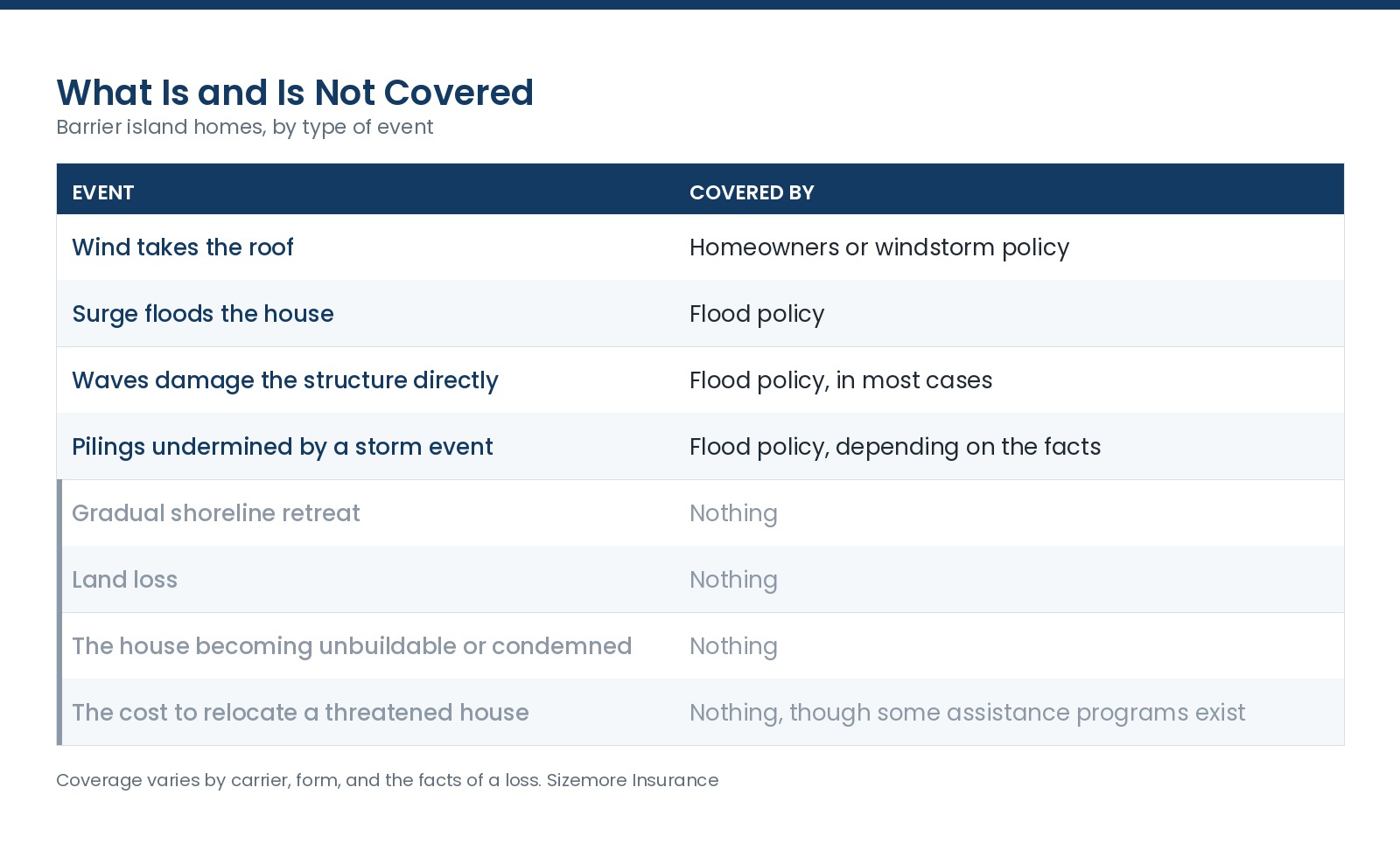
The takeaway: insurance covers events, not processes. A storm that undermines a foundation in one night is an event. A shoreline that moves fifteen feet over four years is a process, and it is uninsurable by design.
Coverage varies by carrier, form, and the facts of a loss. Nothing here is a coverage determination.
North Carolina regulates oceanfront construction through the Coastal Area Management Act, administered by the Division of Coastal Management. Oceanfront setbacks are calculated from the long-term annual erosion rate at that specific location and measured from the first line of stable natural vegetation.
Two practical consequences for a homeowner.
The vegetation line moves, and your setback moves with it. A lot that was buildable when you bought may not support the same footprint later.
Rebuilding after a loss is a regulatory question as well as an insurance one. A destroyed oceanfront home does not automatically get rebuilt in the same place at the same size. Setback rules and floodplain requirements both apply to the reconstruction.
That second point is the one that catches people. Your dwelling limit assumes you rebuild the house you had. The regulations may not permit it.
Requirements are set by the state and by the local jurisdiction and they change. Confirm current rules with the Division of Coastal Management and your local permit office before you rely on any of this.
Wind, at an adequate limit, with a deductible you can absorb. Frequently through the Beach Plan on a barrier island.
Flood, including excess flood. The federal program caps residential building coverage at $250,000 and contents at $100,000. On an oceanfront house that is a starting layer and not a program.
Ordinance or law coverage. This is a coverage many owners in this position lack and badly need. It covers the added cost of rebuilding to current code, and on an oceanfront lot the current code is substantially more demanding than what many existing houses were built to. Elevation requirements alone can dominate a rebuild budget.
Loss of use, sized to what alternate housing actually costs on that coast in the months after a storm, which is considerably more than in an ordinary week.
Other structures, for the walkway, the deck, and the dune crossover, all of which are exposed and all of which are typically covered at a percentage of the dwelling limit that nobody has checked.
Substantial damage triggers current standards. In a mapped flood zone, damage exceeding a defined percentage of the structure's value can require the rebuild to meet current floodplain requirements, including elevation. That is one of the largest code exposures an oceanfront homeowner has, and ordinance or law coverage is the only thing that addresses part of it.
Beach nourishment affects risk and cost. Communities that maintain nourishment programs present differently to underwriters than those that do not. It also affects the erosion rate the setback is calculated from.
A sandbag or temporary erosion structure is a regulatory question. North Carolina limits hardened structures on the oceanfront. What is permitted, for how long, and under what conditions is a matter for the Division of Coastal Management, not for your insurance policy.
Post-storm rebuild timelines run long. Between permitting, elevation requirements, and contractor availability on an island, a rebuild takes far longer than owners plan for. Loss of use limits and durations should reflect that.
Buying an oceanfront home deserves an erosion conversation, not just an inspection. The long-term erosion rate for that stretch of shoreline is public information. Look at it before you are committed.
Does insurance cover beach erosion?
No. Gradual shoreline loss and land loss sit outside standard property and flood coverage.
What if a storm undermines my pilings in one night?
That is generally a flood claim, depending on the facts. A single storm event is treated differently from gradual retreat.
Can I rebuild in the same place after a total loss?
Not automatically. Setback and floodplain requirements apply to the reconstruction and may change the footprint, the elevation, or the buildability.
Does ordinance or law coverage help?
Yes, and it is a coverage many oceanfront owners lack. It addresses the added cost of rebuilding to current standards.
Is flood insurance enough on an oceanfront home?
The federal program alone is generally not, given the caps. Excess flood above it is how the building actually gets covered.
How do I find the erosion rate for my stretch of beach?
The Division of Coastal Management publishes long-term erosion rate data. Ask for it before you buy.
We have been an independent insurance company in North Carolina since 1977. We will tell you plainly what we can cover on an oceanfront home and what nobody can, so you can make the decision with the whole picture. Insurance made just for you.
Coverage, program limits, and regulatory requirements vary and change. Setback and floodplain rules are administered by the state and local jurisdictions. Nothing here is legal or regulatory advice. Review your own policy or talk to your advisor.