A commercial property policy is accurate on the day it is bound and slightly less accurate every day after.
Construction costs move. Rents move. A tenant leaves and a different kind of tenant replaces them. A roof gets another year older. A lender refinances and issues new requirements. None of those events notify the carrier, and the automatic inflation adjustment on the policy does not track any of them.
The result is that many commercial buildings are misinsured in more than one place within a few renewals, and the owner has no idea because nothing failed. Nothing fails until a claim.
This is the review. It takes about an hour per building and it is the highest-return hour available to an owner.
Before You Start
Assemble five documents. Everything below runs against them.
- The current declarations page and the endorsement list. The endorsements are where the policy actually lives.
- Your current rent roll.
- Loss runs for the last five years.
- The insurance section of any loan documents.
- Your tenant certificates of insurance.
If you cannot produce the endorsement list, request the full policy from your advisor. A declarations page alone will not surface the roof schedule or the vacancy provision.
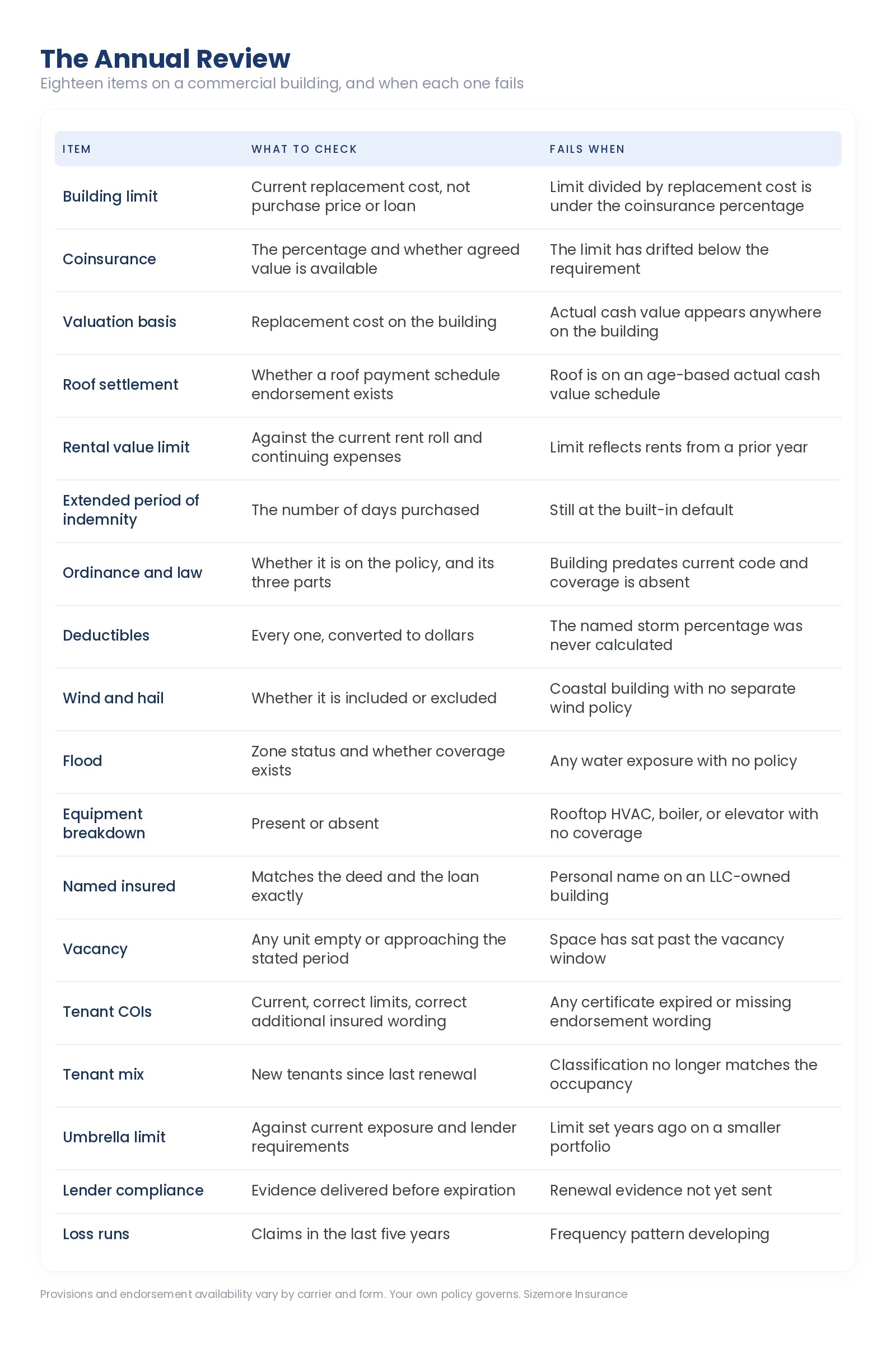
The takeaway: many of those eighteen fail silently. Nothing in your renewal notice tells you that your rental value limit is short or that your roof moved onto an age schedule.
Provisions and endorsement availability vary by carrier and form. Your own policy language governs.
The Five That Cost the Most
If you only have twenty minutes, do these.
Building limit against current replacement cost. Construction costs have outrun automatic inflation adjustments in recent years, which means limits drift below the coinsurance threshold without anything looking wrong. Below that line, the policy reduces partial claims, and partial claims are the ones you will actually have.
Rental value against the current rent roll. A limit set at acquisition against rents that have moved is frequently short. Add the extended period of indemnity check while you are there, because the built-in default is not a leasing cycle.
Named storm deductible, converted to dollars. Two percent of a $3 million building is $60,000. Owners carry a number in their head that came from the everyday deductible.
Roof settlement basis. If a roof payment schedule endorsement is on the policy and the roof is over ten years old, a storm claim will pay a fraction of the repair cost. That single line can matter more than the building limit.
Tenant certificates. A certificate proves a policy existed on the day it was issued. Every one that has expired since the last review is a tenant whose risk is now yours.
Where This Gets Complicated
Vacancy is a moving target. A unit that emptied two months ago may already have crossed the vacancy provision, and the perils that drop out include the ones most likely to hit an empty space: vandalism, water damage, and theft. A vacancy permit endorsement has to be arranged before the space sits, not after a loss in it.
A new tenant can change the whole building’s rating. A restaurant with a commercial kitchen, a dry cleaner with solvents, an auto shop with lifts. One high-hazard occupancy affects classification and pricing for the entire building, and carriers find out at renewal whether you told them or not.
Blanket coverage needs a current statement of values. If your buildings share a blanket limit, check whether a margin clause caps recovery on any one building at a percentage of its reported value. A stale statement of values under a margin clause reintroduces the coinsurance problem you thought blanket coverage solved.
Refinancing resets the lender requirements. New loan documents mean new insurance requirements, new mortgagee wording, and often new deductible caps. Send the insurance section to your advisor when you refinance rather than after the reviewer rejects the evidence.
Loss runs tell you what the market sees. Three claims in five years reads very differently than one, and in the current property market claim frequency frequently drives non-renewal more than claim severity. Knowing your own loss history before your carrier reviews it is worth an hour.
Improvements do not report themselves. A new roof, a build-out, an addition, upgraded mechanicals. Each moves replacement cost and none of them update the policy.
Common Questions
How often should I review a commercial property policy?
Annually at minimum, ahead of the renewal date rather than after it, and additionally after any acquisition, refinance, major improvement, or change in tenant mix.
When should the review happen relative to renewal?
Sixty to ninety days out. That leaves time to correct valuations, obtain a fortified roof designation, or market the risk to other carriers if the renewal comes back poorly.
What is the most common problem you find?
An outdated building limit sitting below the coinsurance requirement, followed closely by a rental value limit set at acquisition.
Do I need a professional appraisal?
Not usually. A replacement cost valuation using construction cost data specific to your area, adjusted for anything unusual about the building, is sufficient for most properties. On architecturally unusual or historic buildings, a professional valuation is worth it.
My renewal came in flat. Do I still need to review?
Yes. A flat premium tells you what the carrier is charging, not whether your limits still match your building. Those are unrelated questions.
What if the review turns up a problem I cannot afford to fix?
Then you make an informed decision instead of an accidental one. There is usually a sequence: correct the building limit first, then rental value, then the endorsements. Knowing the gap is worth something even in a year when you cannot close all of it.
The Bottom Line
- Calendar this ninety days before renewal, for every building, every year.
- Run a replacement cost valuation and test the limit against your coinsurance percentage.
- Pull the rent roll and test the rental value limit and the extension against it.
- Convert every deductible to dollars, especially the named storm percentage.
- Read the endorsement list, not the coverage summary. The roof schedule and the vacancy provision live there.
- Collect and verify tenant certificates, checking the additional insured wording rather than the certificate itself.
- Send the insurance section of any new loan documents to your advisor the week you sign them.
Sizemore Insurance is an independent insurance company that has been placing coverage in North Carolina since 1977. Send us your declarations page, your endorsement list, and your rent roll, and we will walk this checklist with you line by line before your renewal rather than after a loss. Insurance made just for you.
Coverage provisions, endorsement availability, and carrier practices vary and are subject to policy language. Review your own policy or talk to your advisor.