

This is one line on a boat policy and it decides more than almost anything else on the page.
Boats depreciate, and they depreciate in a way that is hard to argue about after the fact. Which valuation basis your policy uses determines whether a total loss produces a check you can replace the boat with or a check that starts an argument.
Agreed value. You and the carrier agree on the vessel's value at binding, supported by documentation. A total loss pays that amount, with no depreciation and no comparables debate.
Actual cash value. A total loss pays what the boat was worth immediately before the loss, meaning replacement cost less depreciation. The number is determined after the loss, by the adjuster, from comparables.
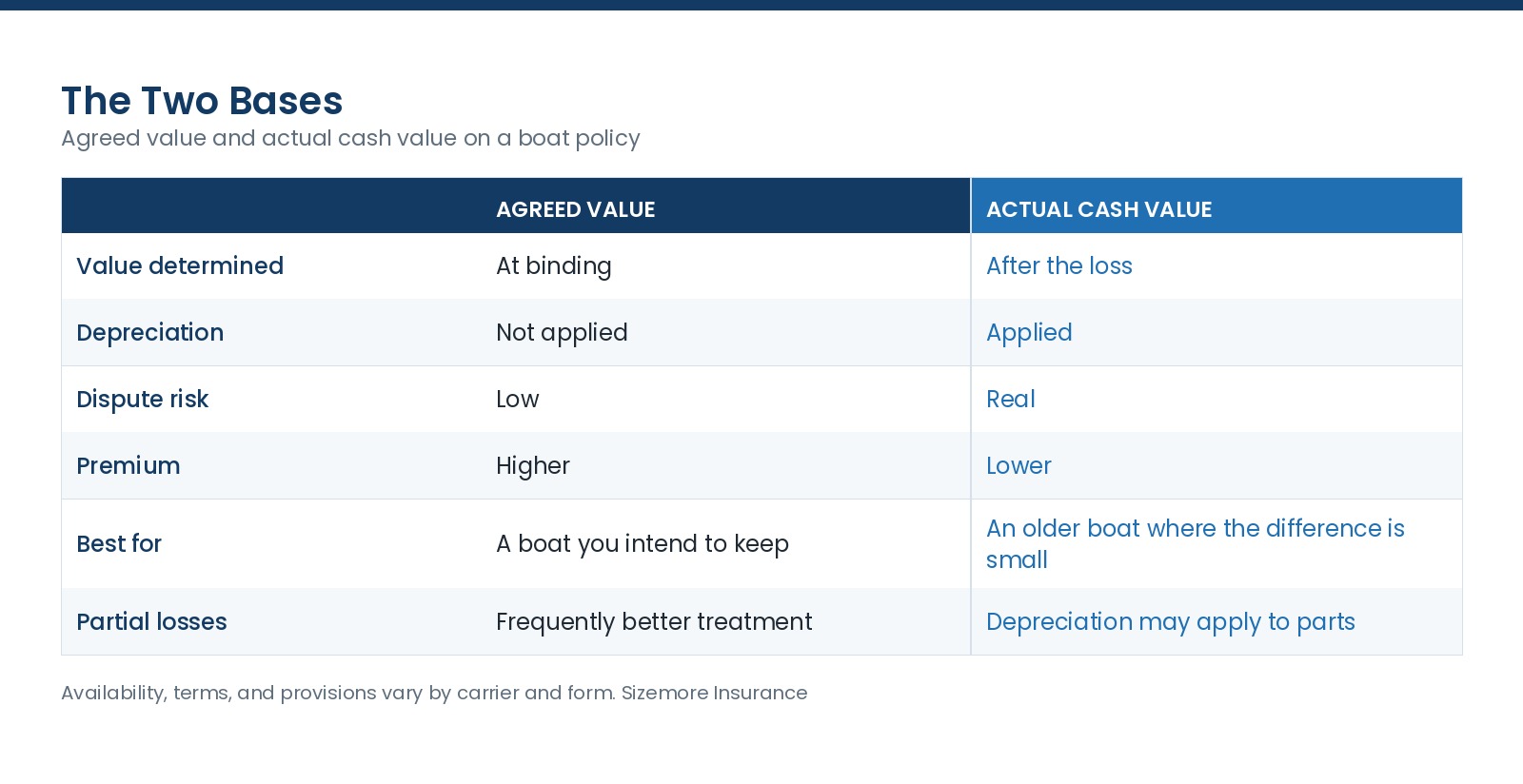
The takeaway: agreed value costs more and removes the argument, and on any boat with real value in it that trade is worth making.
Availability, terms, and provisions vary by carrier and form. Review your own policy.
Two reasons.
Depreciation is steeper and less predictable. Boat values move with the season, the market, hours on the engine, and how the vessel was maintained. Two identical hulls can be worth very different amounts, which makes an after-the-fact valuation genuinely contestable.
Comparables are thinner. There are fewer sales of a specific boat in a specific market than there are of a specific car. That makes the comparables argument harder in both directions.
Agreed value takes the whole conversation off the table before it starts.
Owners think about this as a total loss question and it is not only that.
On an actual cash value policy, depreciation can apply to components in a partial loss. A canvas, an outboard, or electronics several years old may be settled at depreciated value rather than replacement cost.
Some policies offer replacement cost on partial losses within a defined age, and some depreciate everything. Ask specifically, because it affects far more claims than a total loss does.
Update the agreed value. A value set five years ago is stale in either direction. If you added electronics, repowered, or the market moved, revisit it.
A survey may be required, particularly on older or larger vessels. That is what supports the value.
Aftermarket equipment needs to be included. Electronics, outriggers, a T-top, upgraded seating, and a repower all add value that is not in a base valuation.
Over-insuring is a mistake too. An agreed value substantially above what the boat is worth is premium spent on a number a carrier may question at claim time. Document it properly rather than inflating it.
A repower changes the value materially, and it is one of the more common things owners never report.
Trailer valuation is separate, and frequently on a different basis.
Consequential damage exclusions apply either way. Corrosion, wear, and a failed part are handled by exclusions rather than by the valuation basis, and some policies cover resulting damage while excluding the part that failed.
What is agreed value on a boat policy?
A value set at binding that a total loss pays without a depreciation argument.
Is agreed value worth the extra premium?
On any boat you intend to keep, generally yes. It removes the argument that follows a total loss.
How is actual cash value determined?
By the adjuster after the loss, from comparable vessels, with depreciation applied.
Does the basis affect partial losses?
It can. On an actual cash value policy, depreciation may apply to components. Ask how partial losses are settled.
Do I need a survey?
Frequently on older or larger vessels, and it is what supports an agreed value.
How often should I update the value?
Every few years, and after any repower or significant equipment addition.
We have been an independent insurance company in North Carolina since 1977. Send us your declarations page and we will tell you which basis you are on and what agreed value would cost. Insurance made just for you.
Valuation bases, availability, and settlement provisions vary by carrier and form. Review your own policy or talk to your advisor.